Complex numbers are an important part of algebra and higher mathematics that combine real and imaginary numbers in a single expression. Operations such as addition, subtraction, and multiplication of complex numbers follow simple algebraic rules and help students solve advanced mathematical problems with ease. Understanding these operations with solved examples improves conceptual clarity and builds a strong foundation for board exams, JEE Main, NDA and other competitive examinations.
What Are Complex Numbers ?
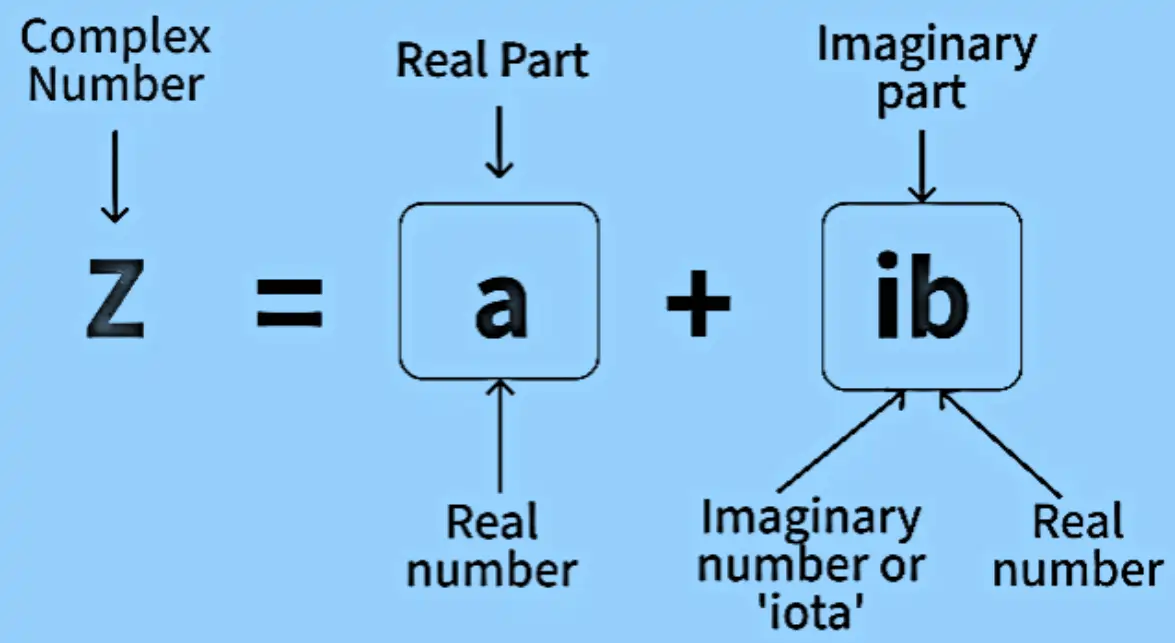
Complex Numbers are numbers that can be written in the form (a + ib), where a represents the real part and ib represents the imaginary part and a and b are the real numbers and i is an imaginary unit called “iota” that represent √-1 and i2 = -1.
What is the Standard Form of a Complex Number?
A number of the form x + iy, where x and y are real numbers and , is called a complex number.
The set of complex numbers is denoted by , thus:
Clearly, .
The complex number is generally denoted by z. Thus z = x + iy.
Here x is called the real part of z and is written as Re(z) = x, y is called the imaginary part of z and is written as Im(z) = y.
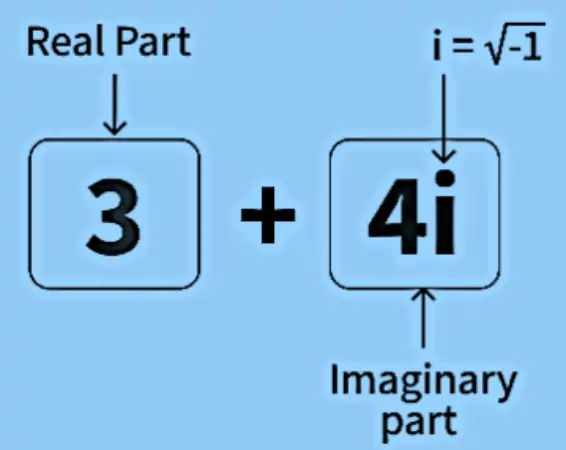
Example: 3 + 4i, is a complex number in which 3 is a real number and 4i is an imaginary number. They can be written as a + ib where a and b are rational numbers that can be represented on a number line extending to infinity.
Examples of Complex Numbers : 3+5i, , are all complex numbers.
In 3+5i, 3 is the real part and 5 the imaginary part.
Thus Re(3+5i) = 3 and Im(3+5i) = 5.
For complete preparation, also study What are Imaginary Numbers and iota (i), Powers of iota, Solved Examples
Classification of Complex Numbers
As we know the standard form of a complex number is z = (a + ib) where a, b ∈ R, and “i” is iota (an imaginary unit). So depending on the values of “a” (called real part) and “b” (called imaginary part), they are classified into four types.
Zero Complex Number :
- If a = 0 & b = 0, then it is called a zero complex number.
- The only example of this is 0.
Purely Real Numbers :
- If a ≠ 0 & b = 0, then it is called a purely real number i.e., a number with no imaginary part.
- All the real numbers are examples of this such as 2, 3, 5, 7, etc.
Purely Imaginary Numbers:
- If a = 0 & b ≠ 0, then it is called a purely imaginary number i.e., a number with no real part.
- All numbers with no real parts are examples of this type of number i.e., -7i, -5i, –i, i, 5i, 7i, etc.
Imaginary Numbers :
- If a ≠ 0 & b ≠ 0, then it is called an imaginary number.
- For example, (-1 – i), (1 + i), (1 – i), (2 + 3i), etc.
Thus complex numbers contain both real and imaginary numbers.
If , then is called a non-real complex number.
Property. A real number can never be equal to an imaginary number.
Let be two real numbers such that .
Then :
which contradicts the hypothesis .
Hence, .
Strengthen your fundamentals with NCERT Solutions Exercise-4.1 Complex Numbers and Quadratic Equations
Different Forms of Complex Numbers
There are various forms of complex numbers that are,
Rectangular Form : It is also called Standard Form and it is represented by(a + ib), where a and b are the real numbers.
Example: (5 + 5i), (-7i), (-3 – 4i), etc.
Polar Form: It is the representation of a complex number where coordinates are represented as (r, θ), where r is the distance from the origin and θ is the angle between the line joining the point and origin and the positive x-axis. Any complex number is represented as r [cos θ + i sin θ].
Example: [cos π/2 + i sin π/2], 5[cos π/6 + i sin π/6], etc.
Exponential Form: The Exponential Form, is the representation of complex numbers using Euler’s Formula and in this form, the complex number is represented by reiθ, where r is the distance of a point from the origin and θ is the angle between the positive x-axis and radius vector.
Examples: ei(0), ei(π/2), 5.ei(π/6), etc.
Note: All three forms of the complex numbers discussed above are interconvertible i.e., these can be converted from one form to another very easily.
When are Two Complex Numbers Equal ?
Two complex numbers are equal iff their real and imaginary parts are equal.
If and are two complex numbers, then :
For example : If , then
Squaring,
Thus and .
In particular, if a complex number is zero, then its real and imaginary parts are zero.
Thus if , then .
Important exam-related topics include NCERT Solutions Complex Numbers and Quadratic Equations Miscellaneous Exercise
Solved Examples of Complex Numbers of the form a + ib
Example 1. Write the following as complex numbers :
(i)
(ii)
(iii) (a, c > 0)
Solution.
(i)
(ii)
(iii)
Study Complete Chapter Complex Numbers and Quadratic Equations NCERT Solutions
Example 2. Write the real and imaginary parts of the following complex numbers :
(i) 7 + 3i
(ii) 0 + 7i
(iii)
Solution.
(i) Real part = 7, Imaginary part = 3
(ii) Real part = 0, Imaginary part = 7
(iii) Real part , Imaginary part = 0
Example 3. Given a + ib = 2 – 3i, find a and b.
Solution.
Given a + ib = 2 – 3i
By the definition of equality of two complex numbers, we have :
a = 2, b = -3
Example 4. Find and such that and represent the same complex number.
Solution. We have :
By the definition of equality of two complex numbers, we have :
Hence .
Example 5. Find and when :
Solution. We have :
[By property if , then .]
Hence , .
How do you Add Two Complex Numbers?
If and are two complex numbers (), then their sum, which is denoted by , is defined as :
For Example: .
We observe that
Sum of real number and imaginary number .
What is the Negative of a Complex Number ?
If is a complex number (), then its negative, which is denoted by , is defined as:
is called the additive inverse of .
For Example: The additive inverse of is .
How do you Subtract Two Complex Numbers ?
If and () are two complex numbers, then the difference is defined by , where is the negative of .
i.e. .
For Example: .
Solved Examples Based On Addition of Two Complex Numbers, Negative of a Complex Number, Subtraction of Two Complex Numbers
Example 1. Perform the indicated operations and write the result in the form :
(i)
(ii)
(iii) .
Solution.
(i)
.
(ii)
.
(iii)
.
Example 2. Prove that .
Solution. Let .
Then .
and
Hence, .
Properties of Binary Operation of Addition in Complex Numbers
The following properties hold under addition :
A₁. Closure Property
The sum of any two complex numbers is a complex number i.e.
.
Proof. Let and ().
Then .
[ and ]
A₂. Commutativity Property
Proof. Let and ().
Then
[ Commutative property holds in ]
.
A₃. Associativity Property
Proof. Let , , ().
Then
[ Associative property holds in ]
.
A₄. Existence of Identity Property
The complex number is the additive identity in
i.e. .
Proof. Let where .
Then .
[ is the additive identity in ]
Similarly
Combining, .
Note. Additive Identity is unique. (Verify !)
A₅. Existence of Inverse Property
If is a complex number, then is its additive inverse in i.e.
Proof. Let
Then
and
Thus
A₆. Cancellation Law.
Proof. Let
Then
[By the equality of two complex numbers]
[ Cancellation Law holds in ]
[By the equality of two complex numbers]
How do you Multiply Two Complex Numbers?
If and are two complex numbers (), then their product, which is denoted as , is defined as :
For Examples :
(I)
(II)
Properties of Binary Operation of Multiplication in Complex Numbers
The following properties hold under multiplication :
M₁. Closure. The product of two complex numbers is a complex number i.e. .
Proof. Let
Then
[ and ]
M₂. Commutativity.
Proof. Let
Then
[ Commutative property holds in ]
M₃. Associativity.
Proof. Let , , ().
Then
M₄. Existence of Identity.
The complex number is the multiplicative identity in
i.e. .
Proof. Let , where .
Then .
Similarly, .
Combining, .
Note. Multiplicative identity is unique. (Verify !)
M₅. Existence of Inverse.
If is a complex number, then there exists a complex number , such that
.
Proof. Let , where .
Then
M₆. Distributive Law.
Proof. Let , , ().
Then
M₇. Cancellation Law.
Proof. Let , and , (where ).
Then
Why are Complex Numbers Important?
Complex numbers extend the real number system to include solutions to equations that have no real solutions and also provide a complete framework for solving a wide range of mathematical problems and have numerous applications in various fields.
Solving Polynomial Equations: Some polynomial equations do not have real solutions. For instance, the equation x2 + 1 = 0 has no real solution because the square of any real number is non-negative. However, using complex numbers, the solutions are x = i and x = −i.
Mathematical Completeness: The set of complex numbers is algebraically closed, meaning every non-constant polynomial equation with complex coefficients has a solution in the complex numbers. This is a significant advantage over the real numbers, which do not have this property.
Simplifying Calculations: In some cases, working with complex numbers can simplify mathematical expressions and calculations, especially in trigonometry and calculus.
Applications in Various Fields: Complex numbers are used extensively in engineering, physics, computer science, and other fields to model and solve real-world problems.
Short Conceptual Questions and Answers Based on Complex Numbers: Addition, Subtraction, Multiplication of Two Complex Numbers
What are complex numbers?
Complex numbers are numbers written in the form a + ib, where a is the real part and b is the imaginary part. Here, i is called the imaginary unit and satisfies i2 = -1.
What is the standard form of a complex number?
The standard form of a complex number is a + ib, where both a and b are real numbers.
What is the real part and imaginary part of a complex number?
In a complex number a + ib, the real part is a and the imaginary part is b.
What is the value of i2 ?
The value of i2 is -1.
How do you add two complex numbers?
Add the real parts separately and imaginary parts separately.
Example: (2 + 3i) + (4 + 5i) = 6 + 8i.
How do you subtract two complex numbers?
Subtract the real parts and imaginary parts separately. Example: (5 + 7i) – (2 + 3i) = 3 + 4i.
How do you multiply two complex numbers?
Use algebraic multiplication and replace i2 with -1.
Example : (2 + 3i)(4 + 5i) = 8 + 10i + 12i + 15i2 = -7 + 22i
What are purely real numbers in complex numbers?
If the imaginary part is zero, then the complex number is called a purely real number. Example: 5 + 0i
What are purely imaginary numbers?
If the real part is zero, then the number is called a purely imaginary number.
Example: 7i, -3i
When are two complex numbers equal?
Two complex numbers are equal when their real parts are equal and their imaginary parts are also equal.
What is the additive inverse of a complex number?
The additive inverse of a + ib is –a – ib because their sum is zero.
Why are complex numbers important?
Complex numbers are used in algebra, engineering, physics, electronics, signal processing, and many advanced mathematical calculations.