Types of Sets is an important concept in Class 11 Mathematics that helps classify sets based on the number and nature of their elements. Understanding different types such as empty, singleton, finite, infinite, equivalent, and equal sets is essential for building a strong foundation in set theory. These concepts not only improve logical reasoning but also play a key role in solving problems in higher mathematics and competitive exams.
What are the Types of Sets ?
Types of sets classify collections based on the number and nature of their elements, helping in better understanding and analysis of mathematical problems. Concepts such as finite, infinite, empty, and singleton sets form the basic foundation of set theory and are essential for solving questions in Class 11 Mathematics and competitive exams like JEE.
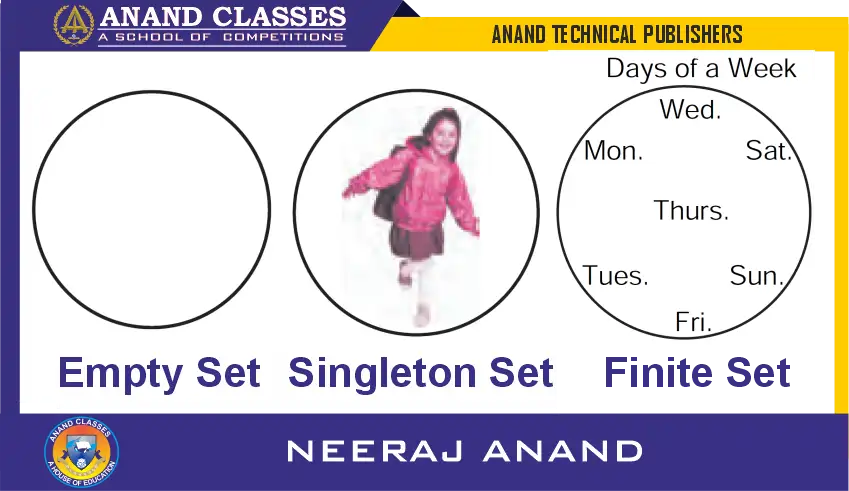
What is an Empty Set and Give Examples?
A SET, which does not contain any element is called an empty set or null set or void set. It is denoted by $\phi$ or $\left\{ \right\}$.
For example : Let us consider the set
$$A = \left\{x : x \text{ is a man living on the moon}\right\}$$
We know that there is no man living on the moon. Therefore, the set $A$ contains no element and hence, it is an empty set.
Some more examples of empty set are as follows:
(i) Let $A = \left\{x : x \text{ is a natural number and } 5 < x < 6\right\}$.
Then, $A$ is an empty set, because there is no natural number between 5 and 6.
(ii) Let $B = \left\{x : x \text{ is a number, } x \neq x\right\}$.
Then, $B$ is an empty set, because there is no number which is not equal to itself.
| Key Point |
|---|
| $\left\{0\right\}$ is not empty set, because it has one element, namely 0. |
Practical Examples of Empty Sets
(i) $\{x : x \in N \text{ and } 2 < x < 3\} = \emptyset$, since there is no natural number lying between $2$ and $3$.
(ii) $\{x : x \text{ is a number}, x \neq x\} = \emptyset$, since there is no number which is not equal to itself.
(iii) $\{x : x \in N, x < 5 \text{ and } x > 7\} = \emptyset$, since there is no natural number which is less than $5$ and greater than $7$.
(iv) $\{x : x \in R \text{ and } x^2 = -1\} = \emptyset$, since there is no real number whose square is $-1$.
(v) $\{x : x \text{ is rational and } x^2 – 2 = 0\} = \emptyset$, since there is no rational number whose square is $2$.
(vi) $\{x : x \text{ is an even prime number greater than } 2\} = \emptyset$, since there is no prime number which is even and greater than $2$.
(vii) $\{x : x \text{ is a point common to two parallel lines}\} = \emptyset$, since there is no point common to two parallel lines.
Solved Example of Empty SET
Example 1. Which of the following sets are empty sets:
(i) $A = \left\{x : x \text{ is a human being living on the Mars}\right\}$.
(ii) $B = \left\{x : x \text{ is an odd natural number divisible by 2}\right\}$.
(iii) $C = \left\{x : x \text{ is a point common to any two parallel lines}\right\}$.
(iv) $D = \left\{x : x \text{ is a natural number, } x < 5 \text{ and simultaneously } x > 7\right\}$.
Solution.
(i) We know that there is no human being living on the Mars. Hence, $A$ is an empty set.
(ii) We know that there is no odd number, which is divisible by 2. Hence, $B$ is an empty set.
(iii) We know that there is no common point on the parallel lines. Therefore, $C$ is an empty set.
(iv) We know that any natural number cannot be less than 5 and greater than 7 simultaneously. Hence, $D$ is an empty set.
What is Singleton Set and Give Examples?
A SET, consisting of a single element is called a singleton set.
The sets $\left\{0\right\}, \left\{5\right\}, \left\{-7\right\}$ are singleton sets.
$\left\{x : x + 6 = 0, x \in Z\right\}$ is a singleton set, because this set contains only one integer namely, $-6$.
Practical Examples of Singleton Sets
(i) $\{0\}$ is a singleton set whose only element is $0$.
(ii) $\{15\}$ is a singleton set whose only element is $15$.
(iii) $\{-8\}$ is a singleton set whose only element is $-8$.
(iv) $\{x : x \in N \text{ and } x^2 = 4\} = \{2\}$, since $2$ is the only natural number whose square is $4$.
However, $\{x : x \in Z \text{ and } x^2 = 4\} = \{-2, 2\}$, which is not a singleton set.
(v) Consider the set $\{x : x \in R \text{ and } x^3 – 1 = 0\}$.
Now, $x^3 – 1 = 0 \Rightarrow (x-1)(x^2 + x + 1) = 0$
$\Rightarrow x = 1$ or $x = \dfrac{-1 \pm \sqrt{1-4}}{2} = \dfrac{-1 \pm \sqrt{-3}}{2}$.
Thus, the given equation has one real root, namely $x = 1$.
$\therefore \{x : x \in R \text{ and } x^3 – 1 = 0\} = \{1\}$, which is a singleton set.
What is a Finite Set and Give Examples ?
A SET, which is empty or consists of a definite number of elements is called a finite set.
The number of distinct elements contained in a finite set $A$ is denoted by $n(A)$.
(i) The set $\left\{3, 4, 5, 6\right\}$ is a finite set, because it contains a definite number of elements i.e. only 4 elements.
(ii) The set of days in a week is a finite set, because it contains a definite number of elements i.e. only 7 days.
(iii) The set of solution(s) of $x^2 = 36$ is a finite set, because it contains a definite number of elements i.e. only 6 and $-6$.
(iv) An empty set, which does not contain any element (no element) is also a finite set.
| Key Point |
|---|
| An empty set, which does not contain any element (no element) is also a finite set. |
Practical Examples of Finite Sets
(i) Let $A = \{2, 4, 6, 8, 10, 12\}$. Then, $A$ is clearly a finite set and $n(A) = 6$.
(ii) Let $B =$ set of all letters in the English alphabet. Then, $n(B) = 26$ and therefore, $B$ is finite.
(iii) Let $C = \{x : x \in Z \text{ and } x^2 – 36 = 0\}$. Then, $C = \{-6, 6\}$, which is clearly a finite set and $n(C) = 2$.
(iv) The set of all persons on earth is a finite set.
(v) The set of all animals on earth is a finite set.
What is a Infinite Set and Give Examples ?
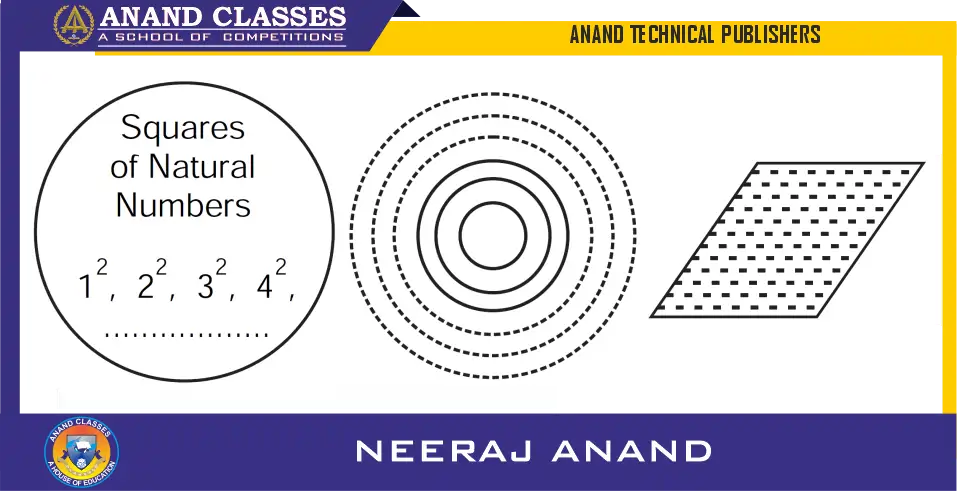
A SET, whose elements cannot be listed by the natural numbers $1, 2, 3, \dots, n$, for any natural number $n$ is called an infinite set.
(i) The set of squares of natural numbers is an infinite set, because such natural numbers are infinite.
(ii) The set of concentric circles is an infinite set.
(iii) The set of all points in a plane is an infinite set.
Practical Examples of Infinite Sets
(i) The set of all points on the arc of a circle is an infinite set.
(ii) The set of all points on a line segment is an infinite set.
(iii) The set of all circles passing through a given point is an infinite set.
(iv) The set of all straight lines parallel to a given line, say the $x$-axis, is an infinite set.
(v) The set of all positive integral multiples of $5$ is an infinite set.
Let $Z^+$ be the set of all positive integers.
Then, $\{x : x \in Z^+ \text{ and } x = 5k, k \in N\} = \{5, 10, 15, 20, 25, \dots\}$ is an infinite set.
(vi) Each of the sets $N$, $Z$, $Q$ and $R$ is an infinite set.
| Key Point |
|---|
| All infinite sets cannot be described in roster form. For example, the set $R$ of all real numbers cannot be described in this form, since the elements of this set do not follow a particular pattern. |
What is Equal Sets and Give Examples ?
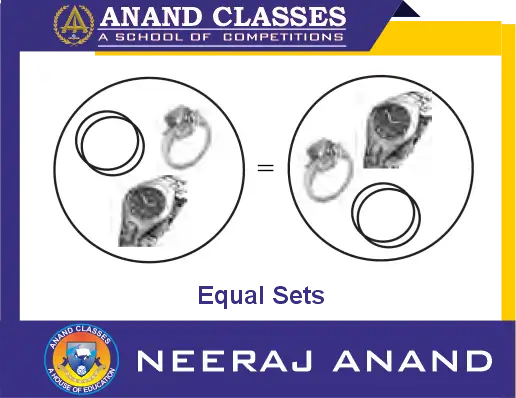
Two nonempty sets $A$ and $B$ are said to be equal, if they have exactly the same elements and we write $A = B$.
Otherwise, the sets are said to be unequal and we write $A \neq B$.
For example:
Let $A = \left\{\text{Bangle, Ring, Watch}\right\}$ and
$B = \left\{\text{Ring, Watch, Bongle}\right\}$,
then $A = B$, because each element of $A$ is in $B$ and vice-versa.
REMARKS
(i) The elements of a set may be listed in any order.
Thus, $\{1, 2, 3\} = \{2, 1, 3\} = \{3, 2, 1\}$.
(ii) The repetition of elements in a set has no meaning.
Thus, $\{1, 1, 2, 2, 3\} = \{1, 2, 3\}$.
Practical Examples of Equal Sets
EXAMPLE 1 : Let $A =$ set of letters in the word ‘follow’, and $B =$ set of letters in the word ‘wolf’. Show that $A = B$.
SOLUTION
Clearly, we have $A = \{f, o, l, w\}$ and $B = \{w, o, l, f\}$.
Clearly, $A$ and $B$ have exactly same elements.
$\therefore A = B$.
EXAMPLE 2 : Let $A = \{p, q, r, s\}$ and $B = \{q, r, p, s\}$. Are $A$ and $B$ equal?
SOLUTION
Since $A$ and $B$ have exactly the same elements, so $A = B$.
EXAMPLE 3 : Show that $\emptyset$, $\{0\}$ and $0$ are all different.
SOLUTION
We know that $\emptyset$ is a set containing no element at all.
And, $\{0\}$ is a set containing one element, namely $0$.
Also, $0$ is a number, not a set.
Hence, $\emptyset$, $\{0\}$ and $0$ are all different.
EXAMPLE 4 : Let
$$
A = \{x : x \in N, x^2 – 9 = 0\} \quad \text{and} \quad B = \{x : x \in Z, x^2 – 9 = 0\}.
$$
Show that $A \neq B$.
SOLUTION
$x^2 – 9 = 0 \Rightarrow (x + 3)(x – 3) = 0 \Rightarrow x = -3$ or $x = 3$.
$\therefore A = \{x : x \in N, x^2 – 9 = 0\} = \{3\}$ ($-3 \notin N$)
and $B = \{x : x \in Z, x^2 – 9 = 0\} = \{-3, 3\}$.
Hence, $A \neq B$.
What is an Equivalent Set and Give Examples ?
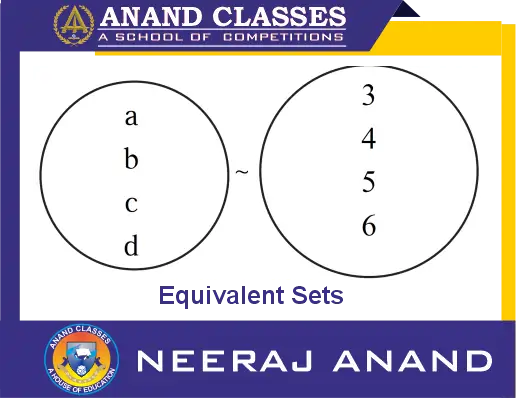
Two finite sets $A$ and $B$ are equivalent, if their cardinal numbers are same i.e. $n(A) = n(B)$.
For example:
Let $A = \left\{a, b, c, d\right\}$ and
$B = \left\{3, 4, 5, 6\right\}$,
then $n(A) = 4$ and $n(B) = 4$.
Therefore, $A$ and $B$ are equivalent sets.
| Key Point |
|---|
| Equal sets are always equivalent. But, equivalent sets need not be equal. |
Practical Examples of Equivalent Sets
EXAMPLE 1 : Let $A = \{1, 3, 5\}$ and $B = \{2, 4, 6\}$. Prove that these sets are equivalent but not equal.
SOLUTION
Then, $n(A) = n(B) = 3$.
So, $A$ and $B$ are equivalent.
Clearly, $A \neq B$.
Hence, $A$ and $B$ are equivalent sets but not equal.
EXAMPLE 2 : Show that $\{0\}$ and $\emptyset$ are not equivalent sets.
SOLUTION
Let $A = \{0\}$ and $B = \emptyset$.
Then, clearly $n(A) = 1$ and $n(B) = 0$.
$\therefore n(A) \neq n(B)$ and hence $A$ and $B$ are not equivalent sets.
PRACTICE EXERCISE
1. Which of the following are examples of the null set?
(i) Set of odd natural numbers divisible by $2$.
(ii) Set of even prime numbers.
(iii) $A = \{x : x \in N, x < 2\}$
(iv) $B = \{x : x \in N, 2 < x < 4\}$
(v) $C = \{x : x \text{ is prime}, 90 < x < 96\}$
(vi) $D = \{x : x \in N, x^2 + 1 = 0\}$
(vii) $E = \{x : x \in W, x + 3 \leq 3\}$
(viii) $F = \{x : x \in Q, 1 < x < 2\}$
(ix) $G = \{0\}$
2. Which of the following are examples of the singleton set?
(i) $\{x : x \in Z, x^2 = 4\}$
(ii) $\{x : x \in Z, x + 5 = 0\}$
(iii) $\{x : x \in Z, |x| = 1\}$
(iv) $\{x : x \in N, x^2 = 16\}$
(v) $\{x : x \text{ is an even prime number}\}$
3. Which of the following are pairs of equal sets?
(i) $A =$ set of letters in the word, ‘ALLOY’
$B =$ set of letters in the word, ‘LOYAL’
(ii) $C =$ set of letters in the word, ‘CATARACT’
$D =$ set of letters in the word ‘TRACT’
(iii) $E = \{x : x \in Z, x^2 \leq 4\}$ and $F = \{x : x \in Z, x^2 = 4\}$
(iv) $G = \{-1, 1\}$ and $H = \{x : x \in Z, x^2 = 1\}$
(v) $J = \{2, 3\}$ and $K = \{x : x \in Z, (x + 5)(x – 6) = 0\}$
4. Which of the following are pairs of equivalent sets?
(i) $A = \{-2, -1, 0\}$ and $B = \{1, 2, 3\}$
(ii) $C = \{x : x \in N, x < 3\}$ and $D = \{x : x \in W, x < 3\}$
(iii) $E = \{a, e, i, o, u\}$ and $F = \{p, q, r, s, t\}$
5. State whether the given set is finite or infinite:
(i) $A =$ set of all triangles in a plane
(ii) $B =$ set of all points on the circumference of a circle
(iii) $C =$ set of all lines parallel to the $y$-axis
(iv) $D =$ set of all leaves on a tree
(v) $E =$ set of all positive integers greater than $500$
(vi) $F = \{x \in R : 0 < x < 1\}$
(vii) $G = \{x \in Z : x < 1\}$
(viii) $H = \{x \in Z : -15 \leq x \leq 15\}$
(ix) $J = \{x : x \in N \text{ and } x \text{ is prime}\}$
(x) $K = \{x : x \in N \text{ and } x \text{ is odd}\}$
(xi) $L =$ set of all circles passing through the origin $(0, 0)$
6. Rewrite the following statements using set notation:
(i) $a$ is an element of set $A$.
(ii) $b$ is not an element of $A$.
(iii) $A$ is an empty set and $B$ is a nonempty set.
(iv) Number of elements in $A$ is $6$.
(v) $0$ is a whole number but not a natural number.
ANSWERS (PRACTICE EXERCISE)
- (i), (iv), (v), (vi)
- (ii), (iv), (v)
- (i) $A = B$ (ii) $C = D$ (iv) $G = H$
- (i) $A$ and $B$ are equivalent sets (iii) $E$ and $F$ are equivalent sets
- (i) infinite (ii) infinite (iii) infinite (iv) finite (v) infinite
(vi) infinite (vii) infinite (viii) finite (ix) infinite (x) infinite
(xi) infinite - (i) $a \in A$ (ii) $b \notin A$ (iii) $A = \emptyset$ and $B \neq \emptyset$
(iv) $n(A) = 6$
(v) $0 \in W$ but $0 \notin N$
Important Chapter Links
In this section on Types of Sets: Empty, Singleton, Finite, Infinite, Equivalent, Equal Sets, students will learn how SETS are classified based on their elements and properties. Designed for Class 11 Mathematics, this chapter includes clear explanations and examples to strengthen concepts. It also supports preparation for JEE PYQs and IMUCET PYQs, helping students build a solid foundation for advanced topics and competitive exams.
FAQs – Types of Sets
What are types of sets in mathematics?
Types of sets are different classifications of sets based on the number and nature of their elements, such as empty, finite, and infinite sets.
What is an empty set?
An empty set is a set that contains no elements and is denoted by $\emptyset$ or ${}$.
What is a singleton set?
A singleton set is a set that contains exactly one element.
What is a finite set?
A finite set is a set that has a limited or countable number of elements.
What is an infinite set?
An infinite set is a set that has an unlimited number of elements.
What are equal sets?
Two sets are equal if they contain exactly the same elements.
What are equivalent sets?
Two sets are equivalent if they have the same number of elements, even if the elements are different.
What is the difference between equal and equivalent sets?
Equal sets have identical elements, while equivalent sets only have the same number of elements.
Why is it important to study types of sets?
It helps in understanding set operations, relations, and advanced mathematical concepts.
Are types of sets important for competitive exams?
Yes, they are important for exams like JEE as they form the foundation for many mathematical topics.