SETS NCERT Solutions Exercise 1.5 for Class 11 Maths focuses on advanced applications of set operations using Venn diagrams and real-life problems. This exercise helps students apply concepts like union, intersection, complement, and difference to solve complex questions. It is an important part of Class 11 CBSE Mathematics and is highly useful for competitive exams of India.
Chapter 1 SETS Exercise 1.5 NCERT Solutions for Class 11 Maths
NCERT Question 1. Let U = {1, 2, 3, 4, 5, 6, 7, 8, 9},
A = {1, 2, 3, 4}, B = {2, 4, 6, 8} and C = {3, 4, 5, 6}. Find:
(i) A’ $\quad $ (ii) B′ $\quad $ (iii) (A ∪ C)′ $\quad $ (iv) (A ∪ B)′$\quad $
(v) (A′)′ $\quad $ (vi) (B – C)′.
Solution :
(i)
A′ = U – A = { 1, 2, 3, 4, 5, 6, 7, 8, 9 } – { 1, 2, 3, 4 } = { 5, 6, 7, 8, 9 }
(ii)
B′ = U – B = { 1, 2, 3, 4, 5, 6, 7, 8, 9 } – { 2, 4, 6, 8 } = { 1, 3, 5, 7, 9 }
(iii)
A ∪ C = { 1, 2, 3, 4 } ∪ { 3, 4, 5, 6 } = { 1, 2, 3, 4, 5, 6 }
(A ∪ C)′= U – (A ∪ C) = { 1, 2, 3, 4, 5, 6, 7, 8, 9 } – { 1, 2, 3, 4, 5, 6 } = { 7, 8, 9 }
(iv)
A ∪ B = { 1, 2, 3, 4 } ∪ { 2, 4, 6, 8 } = { 1, 2, 3, 4, 6, 8 }
(A ∪ B)′= U – (A ∪ B) = { 1, 2, 3, 4, 5, 6, 7, 8, 9 } – { 1, 2, 3, 4, 6, 8 } = { 5, 7, 9 }
(v)
A′ = U – A = { 1, 2, 3, 4, 5, 6, 7, 8, 9 } – { 1, 2, 3, 4 } = { 5, 6, 7, 8, 9 }
(A′)′ = U – A′ = { 1, 2, 3, 4, 5, 6, 7, 8, 9 } – { 5, 6, 7, 8, 9 } = { 1, 2, 3, 4 } = A
(vi)
B – C = { 2, 4, 6, 8 } – { 3, 4, 5, 6 } = { 2, 8 }
(B – C)′= U – (B – C) = { 1, 2, 3, 4, 5, 6, 7, 8, 9 } – { 2, 8 } = { 1, 3, 4, 5, 6, 7, 9 }.
NCERT Question 2. If U = {a, b, c, d, e, f, g, h}, find the complements of the following sets :
(i) A = { a, b, c}
(ii) B = { d, e, f, g }
(iii) C = { a, c, e, g}
(iv) D = { f, g, h, a }
Solution :
(i) A = { a, b, c}
Complement of set A = A
A’ = U – A
A’ = {a, b, c, d, e, f, g, h} – {a, b, c}
A’ = {d, e, f, g, h}
(ii)
(ii) B = { d, e, f, g }
Complement of set B = B’
B’ = U – B
B’ = {a, b, c, d, e, f, g, h} – {d, e, f, g}
B’ = {a, b, c, h}
(iii) C = {a, c, e, g}
Complement of set C = C’
C’ = U – C
C’ = {a, b, c, d, e, f, g, h} – {a, c, e, g}
C’ = {b, d, f, h}
(iv) D = {f, g, h, a}
Complement of set D = D’
D’ = U – D
D’ = {a, b, c, d, e, f, g, h} – {f, g, h, a}
D’ = {b, c, d, e}
NCERT Question 3. Taking the set of natural numbers as the universal set, write down the complements of the following sets:
(a) {x : x is an even natural number}
(b) {x : x is an odd natural number}
(c) {x : x is a positive multiple of 3}
(d) {x : x is a prime number}
(e) {x : x is a natural number divisible by 3 and 5}
(f) {x : x is a perfect square}
(g) {x : x is a perfect cube}
(h) {x : x + 5 = 8}
(i) {x : 2x + 5 = 9}
(j) {x : x ≥ 7}
(k) {x : x ∈ N and 2x + 1 > 10}
Solution : Let
U = N: set of natural numbers
(a) {x : x is an even natural number}
=> {x : x is an odd natural number}
(b) {x : x is an odd natural number}
=>{x : x is an even natural number}
(c) {x : x is a positive multiple of 3}
=>{x : x ∈ N and x is not a multiple of 3}
(d) {x : x is a prime number}
=> {x : x is a positive composite number and x = 1}
Def: Composite number: A natural number > 1 is said to be composite if it is not prime, i.e., if it has at least one divisor other than 1 and itself. For example, 4, 6, 8, 9, … are composite.
Note. In fact N is the union of (set of primes, set of composites and {1})
(e) {x : x is a natural number divisible by 3 and 5}
=> {x : x is a natural number that is not divisible by 3 or 5}
(f) {x : x is a perfect square}
=> {x : x∈N and x is not perfect square}
(g) {x : x is a perfect cube}
=> {x : x ∈ N and x is not perfect cube}
(h) {x : x + 5 = 8}
=> {x : x ∈ N and x ≠ 3}
(i) {x : 2x + 5 = 9}
=> {x : x ∈ N and x ≠ 2}
(j) {x : x ≥ 7}
=> {x : x∈N and x < 7}
(k) {x : x ∈ N and 2x + 1 > 10}
=> {x : x∈N and x ≤ 9/2} = {1, 2, 3, 4}
Question 4. If U = {1, 2, 3, 4, 5, 6, 7, 8, 9}, A = {2, 4, 6, 8} and B = { 2, 3, 5, 7}. Verify that
(a) (A ∪ B)’= A’ ∩ B’
(b) (A ∩ B)′ = A′ ∪ B′
Solution:
(a) (A ∪ B)’= A’ ∩ B’
=> (A ∪ B)’= U – (A∪B)
=> {1, 2, 3, 4, 5, 6, 7, 8, 9} – {2, 3, 4, 5, 6, 7, 8}
=> (A∪B)’ = {1, 9}
A’ ∩ B’ = (U – A) ∩ (U – B)
=> {1, 3, 5, 7, 9} ∩ {1, 4, 6, 8, 9}
=> A’ ∩ B’ = {1, 9}
Hence, Verified!!! (A∪ B)’ = A’ ∩ B’
(b) (A ∩ B)′ = A′ ∪ B′
=> (A ∩ B)’ = U – (A ∩ B)
=> {1, 2, 3, 4, 5, 6, 7, 8, 9} – {2}
=> (A ∩ B)′ = {1, 3, 4, 5, 6, 7, 8, 9}
A’ ∪ B’= (U – A) ∪ (U – B)
=> {1, 3, 5, 7, 9} ∪ {1, 4, 6, 8, 9}
=> A′ ∪ B′ = {1, 3, 4, 5, 6, 7, 8, 9}
Hence, Verified!!! (A ∩ B)′ = A′ ∪ B′
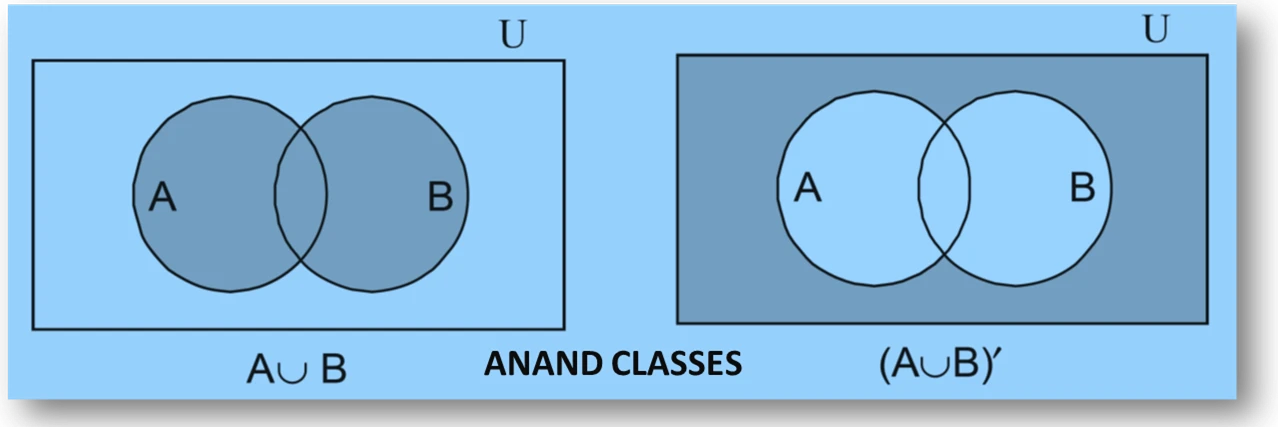
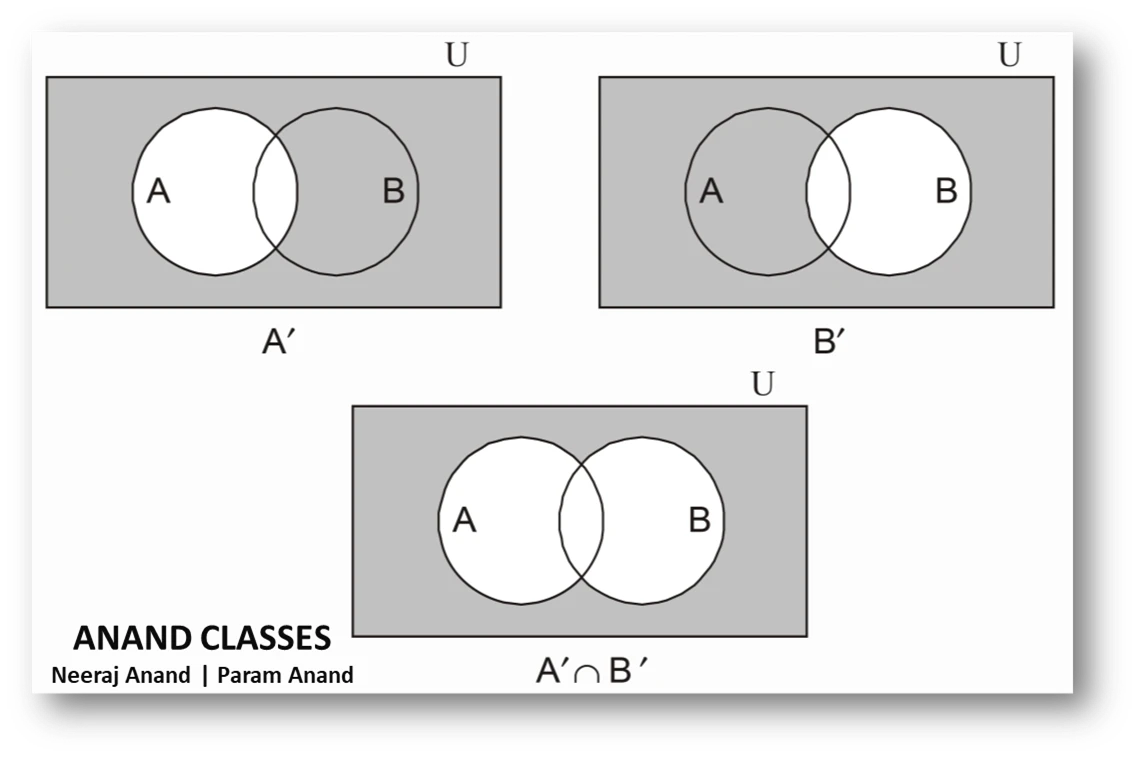
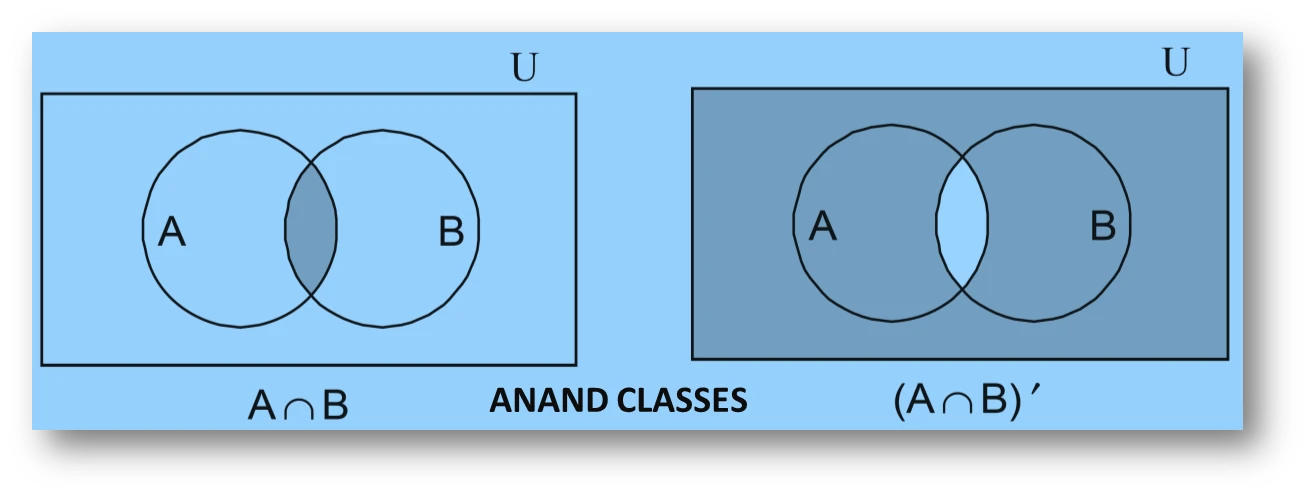
NCERT Question 5. Draw appropriate Venn diagram for each of the following:
(i) (A ∪ B)′ (ii) A′ ∩ B′ (iii) (A ∩ B)′ (iv) A′ ∪ B′.
(a) (A ∪ B)′ = Unshaded portion in Venn Diagram
(b) A’ ∩ B’ =
(c) (A ∩ B)′ =
(d) A′ ∪ B′ =
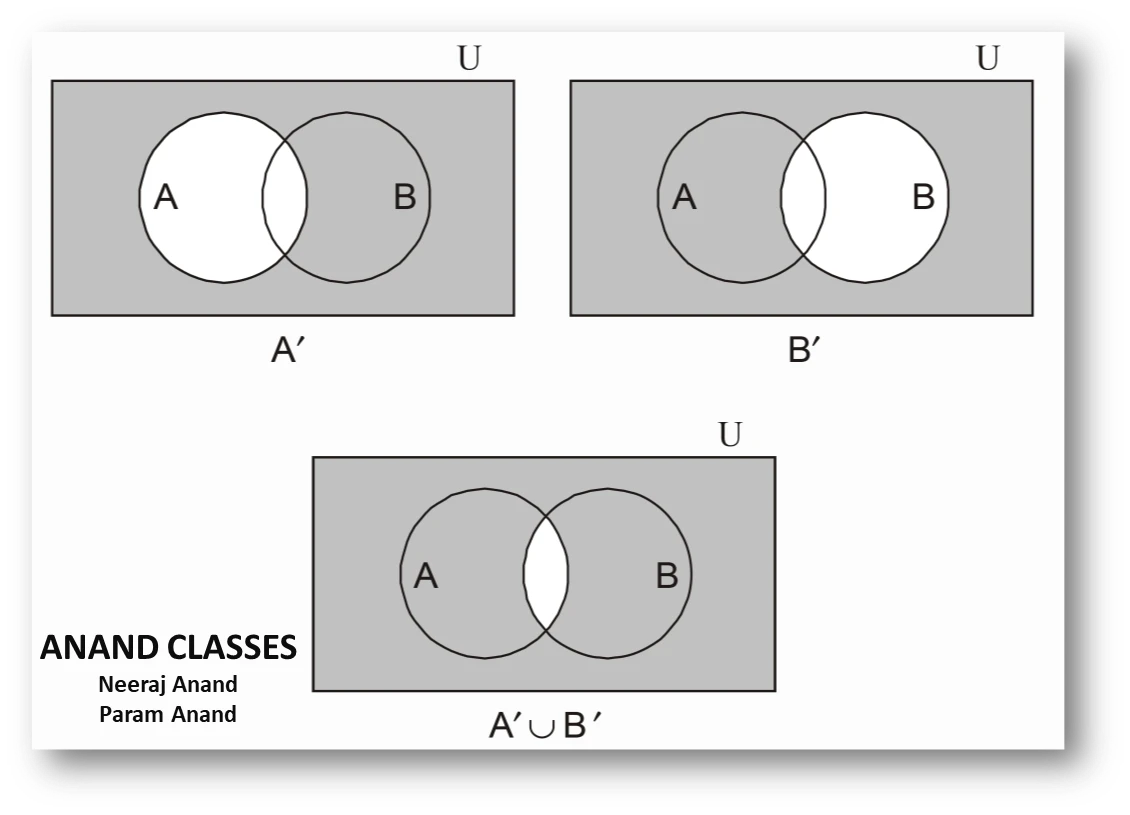
NCERT Question 6. Let U be the set of all triangles in a plane. If A is the set of all triangles with atleast one angle different from 60°, what is A′?
Solution:
U = set of all triangles in plane
A′ = U – A
A = set of all triangles with at least one angle different from 60°
A’ = set of all triangles with no angle different from 60° i.e, set of all triangles with all angles 60°
A’ is the set of all equilateral triangle.
NCERT Question 7. Fill in the blanks to make each of the following a true statement :
(a) A ∪ A′ = …
(b) φ′ ∩ A = …
(c) A ∩ A′ = …
(d) U′ ∩ A = …
Solution:
(a) A ∪ A′ = U
(b) ∅′ ∩ A = A
(c) A ∩ A′ = ∅
(d) U′ ∩ A = ∅
Important Chapter Links
Sets Exercise 1.5 of Class 11 NCERT Mathematics covers advanced problems based on set operations and Venn diagrams. In this exercise, students learn how to solve questions involving multiple sets, real-life data interpretation, and application of formulas. It strengthens the understanding of union, intersection, complement, and difference through practical problems. This exercise is highly useful for improving logical thinking and is important for CBSE exams as well as competitive exams like JEE, NDA, IMUCET, and Merchant Navy entrance exams.
Exercise-wise NCERT Solutions
- Basic definition of sets
- Writing sets in roster and set-builder form
- Types of sets
- Finite and infinite sets
- Subsets and proper subsets
- Number of subsets
- Set operations (union, intersection, complement)
Exercise 1.5
- Advanced problems on set operations and Venn diagrams
- Mixed problems covering all concepts of the chapter
FAQs of Chapter-1 Sets Exercise 1.5 NCERT Solutions for Class 11 Maths
What is Exercise 1.5 about?
It focuses on advanced problems involving set operations and Venn diagrams.
What type of questions are included?
Questions involve real-life situations and multiple sets.
What is the most important formula in this exercise?
$$
n(A \cup B) = n(A) + n(B) – n(A \cap B)
$$
Are Venn diagrams necessary?
Yes, they help in visualizing and solving problems easily.
Is this exercise important for exams?
Yes, it is very important for CBSE and competitive exams.
Can beginners solve this exercise easily?
It may require practice, but concepts from previous exercises help.
Are NCERT solutions enough?
Yes, they are sufficient for CBSE exams and helpful for competitive exams.
What skills are developed in this exercise?
Logical reasoning, problem-solving, and data interpretation.