Sets JEE Previous Year Questions (PYQs) and MCQs with Solutions is an essential practice section for Class 11 CBSE Mathematics that helps students apply theoretical concepts in real exam scenarios. This section covers a wide range of problems based on subsets, power sets, set operations, Venn diagrams, and laws of sets. By solving these questions, students can understand important patterns, improve speed, and gain confidence for exams. Detailed step-by-step solutions are provided to enhance clarity and accuracy, making this section highly useful for competitive exams of India.
SETS Class 11 Maths JEE Main Topicwise Previous Year Questions PYQs and MCQS With Solutions
JEE Main MCQ
Let $S$ be the set of all real roots of the equation:
$3^x(3^x – 1) + 2 = |3^x – 1| + |3^x – 2|$. Then, $S$ :
(a) is a singleton
(b) is an empty set
(c) contains at least four elements
(d) contains exactly two elements
(JEE Main 2020)
Solution. (a) Given equation:
$3^x(3^x – 1) + 2 = |3^x – 1| + |3^x – 2|$
Let $3^x = t$. Since $3^x > 0$ for all $x \in \mathbb{R}$, we have $t > 0$. The equation becomes:
$t(t – 1) + 2 = |t – 1| + |t – 2|$
$\Rightarrow t^2 – t + 2 = |t – 1| + |t – 2| \dots (i)$
The sum of the absolute values $|t – 1| + |t – 2|$ behaves differently across intervals:
$$|t – 1| + |t – 2| = \begin{cases} 3 – 2t, & 0 < t \leq 1 \\ 1, & 1 < t \leq 2 \\ 2t – 3, & t > 2 \end{cases}$$
Case I: If $0 < t \leq 1$
$t^2 – t + 2 = 3 – 2t$
$\Rightarrow t^2 + t – 1 = 0$
Using the quadratic formula :
$t = \dfrac{-1 \pm \sqrt{1 – 4(1)(-1)}}{2} = \dfrac{-1 \pm \sqrt{5}}{2}$
Since $t > 0$, we take $t = \dfrac{\sqrt{5} – 1}{2}$.
As $\dfrac{\sqrt{5} – 1}{2} \approx \dfrac{2.23 – 1}{2} = 0.615$, this value lies in the interval $(0, 1]$.
$\therefore 3^x = \dfrac{\sqrt{5} – 1}{2}$ is a valid solution.
Case II: If $1 < t \leq 2$
$t^2 – t + 2 = 1$
$\Rightarrow t^2 – t + 1 = 0$
The discriminant $D = b^2 – 4ac = (-1)^2 – 4(1)(1) = -3$.
Since $D < 0$, there are no real solutions in this interval.
Case III: If $t > 2$
$t^2 – t + 2 = 2t – 3$
$\Rightarrow t^2 – 3t + 5 = 0$
The discriminant $D = b^2 – 4ac = (-3)^2 – 4(1)(5) = 9 – 20 = -11$.
Since $D < 0$, there are no real solutions in this interval.
Conclusion:
There is exactly one value of $t$, and consequently exactly one value of $x$ ($x = \log_3 \dfrac{\sqrt{5}-1}{2}$).
Thus, $S$ is a singleton set.
Hence, option (a) is correct.
MCQ.
Let $S_1, S_2,$ and $S_3$ be three sets defined in the complex plane $\mathbb{C}$ as:
$S_1 = \{z \in \mathbb{C} : |z – 1| \leq 2\}$
$S_2 = \{z \in \mathbb{C} : \text{Re}((1 – i)z) \geq 1\}$
$S_3 = \{z \in \mathbb{C} : \text{Im}(z) \leq 1\}$
Then, the set $S_1 \cap S_2 \cap S_3$ is:
(a) a singleton
(b) has exactly two elements
(c) has infinitely many elements
(d) has exactly three elements
[JEE Main 2021]
Solution. (c)
To find the intersection, we must define the geometric region represented by each set. Let $z = x + iy$.
1. For $S_1$:
$|z – 1| \leq 2$ represents the region on and inside a circle with:
Center : $(1, 0)$
Radius : $2$The boundary equation is $(x-1)^2 + y^2 = 4$.
2. For $S_2$:
First, simplify the expression $(1 – i)z$ :
$(1 – i)(x + iy) = x + iy – ix – i^2y = (x + y) + i(y – x)$
The condition is $\text{Re}((1 – i)z) \geq 1$, which gives:
$x + y \geq 1$
This represents a half-plane on and above the line $x + y = 1$.
3. For $S_3$:
$\text{Im}(z) \leq 1$ means:
$y \leq 1$
This represents a half-plane on and below the horizontal line $y = 1$.
4. Intersection $S_1 \cap S_2 \cap S_3$ :
The point $(1, 0)$ satisfies all three: $|1-1| \leq 2$ (True), $1+0 \geq 1$ (True), and $0 \leq 1$ (True).
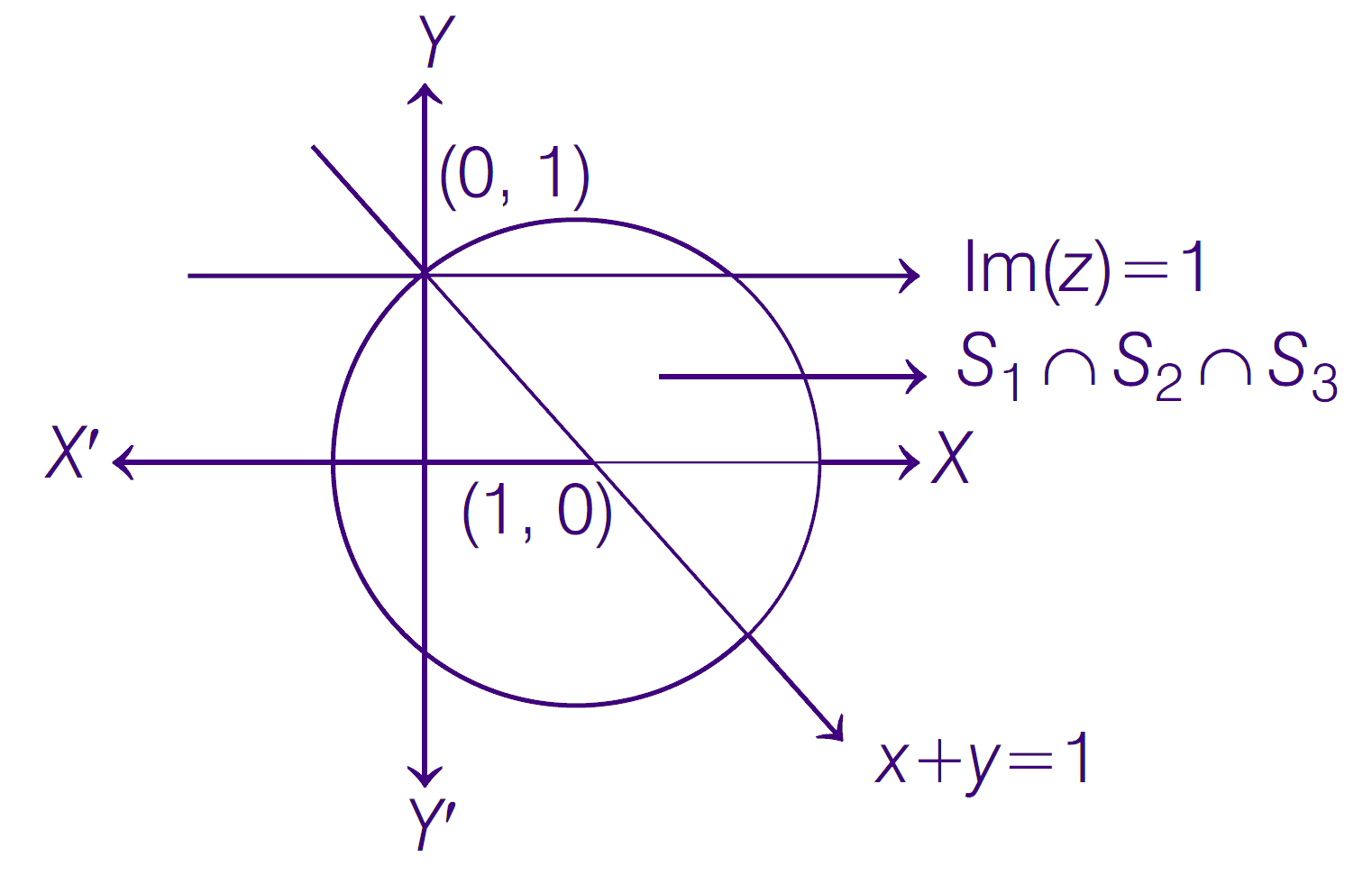
Because the circle is a continuous area and the boundaries are inequalities ($\leq, \geq$), the intersection forms a region (a circular segment or polygon-like area) rather than just discrete points.
Since any common area in the complex plane contains an uncountable number of points, the intersection has infinitely many elements.
Hence, option (c) is correct.
JEE Main MCQ
Let $X_1, X_2, \dots, X_{50}$ be 50 sets, each containing 10 elements. Let $Y_1, Y_2, \dots, Y_n$ be $n$ sets, each containing 5 elements.
Given: $\bigcup_{i=1}^{50} X_i = \bigcup_{i=1}^{n} Y_i = T$.
Each element of $T$ belongs to exactly 20 of $X_i$’s and exactly 6 of $Y_i$’s. We need to find $n$.
[JEE Main 2020]
Solution. (d)
To solve this, we use the principle that the total count of elements (counting repetitions) divided by the number of times each element is repeated equals the number of distinct elements in the union.
Step 1: Calculate the number of elements in $T$ using $X_i$
Total number of sets $X_i = 50$
Number of elements in each $X_i = 10$
Total elements (with repetitions) $= 50 \times 10 = 500$
Each element of $T$ is repeated in 20 sets.
Number of distinct elements in $T = \dfrac{50 \times 10}{20} = \dfrac{500}{20} = 25$
Step 2: Calculate the number of elements in $T$ using $Y_i$
Total number of sets $Y_i = n$
Number of elements in each $Y_i = 5$
Total elements (with repetitions) $= n \times 5 = 5n$
Each element of $T$ is repeated in 6 sets.
Number of distinct elements in $T = \dfrac{n \times 5}{6} = \dfrac{5n}{6}$
Step 3: Equate the two expressions for $T$
Since both expressions represent the number of elements in the same set $T$:
$$\dfrac{5n}{6} = 25$$
Step 4: Solve for $n$
$$5n = 25 \times 6$$
$$5n = 150$$
$$n = \dfrac{150}{5}$$
$$n = 30$$
The value of $n$ is 30.
Hence, option (d) is correct.
JEE Main MCQ
Number of elements in the set $\{x \in \mathbb{R} : (|x| – 3)|x + 4| = 6\}$ is equal to
(a) 3
(b) 2
(c) 4
(d) 1
[JEE Main 2021]
Solution. (b)
The behavior of the expression changes at $x = 0$ (due to $|x|$) and $x = -4$ (due to $|x + 4|$). We examine the three resulting intervals :
Case I: $x \leq -4$
In this region, $|x| = -x$ and $|x + 4| = -(x + 4)$.
$$(-x – 3)(-(x + 4)) = 6$$
$$(x + 3)(x + 4) = 6$$
$$x^2 + 7x + 12 = 6 \implies x^2 + 7x + 6 = 0$$
Factoring gives $(x + 6)(x + 1) = 0$, so $x = -6$ or $x = -1$.
Since we assumed $x \leq -4$, only $x = -6$ is a valid solution.
Case II: $-4 < x < 0$
In this region, $|x| = -x$ and $|x + 4| = x + 4$.
$$(-x – 3)(x + 4) = 6$$
$$-(x + 3)(x + 4) = 6$$
$$-(x^2 + 7x + 12) = 6 \implies x^2 + 7x + 18 = 0$$
Checking the discriminant ($D = b^2 – 4ac$) :
$$D = 7^2 – 4(1)(18) = 49 – 72 = -23$$
Since $D < 0$, there are no real solutions in this interval.
Case III: $x \geq 0$
In this region, $|x| = x$ and $|x + 4| = x + 4$.
$$(x – 3)(x + 4) = 6$$
$$x^2 + x – 12 = 6 \implies x^2 + x – 18 = 0$$
Using the quadratic formula $x = \frac{-b \pm \sqrt{b^2 – 4ac}}{2a}$ :
$$x = \frac{-1 \pm \sqrt{1 + 72}}{2} = \frac{-1 \pm \sqrt{73}}{2}$$
For $x \geq 0$, we must take the positive root: $x = \frac{\sqrt{73} – 1}{2}$.(Note: $\sqrt{73}$ is approx 8.5, so $\frac{7.5}{2} = 3.75$, which is $\geq 0$).
The valid solutions are $x = -6$ and $x = \dfrac{\sqrt{73} – 1}{2}$.
The set contains exactly 2 elements.
Hence, option (b) is correct.
JEE Main MCQ
Two newspapers $A$ and $B$ are published in a city. It is known that 25% of the city population reads $A$ and 20% reads $B$ while 8% reads both $A$ and $B$. Further, 30% of those who read $A$ but not $B$ look into advertisements and 40% of those who read $B$ but not $A$ also look into advertisements, while 50% of those who read both $A$ and $B$ look into advertisements. Then, the percentage of the population who look into advertisements is:
(a) 13.5
(b) 13
(c) 12.8
(d) 13.9
[JEE Main 2019, 9 April Shift-II]
Solution. (d)
Let the total population of the city be 100.
Total population reading $A$:
$n(A) = 25$
Total population reading $B$:
$n(B) = 20$
Population reading both $A$ and $B$:
$n(A \cap B) = 8$
![[JEE Main 2019, 9 April Shift-II] PYQ MCQ](http://mathsanandclasses.co.in/wp-content/uploads/2026/04/JEE-Main-2019-9-April-Shift-II-PYQ-MCQ.png)
Population reading $A$ but not $B$:
$n(A \cap B’) = n(A) – n(A \cap B) = 25 – 8 = 17$
Population reading $B$ but not $A$:
$n(B \cap A’) = n(B) – n(A \cap B) = 20 – 8 = 12$
According to the question, the total percentage is the sum of those who look into advertisements from each group:
$$= \left[ \frac{30}{100} \times n(A \cap B’) \right] + \left[ \frac{40}{100} \times n(B \cap A’) \right] + \left[ \frac{50}{100} \times n(A \cap B) \right]$$
Substituting the values:
$$= \left( \frac{30}{100} \times 17 \right) + \left( \frac{40}{100} \times 12 \right) + \left( \frac{50}{100} \times 8 \right)$$
$$= 5.1 + 4.8 + 4 = 13.9$$
Therefore, the percentage of the population who look into advertisements is 13.9.
JEE Main MCQ
Let $A$, $B$, and $C$ be sets such that $A \cap B \subseteq C$. Then, which of the following statements is not true?
(a) $B \cap C \neq \emptyset$
(b) If $(A – B) \subseteq C$, then $A \subseteq C$
(c) $(C \cup A) \cap (C \cup B) = C$
(d) If $(A – C) \subseteq B$, then $A \subseteq B$
JEE Main 2019, 12 April Shift-II
Answer: (d)
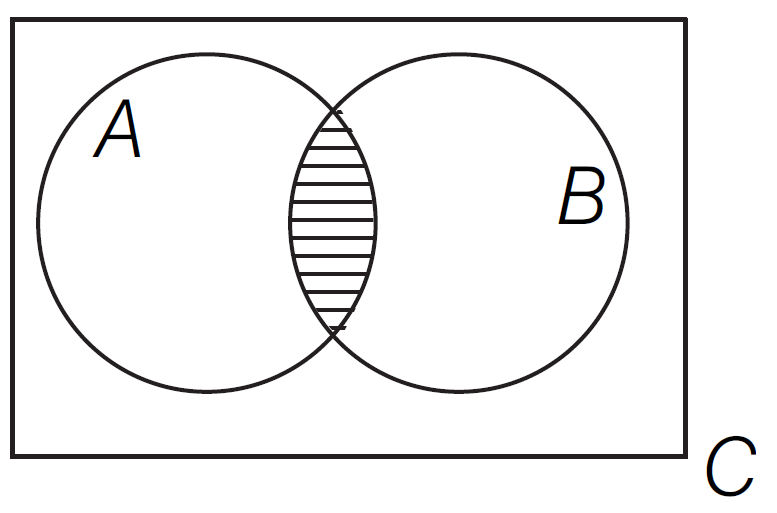
According to the question, we have the following Venn diagram and condition: $A \cap B \subseteq C$ and $A \cap B \neq \emptyset$.
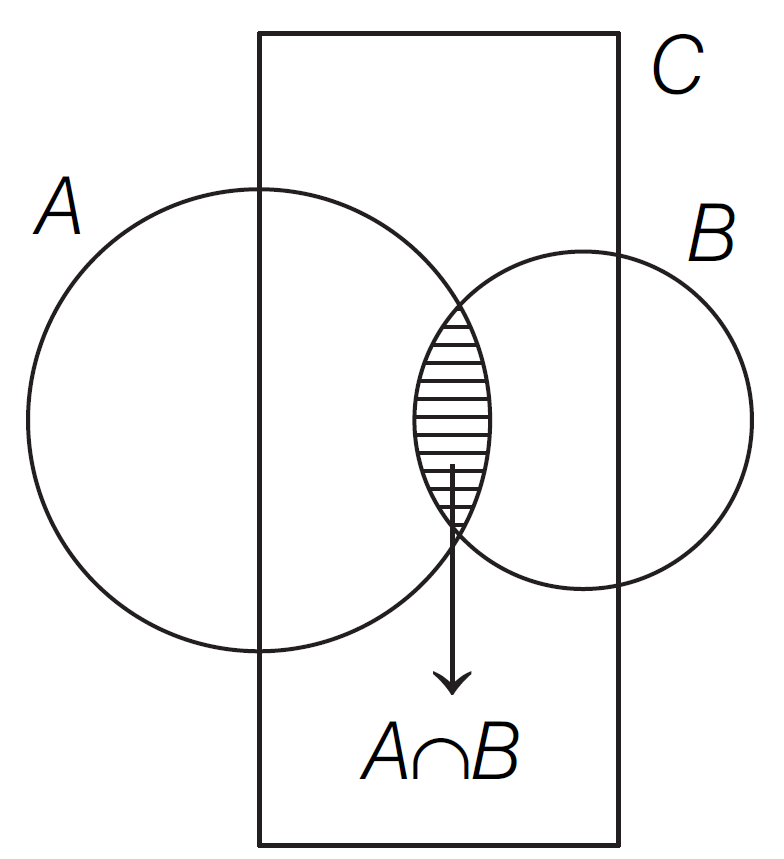
Statement (a): From the Venn diagram, since $A \cap B \subseteq C$ and the intersection is non-empty, it is clear that $B \cap C \neq \emptyset$ is true.
Statement (c): Using distributive laws: $(C \cup A) \cap (C \cup B) = C \cup (A \cap B)$. Since it is given that $A \cap B \subseteq C$, then $C \cup (A \cap B) = C$ is true.
Statement (b): If $(A – B) \subseteq C$, the Venn diagram shows that the part of $A$ outside of $B$ is inside $C$. Since the part of $A$ inside $B$ ($A \cap B$) is already given as a subset of $C$, the entire set $A$ must be a subset of $C$ ($A \subseteq C$).
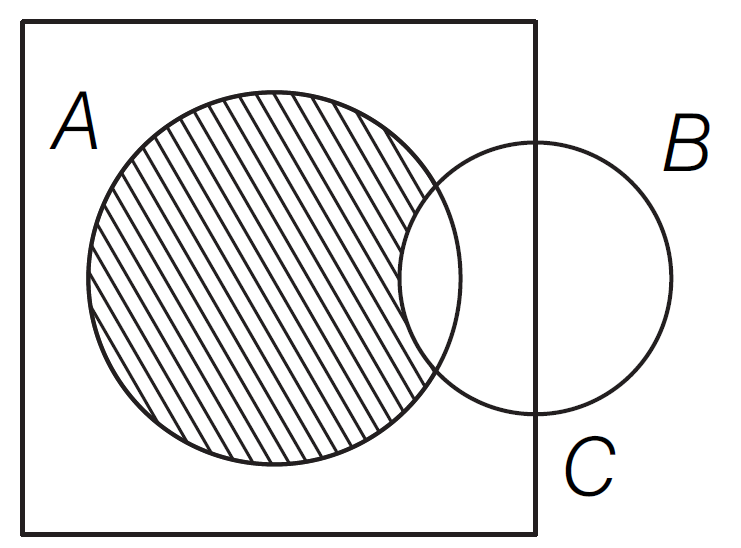
Statement (d): Consider the condition $(A – C) \subseteq B$, for this statement the Venn diagram is as follows. It is possible to have $A \cap B \neq \emptyset$ and $A \cap B \subseteq C$ such that $A – C = \emptyset$ (which is a subset of $B$), yet $A$ is not a subset of $B$ ($A \not\subseteq B$). For example, if $A \subseteq C$, then $A – C = \emptyset$, which is always a subset of $B$, but $A$ does not have to be a subset of $B$.
JEE Main MCQ
In a class of 140 students numbered 1 to 140, all even numbered students opted Mathematics course, those whose number is divisible by 3 opted Physics course and those whose number is divisible by 5 opted Chemistry course. Then, the number of students who did not opt for any of the three courses is:(a) 42
(b) 102
(c) 38
(d) 1
[JEE Main 2019, 10 Jan Shift-I]
Answer: (c)
Let $U$ be the universal set representing the class of 140 students. We use the greatest integer function $[x]$ to find the number of multiples within the range 1 to 140.
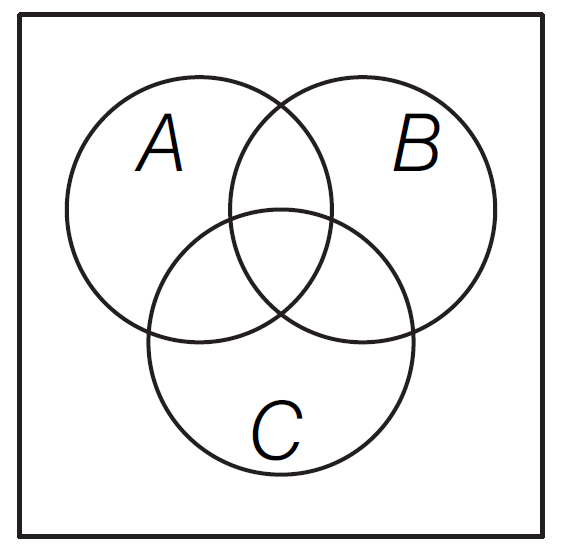
Set $A$ (Mathematics) :
Even numbered students$$n(A) = \left[ \frac{140}{2} \right] = 70$$
Set $B$ (Physics) :
Numbers divisible by 3$$n(B) = \left[ \frac{140}{3} \right] = 46$$
Set $C$ (Chemistry) :
Numbers divisible by 5$$n(C) = \left[ \frac{140}{5} \right] = 28$$
Calculate the intersections:
$A \cap B$ (Divisible by 2 and 3, i.e., 6) :
$$n(A \cap B) = \left[ \frac{140}{6} \right] = 23$$
$B \cap C$ (Divisible by 3 and 5, i.e., 15) :
$$n(B \cap C) = \left[ \frac{140}{15} \right] = 9$$
$C \cap A$ (Divisible by 5 and 2, i.e., 10) :
$$n(C \cap A) = \left[ \frac{140}{10} \right] = 14$$
$A \cap B \cap C$ (Divisible by 2, 3, and 5, i.e., 30) :
$$n(A \cap B \cap C) = \left[ \frac{140}{30} \right] = 4$$
Using the Principle of Inclusion-Exclusion calculate the number of students who opted for at least one course: :
$$n(A \cup B \cup C) = \sum n(A) – \sum n(A \cap B) + n(A \cap B \cap C)$$
$$n(A \cup B \cup C) = (70 + 46 + 28) – (23 + 9 + 14) + 4$$
$$n(A \cup B \cup C) = 144 – 46 + 4 = 102$$
The number of students who did not opt for any of the three courses :
$$= \text{Total students} – n(A \cup B \cup C)$$
$$= 140 – 102 = 38$$
JEE Main MCQ
If $f(x) + 2f\left(\dfrac{1}{x}\right) = 3x$, $x \neq 0$ and $S = \{x \in R : f(x) = f(-x)\}$ , then $S$:
(a) contains exactly two elements.
(b) contains more than two elements.
(c) is an empty set.
(d) contains exactly one element.
[JEE Main 2016]
Answer: (a)
$$f(x) + 2f\left(\frac{1}{x}\right) = 3x \text{ …….(1)}$$
$$f\left(\frac{1}{x}\right) + 2f(x) = \frac{3}{x} \text{ …….(2)}$$
Adding (1) and (2):
$$\Rightarrow f(x) + f\left(\frac{1}{x}\right) = x + \frac{1}{x}$$
Subtracting (1) from (2):
$$\Rightarrow f(x) – f\left(\frac{1}{x}\right) = \frac{3}{x} – 3x$$
On adding the above equations:
$$\Rightarrow f(x) + f\left(\frac{1}{x}\right) + f(x) – f\left(\frac{1}{x}\right) = x + \frac{1}{x} +\frac{3}{x} – 3x $$
$$ 2 f(x) = \frac{4}{x} – 2x$$
$$ f(x) = \frac{2}{x} – x$$
$$ f(-x) = -\frac{2}{x} + x$$
To find the set $S$:
$$f(x) = f(-x) \Rightarrow \frac{2}{x} – x = \frac{-2}{x} + x$$
$$ 2x = \frac{4}{x}$$
$$x = \frac{2}{x}$$
$$x^2 = 2 \text{ or } x = \sqrt{2}, -\sqrt{2}$$
JEE Main MCQ
Let $P = \{\theta : \sin\theta – \cos\theta = \sqrt{2} \cos\theta\}$ and $Q = \{\theta : \sin\theta + \cos\theta = \sqrt{2} \sin\theta\}$ be two sets. Then:
(a) $P \subset Q$ and $Q – P \neq \phi$
(b) $Q \not\subset P$
(c) $P = Q$
(d) $P \not\subset Q$
[JEE Online April 10, 2016]
Answer: (c)
Given the condition for set $P$:
$$\sin\theta – \cos\theta = \sqrt{2} \cos\theta$$
$$\Rightarrow \sin\theta = \cos\theta + \sqrt{2} \cos\theta$$
$$\Rightarrow \sin\theta = (\sqrt{2} + 1) \cos\theta$$
To rationalize, we can write this as:
$$\sin\theta = \left( \frac{(\sqrt{2} + 1)(\sqrt{2} – 1)}{\sqrt{2} – 1} \right) \cos\theta$$
$$\sin\theta = \left( \frac{2 – 1}{\sqrt{2} – 1} \right) \cos\theta$$
$$\Rightarrow (\sqrt{2} – 1) \sin\theta = \cos\theta$$
$$\Rightarrow \sqrt{2} \sin\theta – \sin\theta = \cos\theta$$
$$\Rightarrow \sin\theta + \cos\theta = \sqrt{2} \sin\theta$$
This final equation is the defining condition for set $Q$. Therefore, $P = Q$.
JEE Main MCQ
A relation on the set $A = \{x : |x| < 3, x \in Z\}$, where $Z$ is the set of integers, is defined by $R = \{(x, y) : y = |x|, x \neq -1\}$. Then the number of elements in the power set of $R$ is:
(a) 32
(b) 16
(c) 8
(d) 64
[JEE Online April 12, 2014]
Answer: (b)
First, determine the elements of set $A$:
$$A = \{x : |x| < 3, x \in Z\}$$
$$A = \{-2, -1, 0, 1, 2\}$$
Now, define the relation $R$ based on the condition $y = |x|$ where $x \neq -1$:
For $x = -2$, $y = |-2| = 2$. Pair: $(-2, 2)$
For $x = -1$, the condition $x \neq -1$ excludes this value.
For $x = 0$, $y = |0| = 0$. Pair: $(0, 0)$
For $x = 1$, $y = |1| = 1$. Pair: $(1, 1)$
For $x = 2$, $y = |2| = 2$. Pair: $(2, 2)$
Thus, $R = \{(-2, 2), (0, 0), (1, 1), (2, 2)\}$.
$R$ has four elements ($n = 4$).
The number of elements in the power set of $R$ is given by $2^n$:
$$2^4 = 16$$
JEE Main MCQ
Let $X = \{1, 2, 3, 4, 5\}$. The number of different ordered pairs $(Y, Z)$ that can be formed such that $Y \subseteq X$, $Z \subseteq X$ and $Y \cap Z$ is empty is:
(a) $5^{2}$
(b) $3^{5}$
(c) $2^{5}$
(d) $5^{3}$
[AIEEE 2012]
Answer: (b)
Given: A set $X = \{1, 2, 3, 4, 5\}$
The number of different ordered pairs $(Y, Z)$ such that $Y \subseteq X, Z \subseteq X$ and $Y \cap Z = \emptyset$.
Since $Y \subseteq X$ and $Z \subseteq X$, we can only use the elements of $X$ to construct sets $Y$ and $Z$.
We can categorize the possibilities based on the number of elements in set $Y$, denoted as $n(Y)$ :
| n(Y) | Number of ways to make Y | Number of ways to make Z such that Y∩Z = ∅ |
| 0 | $^5C_0$ | $2^5$ |
| 1 | $^5C_1$ | $2^4$ |
| 2 | $^5C_2$ | $2^3$ |
| 3 | $^5C_3$ | $2^2$ |
| 4 | $^5C_4$ | $2^1$ |
| 5 | $^5C_5$ | $2^0$ |
Explanation (using the third row as an example):
In the third row, the number of elements in $Y$ is 2.
The number of ways to select $Y$ is $^5C_2$ ways because any 2 elements of $X$ can be part of $Y$.
If $Y$ contains 2 specific elements, those elements cannot be used to construct $Z$ because we require $Y \cap Z = \emptyset$.
From the remaining 3 elements not present in $Y$, $2^3$ subsets can be made. Each of these can be set $Z$, and the condition $Y \cap Z = \emptyset$ will still be true.
The total number of ways to construct sets $Y$ and $Z$ such that $Y \cap Z = \emptyset$ is the sum of these possibilities :
$= (^5C_0 \times 2^5) + (^5C_1 \times 2^4) + (^5C_2 \times 2^3) + (^5C_3 \times 2^2) + (^5C_4 \times 2^1) + (^5C_5 \times 2^0)$
This is the binomial expansion of $(2 + 1)^5$:
$$= (2 + 1)^5 = 3^5$$
Alternate Method
Let $X = \{1, 2, 3, 4, 5\}$
Total number of elements in set $X = 5$
To form the ordered pair $(Y, Z)$ such that $Y \cap Z = \emptyset$, each element in $X$ has exactly 3 options:
The element is in set $Y$ (and therefore not in $Z$).
The element is in set $Z$ (and therefore not in $Y$).
The element is in neither set $Y$ nor set $Z$.
Since there are 5 elements and each has 3 independent choices, the total number of ordered pairs is:
$$3 \times 3 \times 3 \times 3 \times 3 = 3^5$$
JEE Main MCQ
If $A$, $B$ and $C$ are three sets such that $A \cap B = A \cap C$ and
$A \cup B = A \cup C$, then:
(a) $A = C$
(b) $B = C$
(c) $A \cap B = \phi$
(d) $A = B$
[AIEEE 2009]
Answer: (b)
To prove $B = C$, we show that $B \subseteq C$ and $C \subseteq B$.
Part 1: Showing $B \subseteq C$
Let $x \in B$.
Then $x \in A \cup B$, which implies $x \in A \cup C$ (since $A \cup B = A \cup C$).
Case 1: If $x \in C$, then this part is satisfied.
Case 2: If $x \in A$, then $x \in A \cap B$ (since we started with $x \in B$).
This implies $x \in A \cap C$ (since $A \cap B = A \cap C$).
Therefore, $x \in C$.
Thus, in all cases, $x \in B \Rightarrow x \in C$, so $B \subseteq C$.
Part 2: Showing $C \subseteq B$
Similarly, by following the same logic starting with $x \in C$, we find that $C \subseteq B$.
Therefore
Since $B \subseteq C$ and $C \subseteq B$, we have $B = C$.
JEE Main MCQ
In a certain town, 25% of the families own a phone and 15% own a car; 65% families own neither a phone nor a car and 2,000 families own both a car and a phone. Consider the following three statements:
(A) 5% families own both a car and a phone
(B) 35% families own either a car or a phone
(C) 40,000 families live in the town
Then,
(a) Only (A) and (C) are correct.
(b) Only (B) and (C) are correct.
(c) All (A), (B) and (C) are correct.
(d) Only (A) and (B) are correct.
[JEE Online April 10, 2015]
Answer: (c)
Let $P$ be the set of families owning a phone and $C$ be the set of families owning a car.
Given Data:
Percentage owning a phone: $n(P) = 25\%$
Percentage owning a car: $n(C) = 15\%$
Percentage owning neither: $n(P’ \cap C’) = 65\%$
Step 1: Find the percentage owning either a car or a phone (Statement B)
By De Morgan’s Law, $n(P’ \cap C’) = n(P \cup C)’ = 65\%$
Therefore, $n(P \cup C) = 100\% – 65\% = 35\%$
Statement (B) is correct.
Step 2: Find the percentage owning both (Statement A)
Using the inclusion-exclusion principle:$$n(P \cap C) = n(P) + n(C) – n(P \cup C)$$$$n(P \cap C) = 25\% + 15\% – 35\% = 5\%$$
Statement (A) is correct.
Step 3: Find the total number of families in the town (Statement C)
Let the total number of families be $x$.
We know 2,000 families own both, which corresponds to 5% of the total. $$x \times 5\% = 2000$$$$x = \frac{2000 \times 100}{5} = 40,000$$
Statement (C) is correct.
JEE Main MCQ
If $X = \{4^n – 3n – 1 : n \in N\}$ and $Y = \{9(n – 1) : n \in N\}$, where $N$ is the set of natural numbers, then $X \cup Y$ is equal to:
(a) $N$
(b) $Y – X$
(c) $X$
(d) $Y$
Answer: (d)
Given sets:
$X = \{4^n – 3n – 1 : n \in N\}$
$Y = \{9(n – 1) : n \in N\}$
List the elements of set $X$
By substituting $n = 1, 2, 3, \dots$ :
For $n = 1$ : $4^1 – 3(1) – 1 = 4 – 3 – 1 = 0$
For $n = 2$ : $4^2 – 3(2) – 1 = 16 – 6 – 1 = 9$
For $n = 3$ : $4^3 – 3(3) – 1 = 64 – 9 – 1 = 54$
For $n = 4$ : $4^4 – 3(4) – 1 = 256 – 12 – 1 = 243$
Thus, $X = \{0, 9, 54, 243, \dots\}$
List the elements of set $Y$
By substituting $n = 1, 2, 3, \dots$:
For $n = 1$ : $9(1 – 1) = 0$
For $n = 2$ : $9(2 – 1) = 9$
For $n = 3$ : $9(3 – 1) = 18$
For $n = 4$ : $9(4 – 1) = 27$
Thus, $Y = \{0, 9, 18, 27, 36, 45, 54, \dots\}$, which is the set of all multiples of 9 starting from 0.
Compare the sets
It is observed that every element in set $X$ is a multiple of 9 (since $4^n – 3n – 1 = (1+3)^n – 3n – 1$, which by binomial expansion results in terms divisible by $3^2$ or 9).
Therefore, $X \subset Y$.
Since $X$ is a subset of $Y$, their union is simply set $Y$:
$$X \cup Y = Y$$
Numerical Value Type Questions Based on JEE Main
Question.
Let $X = \{n \in \mathbb{N} : 1 \leq n \leq 50\}$. If $A = \{n \in X : n \text{ is a multiple of } 2\}$ and $B = \{n \in X : n \text{ is a multiple of } 7\}$, then the number of elements in the smallest subset of $X$ containing both $A$ and $B$ is ________.
(JEE Main 2020)
Solution : (29)
The “smallest subset of $X$ containing both $A$ and $B$” is the definition of the union of the two sets, $A \cup B$. To find the number of elements in $A \cup B$, we use the principle of inclusion-exclusion.
$A$ consists of multiples of 2 up to 50: $\{2, 4, 6, \dots, 50\}$.
$$n(A) = \left\lfloor \frac{50}{2} \right\rfloor = 25$$
$B$ consists of multiples of 7 up to 50: $\{7, 14, 21, 28, 35, 42, 49\}$.
$$n(B) = \left\lfloor \frac{50}{7} \right\rfloor = 7$$
The intersection contains elements that are multiples of both 2 and 7. Since 2 and 7 are coprime, these are multiples of $\text{LCM}(2, 7) = 14$.
The multiples of 14 up to 50 are $\{14, 28, 42\}$.
$$n(A \cap B) = \left\lfloor \frac{50}{14} \right\rfloor = 3$$
Using the formula :
$$n(A \cup B) = n(A) + n(B) – n(A \cap B)$$
$$n(A \cup B) = 25 + 7 – 3$$
$$n(A \cup B) = 32 – 3 = 29$$
The smallest subset of $X$ containing both $A$ and $B$ has 29 elements.
Question
Suppose $A_1, A_2, \dots, A_{30}$ are thirty sets, each having 5 elements, and $B_1, B_2, \dots, B_n$ are $n$ sets, each having 3 elements. Let $\bigcup_{i=1}^{30} A_i = \bigcup_{j=1}^{n} B_j = S$. Each element of $S$ belongs to exactly 10 of the $A_i$ sets and exactly 9 of the $B_j$ sets. The value of $n$ is equal to :
Solution :
To find $n$, we use the principle that the total count of elements (including repetitions) divided by the frequency of each element equals the number of unique elements in the set $S$.
Step 1: Find the number of elements in $S$ using $A_i$
Total number of sets $A_i = 30$
Elements in each set $A_i = 5$
Total count with repetitions $= 30 \times 5 = 150$
Each element is repeated exactly 10 times.
Number of unique elements $n(S) = \dfrac{30 \times 5}{10} = \dfrac{150}{10} = 15$
Step 2: Find the number of elements in $S$ using $B_j$
Total number of sets $B_j = n$
Elements in each set $B_j = 3$
Total count with repetitions $= n \times 3 = 3n$
Each element is repeated exactly 9 times.
Number of unique elements $n(S) = \dfrac{3n}{9}$
Step 3: Equate the two results for $n(S)$
Since both expressions represent the same set $S$, we set them equal:
$$\frac{3n}{9} = 15$$
Step 4: Solve for $n$
Simplify the fraction : $\dfrac{n}{3} = 15$
Multiply by 3 : $n = 15 \times 3$
$n = 45$
The value of $n$ is 45.
Question.
Let $S = \{1, 2, 3, \dots, 50\}$. The number of non-empty subsets $A$ of $S$ such that the product of elements in $A$ is even, is $2^m(2^n – 1)$, then the value of $(m + n)$ is equal to………..
Solution
To find the number of subsets with an even product, it is easiest to subtract the number of subsets with an odd product from the total number of non-empty subsets.
The set $S$ contains 50 elements. The total number of subsets is $2^{50}$, so the number of non-empty subsets is :
$$\text{Total non-empty subsets} = 2^{50} – 1$$
For the product of elements in a subset to be odd, every element in that subset must be an odd number.
The odd numbers in $S$ are $\{1, 3, 5, \dots, 49\}$.
There are exactly 25 odd numbers. The number of non-empty subsets formed using only these 25 odd numbers is:$$\text{Odd product subsets} = 2^{25} – 1$$
An even product occurs if there is at least one even number in the subset.
$$\text{Even product subsets} = (\text{Total non-empty subsets}) – (\text{Odd product subsets})$$
$$\text{Even product subsets} = (2^{50} – 1) – (2^{25} – 1)$$
$$\text{Even product subsets} = 2^{50} – 1 – 2^{25} + 1$$
$$\text{Even product subsets} = 2^{50} – 2^{25}$$
The expression is $2^{50} – 2^{25}$.
We can factor out $2^{25}$ :
$$2^{25}(2^{25} – 1)$$
The problem gives the form $2^m(2^n – 1)$. Comparing this to our result $2^{25}(2^{25} – 1)$ :
$m = 25$
$n = 25$
$$m + n = 25 + 25 = 50$$
The value of $(m + n)$ is 50.
Question.
Maximum number of sets obtainable from two sets $A$ and $B$ using only the union ($\cup$) and difference ($-$) operations………….
Solution
Step 1: Identify the Disjoint Basic Regions
In a Venn diagram for two sets $A$ and $B$, there are three fundamental disjoint regions :
- Only $A$ ($A – B$)
- Only $B$ ($B – A$)
- The intersection ($A \cap B$)
Step 2: Construct the Sets
Using only union and difference, we can generate the following 8 distinct sets:
| No. | Set Expression | Description |
| 1 | $A \cup B$ | The union of both sets |
| 2 | $A – B$ | Elements only in $A$ |
| 3 | $B – A$ | Elements only in $B$ |
| 4 | $(A \cup B) – (B – A) = \mathbf{A}$ | The complete set $A$ |
| 5 | $(A \cup B) – (A – B) = \mathbf{B}$ | The complete set $B$ |
| 6 | $(A – B) \cup (B – A) = \mathbf{A \Delta B}$ | Symmetric difference (elements in $A$ or $B$, but not both) |
| 7 | $(A \cup B) – ((A – B) \cup (B – A)) = \mathbf{A \cap B}$ | The intersection |
| 8 | $(A – B) – A = \mathbf{\emptyset}$ | The empty set |
Step 3: Why only 8?
Any set formed by these operations is a union of some combination of the three basic disjoint regions ($A-B$, $B-A$, and $A \cap B$).
- Mathematically, the number of ways to combine $k$ disjoint regions is $2^k$.
- Here, $k = 3$, so the total number of possible combinations is $2^3 = 8$.
Note on the Complement :
The universal set $X$ and the complements ($A’$, $B’$) are not obtainable unless the universal set itself is provided as a starting set, because the difference operation here is restricted to $A$ and $B$.
The maximum number of sets obtainable is 8.
Question.
In a factory, 70% of the workers like oranges and 64% like apples. If $x$% like both oranges and apples, then the minimum value of $x$ is ________.
Solution.
To find the minimum value of the intersection (those who like both), we use the principle of inclusion-exclusion.
Let the total number of workers be 100%.
Workers who like oranges, $n(O) = 70\%$
Workers who like apples, $n(A) = 64\%$
Workers who like both, $n(O \cap A) = x\%$
The percentage of workers who like at least one of the fruits is given by :
$$n(O \cup A) = n(O) + n(A) – n(O \cap A)$$
$$x = n(O) + n(A) – n(O \cup A)$$
The value of $x$ is at its minimum when the union $n(O \cup A)$ is at its maximum.
The maximum possible value for any union of sets within a population is the population itself, which is 100%.
Substitute the values into the equation:
$$x_{\min} = 70\% + 64\% – 100\%$$
$$x_{\min} = 134\% – 100\%$$
$$x_{\min} = 34\%$$
If fewer than 34% liked both, the total percentage of workers (those who like oranges, plus those who like apples, minus the overlap) would exceed 100%, which is mathematically impossible. For example, if only 30% liked both, you would have $70 + 64 – 30 = 104\%$. To keep the total at or below 100%, at least 34% must overlap.
Therefore, the minimum value of $x$ is 34.
Question.
Set $A$ has $m$ elements and Set $B$ has $n$ elements. If the total number of subsets of $A$ is $112$ more than the total number of subsets of $B$, then the value of $m \times n$ is …..
(JEE Main 2020)
Solution. (28)
It is given that $n(A) = m$ and $n(B) = n$ and number of subsets of set $A$ and $B$ are $2^m$ and $2^n$ respectively.
According to question : $2^m = 2^n + 112$.
$2^m = 2^n + 112$.
$\Rightarrow 2^m – 2^n = 112$
$\Rightarrow 2^m – 2^n = 2^4 \times 7$
$\Rightarrow 2^n(2^{m-n} – 1) = 2^4(2^3 – 1)$
On comparing:
$n = 4$ and $m – n = 3$
$\Rightarrow m – 4 = 3 \Rightarrow m = 7$
$\therefore m \times n = 7 \times 4 = 28$
Important Chapter Links
Sets is a fundamental topic in Class 11 CBSE Mathematics and plays an important role in competitive exams like JEE. Practicing JEE Previous Year Questions (PYQs) and MCQs helps in strengthening conceptual understanding of subsets, set operations, Venn diagrams, and laws of sets. This section provides a collection of important questions with detailed solutions to improve accuracy and problem-solving speed.
Exercise-wise NCERT Solutions
- Basic definition of sets
- Writing sets in roster and set-builder form
- Types of sets
- Finite and infinite sets
- Subsets and proper subsets
- Number of subsets
- Set operations (union, intersection, complement)
- Advanced problems on set operations and Venn diagrams
- Mixed problems covering all concepts of the chapter
FAQs for JEE Previous Year Questions (PYQs) on SETS
Why should I practice JEE PYQs for Sets?
JEE PYQs help you understand exam patterns, important topics, and frequently asked concepts, improving your preparation.
Are MCQs enough for mastering Sets?
MCQs are helpful for practice, but combining them with conceptual understanding and theory is essential for complete mastery.
What topics are covered in Sets PYQs?
Topics include subsets, power sets, set operations, Venn diagrams, and laws of sets.
How do solutions help in preparation?
Step-by-step solutions help identify mistakes, improve understanding, and develop better problem-solving strategies.
Are PYQs repeated in exams?
Exact questions may not repeat, but similar concepts and patterns are often asked.
How many questions should I practice daily?
Practicing 15–30 quality questions daily is effective for steady improvement.
Is Sets important for JEE?
Yes, Sets is a foundational topic and supports other chapters like relations, functions, and probability.
Can beginners solve PYQs directly?
Beginners should first understand theory, then move to PYQs for better results.
What is the best strategy to solve MCQs?
Focus on concepts, eliminate wrong options, and manage time efficiently.
Are Venn diagrams useful in solving PYQs?
Yes, Venn diagrams simplify many problems and help in quick visualization of set relationships.