IMU CET DNS GME Maths PYQs and MCQs on Sets with Solutions is a focused practice section designed for Class 11 CBSE Mathematics students preparing for Merchant Navy entrance exams. This section covers important questions based on subsets, power sets, set operations, Venn diagrams, and laws of sets, aligned with the IMU CET pattern. By solving these PYQs and MCQs, Merchant Navy aspirants can understand question trends, improve problem-solving speed, and strengthen conceptual clarity. Detailed step-by-step solutions are provided to ensure better understanding and effective preparation for IMU CET (DNS, GME) and other related competitive exams.
Merchant Navy IMU CET (DNS & GME) Maths PYQs and MCQs on Sets with Solutions
MCQ.
Are the given sets disjoint?
$A = \{x : x$ is the boys of your school$\}$
$B = \{x : x$ is the girls of your school$\}$
(a) Yes
(b) No
(c) Can’t say
(d) Insufficient data
[IMU CET-2022]
Solution. (a)
Here, $A = \{b_1, b_2, \dots, b_n\}$ and $B = \{g_1, g_2, \dots, g_m\}$
where, $b_1, b_2, \dots, b_n$ are the boys and $g_1, g_2, \dots, g_m$ are the girls of school.
Clearly, $A \cap B = \phi$
Hence, this pair of set is disjoint set.
MCQ.
Let $A$ and $B$ be two sets such that $n(A) = 0.16$, $n(B) = 0.14$ and $n(A \cup B) = 0.25$. Then, $n(A \cap B)$ is equal to
(a) 0.3
(b) 0.5
(c) 0.05
(d) None of these
[IMU CET-2021]
Solution. (c)
Given, $n(A) = 0.16$, $n(B) = 0.14$
and $n(A \cup B) = 0.25$
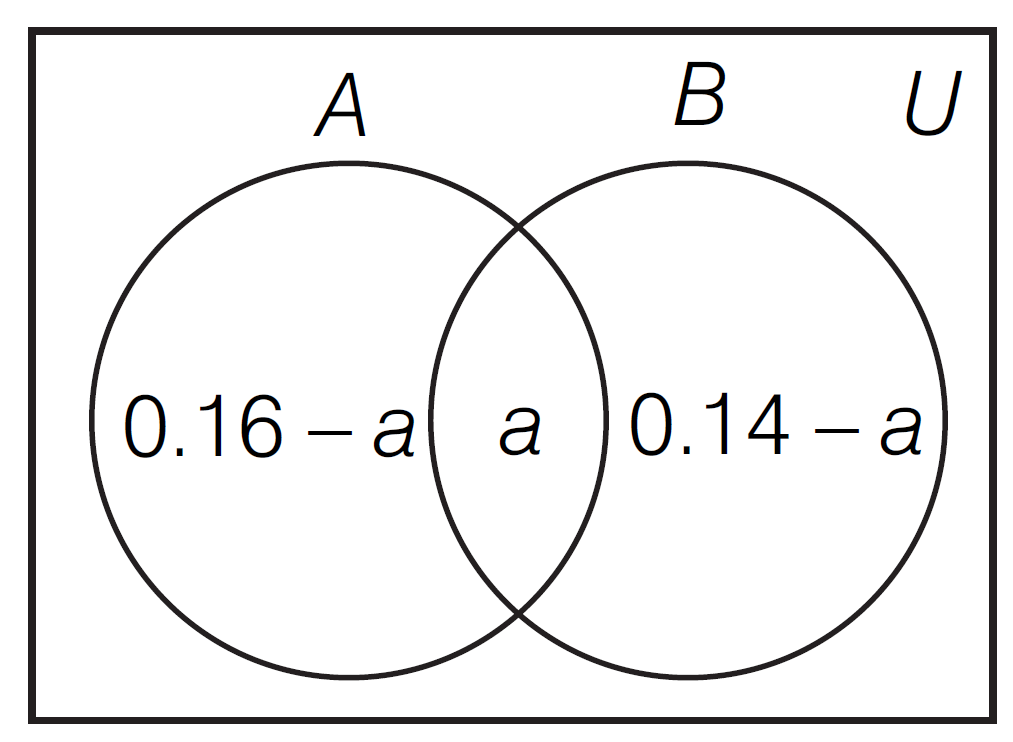
Let $n(A \cap B) = a$
$\therefore n(A \cup B) = 0.16 – a + 0.14 – a$
$\Rightarrow 0.25 = 0.30 – a$
$\Rightarrow a = 0.05$
MCQ.
If $X$ and $Y$ are two sets such that $X$ has 40 elements, $X \cup Y$ has 60 elements and $X \cap Y$ has 10 elements, then the number of elements does $Y$ have
(a) 10
(b) 20
(c) 30
(d) 40
[IMU CET-2019]
Solution. (c)
Given, $n(X) = 40$, $n(X \cup Y) = 60$
and $n(X \cap Y) = 10$
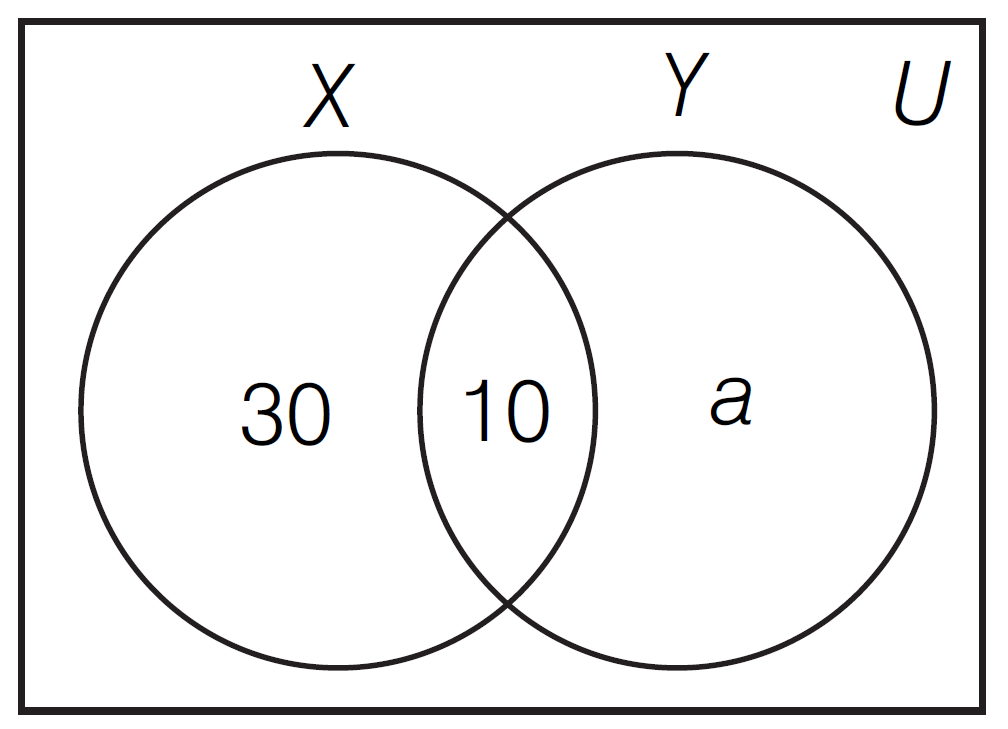
Clearly, $n(X \cup Y) = 30 + 10 + a$
$\Rightarrow 60 = 30 + 10 + a$
$\Rightarrow a = 20$
Hence, $Y$ have $10 + 10 + 20 = 30$ elements.
MCQ.
Which of the following is a singleton set?
(a) $\{x : |x| < 1, x \in I\}$
(b) $\{x : |x| = 5, x \in I\}$
(c) $\{x : x^2 = 1, x \in I\}$
(d) $\{x : x^2 + x + 1 = 0, x \in R\}$
[IMU CET-2020]
Solution. (a)
(a) $\{x : |x| < 1, x \in I\} = \{x : -1 < x < 1, x \in I\} = \{0\}$
(b) $\{x : |x| = 5, x \in I\} = \{x : x = \pm 5\} = \{-5, 5\}$
(c) $\{x : x^2 = 1, x \in I\} = \{x : x = \pm 1\} = \{-1, 1\}$
(d) $\{x : x^2 + x + 1 = 0, x \in R\} $ =
$$= \left\{ x : x = \dfrac{-1 \pm \sqrt{1^2 – 4(1)(1)}}{2(1)}, x \in R \right\}$$
$$= \left\{ x : x = \dfrac{-1 \pm \sqrt{-3}}{2}, x \in R \right\}$$
$$= \left\{ x : x = \dfrac{-1 \pm i\sqrt{3}}{2}, x \in R \right\} = \phi$$
[$\because x$ is real but here $x$ is a complex number]
Hence, option (a) is correct.
MCQ.
If set $A = \{1, 3, 5\}$, then the number of elements in $P(P(A))$ is:
(a) 8
(b) 256
(c) 248
(d) 250
[IMU CET-2024]
Solution. (b)
Given, $A = \{1, 3, 5\}$
Number of elements in $A$, $n(A) = 3$.
The number of elements in the power set of $A$, $P(A)$, is given by:
$n(P(A)) = 2^{n(A)} = 2^3 = 8$
Now, the number of elements in the power set of $P(A)$, denoted as $P(P(A))$, is:
$n(P(P(A))) = 2^{n(P(A))} = 2^8$
Calculating $2^8$:
$2^8 = 256$
Hence, option (b) is correct.
MCQ.
If $A = \{\phi, \{\phi\}\}$, then the power set of $A$ is:
(a) $A$
(b) $\{\phi, \{\phi\}, A\}$
(c) $\{\phi, \{\phi\}, \{\{\phi\}\}, A\}$
(d) None of these
[IMU CET-2025]
Solution. (c)
We have, $A = \{\phi, \{\phi\}\}$
The elements of set $A$ are $\phi$, $\{\phi\}$
To find the Power Set $P(A)$, we list all possible subsets of $A$:
The empty set: $\phi$
Subsets with one element: $\{\phi\}$ and $\{\{\phi\}\}$
The set itself: $\{\phi, \{\phi\}\}$ (which is $A$)
Therefore, the Power set of $A$ is:
$P(A) = \{\phi, \{\phi\}, \{\{\phi\}\}, \{\phi, \{\phi\}\}\}$
$\Rightarrow P(A) = \{\phi, \{\phi\}, \{\{\phi\}\}, A\}$
Hence, option (c) is correct.
MCQ.
In a town of 10000 families, it was found that 40% families buy newspaper A, 20% families buy newspaper B and 10% families buy newspaper C, 5% buy A and B, 3% buy B and C and 4% buy A and C. If 2% families buy all of three newspapers, then the number of families which buy A only, is:
(a) 4400
(b) 3300
(c) 2000
(d) 500
[IMU CET-2026]
Solution. (b)
First, calculate the number of families for each category based on the total population ($10,000$):
$n(A) = 40\% \text{ of } 10000 = 4000$
$n(B) = 20\% \text{ of } 10000 = 2000$
$n(C) = 10\% \text{ of } 10000 = 1000$
$n(A \cap B) = 5\% \text{ of } 10000 = 500$
$n(B \cap C) = 3\% \text{ of } 10000 = 300$
$n(A \cap C) = 4\% \text{ of } 10000 = 400$
$n(A \cap B \cap C) = 2\% \text{ of } 10000 = 200$
To find the number of families who buy newspaper A only, we subtract those who buy A along with other newspapers from the total $n(A)$, but we must be careful not to subtract the intersection of all three twice.
The formula for A only ($n(A \cap B’ \cap C’)$) is:
$$n(\text{A only}) = n(A) – n(A \cap B) – n(A \cap C) + n(A \cap B \cap C)$$
$$n(\text{A only})= 4000 – 500 – 400 + 200$$
$$n(\text{A only})= 3100 + 200$$
$$n(\text{A only})= 3300$$
Hence, option (b) is correct.
MCQ.
If $X_n = \{z = x + iy : |z| \leq \frac{1}{n}\}$ for all integers $n \geq 1$, then $\bigcap_{n=1}^{\infty} X_n$ is:
(a) a singleton set
(b) not a finite set
(c) an empty set
(d) a finite set with more than one element
[IMU CET-2018]
Solution. (a)
Given, $X_n = \{z = x + iy : |z| \leq \frac{1}{n}\}$
In terms of Cartesian coordinates, $|z| = \sqrt{x^2 + y^2}$. The condition $|z| \leq \frac{1}{n}$ means:
$\sqrt{x^2 + y^2} \leq \frac{1}{n} \Rightarrow x^2 + y^2 \leq \frac{1}{n^2}$
This represents a disk centered at the origin $(0,0)$ with radius $r = \frac{1}{n}$.
Let’s examine the sets as $n$ increases:
For $n=1$: $X_1 = \{x^2 + y^2 \leq 1\}$ (Radius 1)
For $n=2$: $X_2 = \{x^2 + y^2 \leq \frac{1}{4}\}$ (Radius 1/2)
For $n=3$: $X_3 = \{x^2 + y^2 \leq \frac{1}{9}\}$ (Radius 1/3)
As $n \to \infty$, the radius $\frac{1}{n}$ approaches $0$. Since each subsequent set is contained within the previous one ($X_1 \supseteq X_2 \supseteq X_3 \dots$), the intersection $\bigcap_{n=1}^{\infty} X_n$ contains only the points that satisfy the condition for every $n$.
Mathematically, this means:
$$x^2 + y^2 \leq \lim_{n \to \infty} \frac{1}{n^2} = 0$$
Since the sum of squares $x^2 + y^2$ is always non-negative for real $x$ and $y$, the only possible solution is:
$x^2 + y^2 = 0 \implies x = 0, y = 0$
Thus, $\bigcap_{n=1}^{\infty} X_n = \{0\}$, which is a singleton set.
Hence, option (a) is correct.
MCQ.
The set $A = \{x : |2x + 3| < 7\}$ is equal to:
(a) $D = \{x : 0 < x + 5 < 7\}$
(b) $B = \{x : -3 < x < 7\}$
(c) $E = \{x : -7 < x < 7\}$
(d) $C = \{x : -13 < 2x < 4\}$
[IMU CET (DNS)-2024]
Solution. (a)
Given, set $A = \{x : |2x + 3| < 7\}$
To solve the absolute value inequality $|2x + 3| < 7$, we use the property that $|X| < a \implies -a < X < a$:
Remove the absolute value :
$-7 < 2x + 3 < 7$
Subtract 3 from all parts :
$-7 – 3 < 2x < 7 – 3$$\Rightarrow -10 < 2x < 4$
Divide by 2 :
$-5 < x < 2$
Now, let’s compare this result to the given options. Option (a) defines the set as $0 < x + 5 < 7$. If we solve this inequality for $x$:
$0 < x + 5 < 7$
Subtract 5 from all parts:
$0 – 5 < x < 7 – 5$
$-5 < x < 2$
Since the interval $-5 < x < 2$ matches our derived solution for set $A$, option (a) is the equivalent representation.
Hence, option (a) is correct.
MCQ.
Let $A = \{1, \{2, 3\}\}$. Then, the number of subsets of $A$ is:
(a) 2
(b) 4
(c) 8
(d) 7
[IMU CET (DNS)-2025]
Solution. (b)
We have, $A = \{1, \{2, 3\}\}$
The elements of set $A$ are : $1$, $\{2, 3\}$ (Note: This is treated as a single element)
Therefore, the number of elements in $A$, $n(A) = 2$.
The formula for the total number of subsets of a set with $n$ elements is $2^n$.
$\text{Number of subsets} = 2^{n(A)} = 2^2 = 4$
The actual subsets are: $\phi$, $\{1\}$, $\{\{2, 3\}\}$, $\{1, \{2, 3\}\}$
Hence, option (b) is correct.
MCQ.
Let $A$ be a set represented by the squares of natural numbers and $x, y$ are any two elements of $A$, then :
(a) $x – y \in A$
(b) $xy \in A$
(c) $x + y \in A$
(d) $x/y \in A$
[IMU CET-2023]
Solution. (b)
Let $x, y \in A$.
Since $A$ is the set of squares of natural numbers ($A = \{1^2, 2^2, 3^2, \dots\}$), we can write:
$x = m^2$ and $y = n^2$ for some $m, n \in \mathbb{N}$.
Now, consider the product $xy$:
$xy = m^2 \cdot n^2 = (mn)^2$
Since the set of natural numbers is closed under multiplication, $mn$ is also a natural number. Therefore, $(mn)^2$ is the square of a natural number, which means: $xy \in A$
Why other options are incorrect:
(a) $x – y \in A$: If $x=4$ and $y=1$, $x-y=3$, which is not a perfect square.
(c) $x + y \in A$: If $x=1$ and $y=4$, $x+y=5$, which is not a perfect square.
(d) $x/y \in A$: If $x=4$ and $y=9$, $x/y = 4/9$, which is not a square of a natural number.
Hence, option (b) is correct.
MCQ.
If $A$ and $B$ are two non-empty subsets of a set $X$ such that $A$ is not a subset of $B$, then:
(a) $B$ is a subset of $A$
(b) $A$ and $B’$ are non-disjoint sets
(c) $A$ and $B$ are disjoint sets
(d) $A$ is a subset of $B$
[IMU CET-2018]
Solution. (b)
Since $A \not\subseteq B$, it means there is at least one element $x \in A$ such that $x \notin B$.
Analyze $x \in A$ and $x \notin B$:
If $x \notin B$, then by the definition of a complement, $x \in B’$.
Since $x$ is in both $A$ and $B’$, the intersection $A \cap B’$ is not empty ($A \cap B’ \neq \phi$).
Definition of non-disjoint:
Two sets are non-disjoint if their intersection contains at least one element.
Since $A \cap B’ \neq \phi$, the sets $A$ and $B’$ are non-disjoint.
Why other options are incorrect:
(a) If $A = \{1, 2\}$ and $B = \{2, 3\}$, $A \not\subseteq B$, but $B$ is also not a subset of $A$.
(c) $A$ and $B$ could overlap (e.g., sharing one element) even if $A$ is not fully contained in $B$.
(d) This contradicts the given condition $A \not\subseteq B$.
Hence, option (b) is correct.
MCQ.
If $A$ and $B$ are two given sets, then $A \cap (A \cap B)^c$ is equal to:
(a) $A$
(b) $B$
(c) $\phi$
(d) $A \cap B^c$
[IMU CET-2017]
Solution. (d)
Apply De Morgan’s Law :
$A \cap (A \cap B)^c=A \cap (A^c \cup B^c)$
Apply the Distributive Law :
$A \cap (A^c \cup B^c)=(A \cap A^c) \cup (A \cap B^c)$
Since, $A \cap A^c = \phi$.
$\phi \cup (A \cap B^c) = A \cap B^c$
Hence, option (d) is correct.
MCQ.
The set $A = \{x : x \in R, x^2 = 16 \text{ and } 2x = 6\}$ is equal to:
(a) $\phi$
(b) $\{14, 3, 4\}$
(c) $\{3\}$
(d) $\{4\}$
[IMU CET-2016]
Solution. (a)
$x^2 = 16\;$ $\Rightarrow x = \sqrt{16}\; $ $ \Rightarrow x = 4$ or $x = -4$
$2x = 6\;$ $\Rightarrow x = \dfrac{6}{2}\;$ $ \Rightarrow x = 3$
For an element to be in set $A$, it must satisfy both conditions. However, the values from the first equation are $\{4, -4\}$ and the value from the second equation is $\{3\}$.There is no value of $x$ that is common to both sets because there is AND operation (intersection) between two equations.
Since there is no real number that is simultaneously $3$ and either $4$ or $-4$, the set $A$ contains no elements.
$\therefore A = \phi$
Hence, option (a) is correct.
MCQ.
If $A$ and $B$ are two sets, then $(A \cup B)’ \cup (A’ \cap B)$ is equal to:
(a) $A’$
(b) $A$
(c) $B’$
(d) None of these
[IMU CET-2021]
Solution. (a)
Apply De Morgan’s Law : The complement of a union is the intersection of the complements.$$(A \cup B)’ = A’ \cap B’$$Substituting this back into the original expression, we get:$$(A’ \cap B’) \cup (A’ \cap B)$$
Apply the Distributive Law : Notice that $A’$ is common to both terms in the union. We can factor it out:$$A’ \cap (B’ \cup B)$$
Use the Complement Law : The union of any set $B$ and its complement $B’$ is the Universal set ($U$):$$B’ \cup B = U$$The expression now simplifies to:$$A’ \cap U$$
Identity Law : The intersection of any set with the Universal set is the set itself:$$A’ \cap U = A’$$
The expression $(A \cup B)’ \cup (A’ \cap B)$ simplifies to $A’$.
Hence, option (a) is correct.
MCQ.
Three sets $A, B$, and $C$ are such that $A = B \cap C$ and $B = C \cap A$, then :
(a) $A \subset B$
(b) $A \neq B$
(c) $A = B$
(d) $A \subset B’$
[IMU CET-2015]
Solution. (c)
Given equations :
(i) $A = B \cap C$ (ii) $B = C \cap A$
Substitute (ii) into (i):
Since $B = C \cap A$, we can replace $B$ in the first equation:$$A = (C \cap A) \cap C$$
Apply Associative and Commutative Laws:
The order of intersection does not matter:
$$A = A \cap (C \cap C)$$
Since $C \cap C = C$ (Idempotent Law) :
$$A = A \cap C$$
This result tells us that $A$ is a subset of $C$ ($A \subseteq C$).
Substitute (i) into (ii) :
Similarly, replace $A$ in the second equation:
$$B = C \cap (B \cap C)$$$$B = B \cap (C \cap C)$$
$$B = B \cap C$$This result tells us that $B$ is a subset of $C$ ($B \subseteq C$).
From the above steps, we have $A = A \cap C$.From equation (ii), we have $B = C \cap A$, which is the same as $A \cap C$.
Therefore:$$B = A \cap C = A$$
By logic of substitution, $A$ must be equal to $B$.
Hence, option (c) is correct.
MCQ.
The set $(A \cup B \cup C) \cap (A \cap B’ \cap C’)’ \cap C’$ is equal to:
(a) $B \cap C’$
(b) $A \cap C$
(c) $B’ \cap C’$
(d) None of these
[IMU CET-2024]
Solution. (a)
Apply De Morgan’s Law to the middle term :
$$(A \cap B’ \cap C’)’ = A’ \cup (B’)’ \cup (C’)’ = A’ \cup B \cup C$$
Now the expression is:
$$(A \cup B \cup C) \cap (A’ \cup B \cup C) \cap C’$$
Use the Distributive Law :
Notice that $(B \cup C)$ is common to the first two sets in the intersection. We can “factor” it out:
$$(A \cup B \cup C) \cap (A’ \cup B \cup C) = (A \cap A’) \cup (B \cup C)$$
Since $A \cap A’ = \phi$
$$\phi \cup (B \cup C) = B \cup C$$T
The total expression now simplifies to :
$$(B \cup C) \cap C’$$
Distribute the final intersection with $C’$:
$$(B \cap C’) \cup (C \cap C’)$$Since $C \cap C’ = \phi$:$$(B \cap C’) \cup \phi = B \cap C’$$
The expression simplifies to $B \cap C’$.
Hence, option (a) is correct.
MCQ.
Let $A, B, C$ be three sets such that $A \cup B \cup C = U$, where $U$ is the universal set. Then, $\{(A – B) \cup (B – C) \cup (C – A)\}’$ is equal to:
(a) $A \cup B \cup C$
(b) $A \cup (B \cap C)$
(c) $A \cap B \cap C$
(d) $A \cap (B \cup C)$
[IMU CET-2018]
Solution. (c)
Apply De Morgan’s Law :
$$\{(A – B) \cup (B – C) \cup (C – A)\}’ = (A – B)’ \cap (B – C)’ \cap (C – A)’$$
Rewrite the set differences :
$A – B = A \cap B’$. Therefore :
$(A – B)’ = (A \cap B’)’ = A’ \cup B$
$(B – C)’ = (B \cap C’)’ = B’ \cup C$
$(C – A)’ = (C \cap A’)’ = C’ \cup A$
The final expression becomes :
$$(A’ \cup B) \cap (B’ \cup C) \cap (C’ \cup A)$$
Mathematically, for the intersection $(A’ \cup B) \cap (B’ \cup C) \cap (C’ \cup A)$ to hold true :
An element $x$ must be in $B$ or not in $A$.An element $x$ must be in $C$ or not in $B$.An element $x$ must be in $A$ or not in $C$. Therefore,
$[(A – B)’ = B, (B – C)’ = C, (C – A)’ = A]$
The only region that satisfies all these conditions simultaneously within the boundary of $A \cup B \cup C$ is the central intersection where $x \in A$, $x \in B$, and $x \in C$.
Conclusion:
$$\{(A – B) \cup (B – C) \cup (C – A)\}’ = A \cap B \cap C$$
Hence, option (c) is correct.
MCQ.
If $a\mathbb{N} = \{an : n \in \mathbb{N}\}$ and $b\mathbb{N} \cap c\mathbb{N} = d\mathbb{N}$, where $a, b, c \in \mathbb{N}$ and $b, c$ are coprime, then:
(a) $b = cd$
(b) $c = bd$
(c) $d = bc$
(d) None of these
[IMU CET-2015]
Solution. (c)
The set $a\mathbb{N}$ represents the set of all multiples of $a$.
For example, if $a=3$, then $3\mathbb{N} = \{3, 6, 9, 12, \dots\}$.
$b\mathbb{N} \cap c\mathbb{N}$ : The intersection of the set of multiples of $b$ and the set of multiples of $c$ consists of numbers that are multiples of both $b$ and $c$. By definition, the smallest such number is the Least Common Multiple (LCM) of $b$ and $c$.
Therefore, $b\mathbb{N} \cap c\mathbb{N} = \text{LCM}(b, c)\mathbb{N}$.
Given, $b\mathbb{N} \cap c\mathbb{N} = d\mathbb{N}$,
which means : $$d = \text{LCM}(b, c)$$
Use the property of coprime numbers : It is given that $b$ and $c$ are coprime (their Highest Common Factor is 1). For any two coprime numbers, their LCM is simply their product : $$\text{LCM}(b, c) = b \times c$$Therefore, $d = bc$.
Since $d$ must be the least common multiple and $b, c$ share no common factors other than 1, $d$ is equal to $bc$.
Hence, option (c) is correct.
MCQ.
Universal set, $U = \{x : x^4 – 6x^3 + 11x^2 – 6x = 0\}$, $A = \{x : x^2 – 5x + 6 = 0\}$ and $B = \{x : x^2 – 3x + 2 = 0\}$. Then, $(A \cap B)^c$ is equal to :
(a) {1, 3}
(b) {1, 2, 3}
(c) {0, 1, 3}
(d) {0, 1, 2, 3}
[IMU CET (GME)-2025]
Solution. (c)
1. Solve for Universal Set $U$ :
The equation is $x^4 – 6x^3 + 11x^2 – 6x = 0$.
$x(x^3 – 6x^2 + 11x – 6) = 0$
One root is $x = 0$. For the cubic part $x^3 – 6x^2 + 11x – 6$, we test small integers:
If $x=1$ : $1 – 6 + 11 – 6 = 0$. So, $(x-1)$ is a factor. Dividing the cubic by $(x-1)$ gives $(x-2)(x-3)$. $\therefore U = \{0, 1, 2, 3\}$
2. Solve for Set $A$ :
$x^2 – 5x + 6 = 0$
$(x – 2)(x – 3) = 0$
$\therefore A = \{2, 3\}$
3. Solve for Set $B$ :
$x^2 – 3x + 2 = 0$
$(x – 1)(x – 2) = 0$
$\therefore B = \{1, 2\}$
4. Find $(A \cap B)^c$ :
Intersection ($A \cap B$) : The common element between $A$ and $B$ is $2$. $A \cap B = \{2\}$
Complement $(A \cap B)^c$ : This consists of all elements in $U$ that are not in $\{2\}$. $(A \cap B)^c = U – \{2\}$.
$(A \cap B)^c = \{0, 1, 3\}$
The set $(A \cap B)^c$ is $\{0, 1, 3\}$.
Hence, option (c) is correct.
Important Chapter Links
Sets is a fundamental topic in Class 11 CBSE Mathematics and plays an important role in competitive exams like IMU CET for Merchant Navy (DNS, GME). Practicing PYQs and MCQs on Sets helps in building a strong foundation in concepts like subsets, set operations, Venn diagrams, and laws of sets. This section provides exam-oriented questions with detailed solutions to improve accuracy, speed, and confidence for Merchant Navy aspirants.
Exercise-wise NCERT Solutions
- Basic definition of sets
- Writing sets in roster and set-builder form
- Types of sets
- Finite and infinite sets
- Subsets and proper subsets
- Number of subsets
- Set operations (union, intersection, complement)
- Advanced problems on set operations and Venn diagrams
- Mixed problems covering all concepts of the chapter
IMU CET DNS & GME Maths PYQs and MCQs on Sets with Solutions FAQs
Why are Sets important for Merchant Navy exams like IMU CET (DNS, GME)?
Sets form the base for logical reasoning and are frequently used in questions related to relations, functions, and probability in Merchant Navy entrance exams.
Are PYQs enough for Merchant Navy preparation?
PYQs are very important for Merchant Navy exams, but they should be combined with theory and additional practice questions for best results.
What types of questions are asked from Sets in Merchant Navy exams?
Questions are usually based on subsets, power sets, set operations, Venn diagrams, and basic set laws relevant to Merchant Navy entrance tests.
Do Merchant Navy questions require Venn diagrams?
Yes, many problems in Merchant Navy exams can be solved quickly using Venn diagrams for better visualization.
How should I practice MCQs for Merchant Navy exams effectively?
Focus on understanding concepts, practice regularly, and analyze mistakes from solutions to improve performance in Merchant Navy exams.
Is the difficulty level of Sets questions in Merchant Navy exams high?
The difficulty level is generally moderate, focusing more on clarity of concepts than complex calculations for Merchant Navy aspirants.
Can I prepare Sets for Merchant Navy exams from Class 11 syllabus?
Yes, the Class 11 CBSE syllabus is sufficient to cover Sets for Merchant Navy exam preparation.
How many questions should I practice daily for Merchant Navy exams?
Practicing around 15–25 questions daily can help improve speed and accuracy for Merchant Navy preparation.
Are solutions necessary while preparing for Merchant Navy exams?
Yes, detailed solutions help in understanding the correct approach and avoiding common mistakes in Merchant Navy exams.
Can Sets help in other exams besides Merchant Navy?
Yes, Sets is a common topic in exams like JEE, NDA, and other competitive tests along with Merchant Navy entrance exams.