Set theory forms the foundation of mathematics and is widely used in topics ranging from algebra to probability. In this section, we explore important concepts such as subsets, supersets, proper subsets, power sets, and universal sets, along with their key theorems and properties. These concepts help in understanding relationships between different sets and play a crucial role in solving mathematical problems efficiently.
What is a Subset ? – Definition and Symbol – with Examples
A subset is a set whose all elements are contained within another set.
Let $A$ and $B$ be two sets. A set $A$ is said to be a subset of set $B$ if every element of $A$ is also an element of $B$,
Notation of Subset
and we write,
$$
A \subseteq B.
$$
Which is read as “$A$ is a subset of $B$” or $A$ is contained in $B$.
Therefore, $A$ ⊆ $B$, if $x$ ∈ $A$ ⇒ $x$ ∈ $B$.
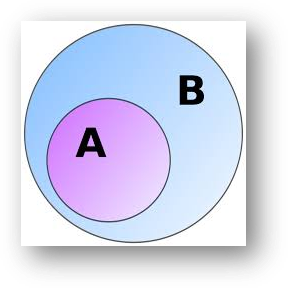
For example :
Consider the sets A and B, where A denotes the set of all the students in your class, B denotes the set of all the students in your school. We observe that every element of A is also an element of B. We say that A is a subset of B i.e. A ⊆ B.
Practical Examples of Subsets
Example.1 :
If A = {2, 4} and B = {1, 2, 3, 4, 5, 6, 7, 8}
then A is a subset of BIn this example, A is a subset of B, because all the elements in A are also in B
For a set A, the number of possible subsets is 2|A|. Where |A| = number of elements in A.
Example.2 :
For the set C = {1, 2, 3}, there are 23 = 8 possible subsets
they are ∅, {1}, {2}, {3}, {1, 2}, {2, 3}, {1, 3}, {1, 2, 3}
Key Properties of Subsets
These properties apply to all sets regardless of their contents :
Reflexive Property : Every set is a subset of itself ($A \subseteq A$). Every element in $A$ is, by definition, in $A$.
The Empty Set Property : The empty set ($\emptyset$) is a subset of every set ($\emptyset \subseteq A$). Since the empty set has no elements, the condition for being a subset is “vacuously true.”
Transitive Property : If $A \subseteq B$ and $B \subseteq C$, then $A \subseteq C$.
Antisymmetric Property : If $A \subseteq B$ and $B \subseteq A$, then $A = B$. This is the standard method used in mathematical proofs to show that two sets are identical.
What is Superset ? – Definition and Symbol – with Examples
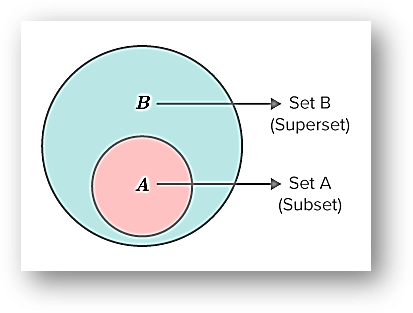
A Superset is a set that contains all the elements of another set, which is called the subset.
For two sets A and B, if A is a subset of B then B is the superset of A. A can be equal to B. If $A \subseteq B$, then $B$ is called a superset of $A$.
Notation of Superset
$$
B \supseteq A.
$$
Practical Examples of Supersets
Example.1 :
If A = {2, 4} and B = {1, 2, 3, 4, 5, 6, 7, 8}
then B is the superset of A, because A is a subset of B
Example.2 :
If A = {11, 12} and B = {11, 12} then B is the super set of A
Key Properties of Supersets
Reflexive Property : Every set is a superset of itself ($A \supseteq A$).
The Empty Set Property : Every set is a superset of the empty set ($A \supseteq \emptyset$).
Transitive Property : If $A \supseteq B$ and $B \supseteq C$, then $A \supseteq C$.
Antisymmetric Property : If $A \supseteq B$ and $B \supseteq A$, then $A = B$.
Proper Superset (also called Strict Superset)
For two sets A and B, if A is a subset of B and A is not equal to B, then B is the proper superset of A. Formally it is written as
Practical Examples of Proper Superset
Example.1 :
If A = {1, 2, 3} and B = {0, 1, 2, 3, 4, 5}
then B is a proper superset of A, because A is a subset of B and A ≠ B
Example.2 :
If A = {2, 4, 6} and B = {2, 4, 6} then B is not a proper superset of A, because A = B
What is Proper Subset ?
If $A \subseteq B$ and $A \neq B$ then $A$ is called a proper subset of $B$ (also called strict subset).
Notation of Proper Subset
The symbol for proper subset is
$$
A \subset B.
$$
For example :
Let A = {x : x is an even natural number} and
B = {x : x is a natural number}
Then, A = { 2, 4, 6, 8…..} and B = { 1, 2, 3, 4, 5…..} ⇒ A ⊂ B.
| Key Point |
|---|
| (i) If there exists even a single element in $A$ which is not in $B$, then $A$ is not a subset of $B$, and we write,$A \not\subseteq B.$ e.g. {2} ⊂ {1, 2, 3} but {2, 4} $\not\subseteq$ B { 1, 2, 3}. |
| (ii) $\phi$ has no proper subset. |
Practical Examples of Proper Subsets
EXAMPLE 1
Let $A = \{2, 3, 5\}$ and $B = \{2, 3, 5, 7, 9\}$.
Then, every element of $A$ is an element of $B$.
$\therefore A \subseteq B$ but $A \neq B$.
Hence, $A$ is a proper subset of set $B$, i.e., $A \subset B$.
EXAMPLE 2
Let $A = \{1, 2\}$ and $B = \{2, 3, 5\}$.
Then, $1 \in A$ but $1 \notin B$.
$\therefore A \not\subseteq B$.
Again, $3 \in B$ but $3 \notin A$.
$\therefore B \not\subseteq A$.
Thus, $A \not\subseteq B$ and $B \not\subseteq A$.
EXAMPLE 3
Clearly,
$$
N \subset W \subset Z \subset Q \subset R.
$$
But, $0 \in W$ and $0 \notin N$.
$$\therefore W \not\subseteq N$$
EXAMPLE 4
Let
$$
A = \{1, \{2, 3\}, 4\}.
$$
Then, which of the following statements is true?
(i) $\{2, 3\} \in A$ (ii) $\{2, 3\} \subset A$
Rectify the wrong statement.
SOLUTION
Clearly, $A$ is a set containing three elements, namely $1$, $\{2, 3\}$ and $4$.
(i) $\{2, 3\} \in A$ is a true statement.
(ii) $\{2, 3\} \subset A$ is wrong.
On rectifying this statement, we get
$$
\{\{2, 3\}\} \subset A
$$
as a true statement.
What is an Improper Subset ?
A set A is said to be an improper subset of itself if all the elements of A are contained in A, and there is no extra element left out. That is, A subset is called an improper subset if it is equal to the original set itself.
Example:
- Let A = {1, 2, 3}
- Subsets of A = {∅, {1}, {2}, {3}, {1,2}, {2,3}, {1,3}, {1,2,3}}
- Among these, {1,2,3} = A, which is the improper subset of A.
Thus, every set has exactly one improper subset, which is the set itself.
Notation of Improper Subset
The symbol for subset is ⊆.
- A ⊆ A → A is an improper subset of A.
- If A ⊂ B → A is a proper subset of B.
| Key Point |
|---|
| Remember: ⊆ allows equality, while ⊂ does not. |
Key Properties of Improper Subsets
- Every set is an improper subset of itself: A ⊆ A always holds true.
- Only one improper subset exists for any set.: Example: If A = {1, 2, 3}, then A itself is the only improper subset.
- The empty set (∅) is never an improper subset : ∅ is always a proper subset, not an improper one.
- Relation with Power Set: In the power set P(A) of a set A, the set A itself is the improper subset.
- Connection with Superset: If A ⊆ B and A = B, then A is an improper subset of B, and B is an improper superset of A.
Practical Examples of Improper Subsets
Example 1:
Let A = {a, b}.
- Subsets = {∅, {a}, {b}, {a,b}}
- Improper subset = {a,b}.
Example 2:
Let X = {1, 2, 3, 4}.
- Total subsets = 2⁴ = 16.
- Among these, the improper subset is X itself = {1, 2, 3, 4}.
Example 3:
Let B = {x}.
- Subsets = {∅, {x}}
- Improper subset = {x}.
Improper Subset Problems
Problem 1: Find the number of improper subsets of A = {1,2,3,4,5}.
Solution:
By definition, a set has only 1 improper subset (the set itself).
Problem 2: If X has 10 elements, how many improper subsets does X have?
Solution:
No matter how large the set is, the number of improper subsets = 1.
Problem 3: If A has 3 elements, find the number of proper and improper subsets.
Solution:
- Total subsets = 2³ = 8
- Proper subsets = 8 – 1 = 7
- Improper subsets = 1
Problem 4: Let U = {1,2,3,4,5}, A = {2,3,4,5}. Is A an improper subset of U?
Solution:
- Since A ≠ U, A is only a proper subset of U.
- A is not an improper subset.
How many Subsets and Proper Subsets does a set have?
If a set has “n” elements, then the number of subset of the given set is 2n and the number of proper subsets of the given subset is given by 2n-1.
Consider an example, If set A has the elements, A = {a, b}, then the proper subset of the given subset are Φ, {a}, and {b}.
Here, the number of elements in the set is 2.
We know that the formula to calculate the number of proper subsets is 2n – 1.
= 22 – 1 = 4 – 1 = 3
Thus, the number of proper subset for the given set is 3 (Φ, {a}, {b}).
Important Theorems on Subsets
THEOREM 1
Every set is a subset of itself.
PROOF
Let $A$ be any set.
Then, each element of $A$ is in $A$.
$\therefore A \subseteq A$.
Hence, every set is a subset of itself.
THEOREM 2
The empty set is a subset of every set.
PROOF
Let $A$ be any set and $\emptyset$ be the empty set.
Since $\emptyset$ contains no element at all, so there is no element of $\emptyset$ which is not contained in $A$.
Hence,
$$
\emptyset \subseteq A.
$$
THEOREM 3
The total number of subsets of a set containing $n$ elements is $2^n$.
PROOF
Let $A$ be a finite set containing $n$ elements. Then,
number of subsets of $A$ each containing no element $ =1 = {}^nC_0 = 1$.
number of subsets of $A$ each containing $1$ element $= {}^nC_1$.
number of subsets of $A$ each containing $2$ elements $= {}^nC_2$.
$\dots$ $\dots$ $\dots$ $\dots$ $\dots$
number of subsets of $A$ each containing $n$ elements $= {}^nC_n$.
$\therefore$ total number of subsets of $A$ [using binomial theorem].
$$
= {}^nC_0 + {}^nC_1 + {}^nC_2 + \dots + {}^nC_n
= (1+1)^n = 2^n
$$
What is Universal Set ?
A Universal Set is the collection of all possible elements under consideration for a particular discussion or problem. It acts as the “master set” from which all other sets in that specific context are derived. We shall denote a universal set by $U$.
EXAMPLE 1
Let
$$
A = \{1, 2, 3\}, \quad B = \{2, 3, 4, 5\} \quad \text\{and\} \quad C = \{6, 7\}.
$$
If we consider the set
$$
U = \{1, 2, 3, 4, 5, 6, 7\}
$$
then clearly, $U$ is a superset of each of the given sets.
Hence, $U$ is the universal set.
EXAMPLE 2
When we discuss sets of lines, triangles or circles in two-dimensional geometry, the plane in which these lines, triangles or circles lie, is the universal set.
| Key Point |
|---|
| Every set $A$ being discussed is necessarily a subset of the Universal Set ($A \subseteq U$). |
Subsets of The Set R of All Real Numbers
(i) Natural Numbers: The simplest numbers are 1, 2, 3, 4… the numbers being used in counting. These are called natural numbers.
$N = \{1, 2, 3, 4, 5, \dots\}$ is the set of all natural numbers.
(ii) Whole numbers: The natural numbers along with the number 0 (zero) form the set of whole numbers. i.e. 0, 1, 2, 3,…… are whole numbers.
$W = \{0, 1, 2, 3, 4, 5, \dots\}$ is the set of all whole numbers.
| Key Point |
|---|
| Set of natural numbers is the subset of the set of whole numbers. That is, N ⊆ W |
(iii) Integers: The natural numbers, their negatives and zero make up the integers.
$Z = \{\dots, -4, -3, -2, -1, 0, 1, 2, 3, 4, \dots\}$ is the set of all integers.
$Z^+ = \{1, 2, 3, 4, 5, \dots\}$ is the set of all positive integers.
$Z^- = \{-1, -2, -3, -4, \dots\}$ is the set of all negative integers.
Sometimes, we denote the set of all integers by $I$.
| Key Point |
|---|
| Set of whole numbers is subset of the set of integers. That is, W ⊂ Z |
(iv) Rational Numbers: Numbers of the type $\dfrac{1}{2}, \dfrac{2}{3}, \dfrac{7}{5} …$ are called rational numbers; not because they are ‘‘reasonable’’, but because they are ratios of natural numbers. The word ‘‘rational’’ is derived from the word ratio.
$Q = \left\{ x : x = \dfrac{p}{q}, \text{ where } p, q \in Z \text{ and } q \neq 0 \right\}$ is the set of all rational numbers.
The set of all positive rational numbers is denoted by $Q^+$.
| Key Point |
|---|
| All the whole numbers are also rational numbers since they can be represented as the ratio e.g. $2 = \dfrac{2}{1}, \dfrac{6}{3}$ etc. |
| Key Point |
|---|
| Natural numbers, negative of natural numbers, zero and common fractions are all rational numbers. The positive numbers, negative numbers and zero collectively are called integers. Therefore, the set of rational numbers contains the set of integers. The set of integers is the subset of the set of rational numbers. Rational number can also be expressed as a decimal like all fractions. That is, Z ⊆ Q |
(v) Irrational Numbers: There are some decimal numbers are not terminating and non repeating. These decimal numbers cannot be put in the form of $\dfrac{p}{q} $ are not the rational numbers. For example, 0.434334333…….
Definition : The numbers which cannot be expressed in decimal form either in terminating or in repeating decimals are known as irrational numbers.
An irrational number cannot be written in the form of $\dfrac{p}{q}$ where q ≠ 0. $\sqrt{2}, \sqrt{3}$ are also irrational numbers.
A number which is not rational is called irrational. The set of irrational numbers is denoted by T.
$T = \{ x : x \in R \text{ and } x \notin Q \}$ is the set of all irrational numbers.
(vi) Real Numbers: Rational numbers and irrational numbers taken together are known as real numbers. Thus every real number is either a rational number or irrational number. The set of real numbers is denoted by R.
| Key Point |
|---|
| The set of rational numbers is the subset of the set of real numbers. That is Q ⊆ R R = {Rational numbers, Irrational numbers} |
Intervals as Subsets of Real Numbers R
Let $a, b \in R$ and $a < b$. Then, we define:
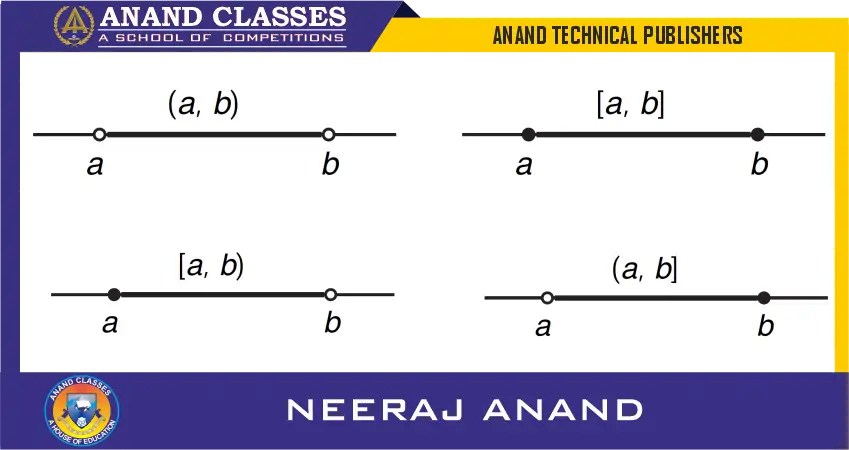
(i) Open Interval $(a, b)$ or $]a, b[$ $$= \{ x : x \in R, \, a < x < b \}$$
Then, the set of real numbers {x : a < x < b} is called an open interval and is denoted by (a, b). All the real numbers between a and b belong to the open interval (a, b) but a and b do not belong to this set (interval).
(ii) Closed Interval $[a, b]$
$$= \{ x : x \in R, \, a \leq x \leq b \}$$
The interval which contains the first and last members of the set is called closed interval.
(iii) Right Half Open Interval $[a, b)$ or $[a, b[$
$$
= \{ x : x \in R, \, a \leq x < b \}.
$$
is an interval which includes a but excludes b.
(iv) Left Half Open Interval $(a, b]$ or $]a, b]$
$$
= \{ x : x \in R, \, a < x \leq b \}.
$$
is an interval which excludes a but includes b.
Examples on intervals
(i) $[-2, 3] = \{ x : x \in R, -2 \leq x \leq 3 \}$
(ii) $(-2, 3) = \{ x : x \in R, -2 < x < 3 \}$
(iii) $[-2, 3) = \{ x : x \in R, -2 \leq x < 3 \}$
(iv) $(-2, 3] = \{ x : x \in R, -2 < x \leq 3 \}$
On the real line, these sets can be shown by the dark portion of the number line.
We represent these intervals as shown below:
For example;
(i) (2, 10) is a subset of (– 1, 11).
(ii) [5, 8) is a subset of [5, 8].
(iii) (a, b] is a subset of [a, b].
(iv) [0, ∞) is the set of non negative real numbers.
(v) (– ∞, 0) is the set of negative real numbers.
(vi) (–∞, ∞) is the set of real numbers.
Length of an Interval
The length of each of the intervals $[a, b]$, $(a, b)$, $[a, b)$ and $(a, b]$ is $(b – a)$.
What is Power Set ? – Definition, Properties, Examples
The set of all subsets of a given set $A$ is called the power set of $A$, denoted by $P(A)$.
i.e. P(A) = { x : x ⊆ A }
Since, the empty set and the set A itself are subsets of A and are therefore elements of P(A). Thus, the power set of a given set is always non-empty.
| Definition of Power set |
|---|
| The Power Set of a set $A$, denoted as $P(A)$ or $2^A$, is the set of all possible subsets of $A$, including the empty set and the set $A$ itself. |
| Key Point |
|---|
| For any set A containing n elements, the total number of subsets formed is 2n. Thus, the power set of A, P(A) has 2n elements. |
Practical Examples of Power set
Example.1
Let A = { 1, 2, 3}, then
P(A) = {Φ, {1}, {2}, {3}, {1, 2}, {1, 3}, {2, 3}, {1, 2, 3}}Here, n = 3, P(A) has 23 = 8 subsets.
| Key Point |
|---|
| If A is the void set Φ, then P(A) has just one element Φ i.e. P{Φ} = {Φ}. |
Example.2
If A = {p, {q}}, find P(A).
Sol.
Let B = {q}.
Then, A = {p, B}∴ P(A) = {Φ, {p}, {B}, {p, B}} = {Φ, {p}, {{q}}, {p, {q}}}.
| Key Point |
|---|
| If $n(A) = m$ then $n(P(A)) = 2^m$. |
Solved Examples On Subsets, Power Set and Intervals
EXAMPLE 1
Write down all possible subsets of $A = \{4\}$.
SOLUTION
All possible subsets of $A$ are $\emptyset, \{4\}$.
$\therefore P(A) = \{\emptyset, \{4\}\}$.
Here, $n(A) = 1$ and $n(P(A)) = 2 = 2^1$.
EXAMPLE 2
Write down all possible subsets of $A = \{2, 3\}$.
SOLUTION
All possible subsets of $A$ are
$\emptyset, \{2\}, \{3\}, \{2, 3\}$.
$\therefore P(A) = \{\emptyset, \{2\}, \{3\}, \{2, 3\}\}$.
Thus, $n(A) = 2$ and $n(P(A)) = 4 = 2^2$.
EXAMPLE 3
Write down all possible subsets of $A = \{-1, 0, 1\}$.
SOLUTION
All possible subsets of $A$ are
$\emptyset, \{-1\}, \{0\}, \{1\}, \{-1, 0\}, \{-1, 1\}, \{0, 1\}, \{-1, 0, 1\}$.
$\therefore P(A) = \{\emptyset, \{-1\}, \{0\}, \{1\}, \{-1, 0\}, \{-1, 1\}, \{0, 1\}, \{-1, 0, 1\}\}$.
Thus, $n(A) = 3$ and $n(P(A)) = 8 = 2^3$.
EXAMPLE 4
Write down all possible subsets of $A = \{1, \{2, 3\}\}$.
SOLUTION
Here, $A$ contains two elements, namely $1$ and $\{2, 3\}$.
Let $\{2, 3\} = B$, then $A = \{1, B\}$.
$\therefore P(A) = \{\emptyset, \{1\}, \{B\}, \{1, B\}\}$
$\Rightarrow P(A) = \{\emptyset, \{1\}, \{\{2, 3\}\}, \{1, \{2, 3\}\}\}$.
EXAMPLE 5
Write down all possible subsets of $\emptyset$.
SOLUTION
$\emptyset$ has only one subset, namely $\emptyset$.
$\therefore P(\emptyset) = \{\emptyset\}$.
EXAMPLE 6
Write each of the following subsets of $R$ as an interval:
(i) $A = \{x : x \in R, -3 \leq x \leq 5\}$
(ii) $B = \{x : x \in R, -5 < x < -1\}$
(iii) $C = \{x : x \in R, -2 \leq x < 0\}$
(iv) $D = \{x : x \in R, -1 \leq x \leq 4\}$
Find the length of each of the above intervals.
SOLUTION
We have
(i) $A = [-3, 5]$. Length$(A) = 5 – (-3) = 8$.
(ii) $B = (-5, -1)$. Length$(B) = -1 – (-5) = 4$.
(iii) $C = [-2, 0)$. Length$(C) = 0 – (-2) = 2$.
(iv) $D = [-1, 4]$. Length$(D) = 4 – (-1) = 5$.
EXAMPLE 7
Write each of the following intervals in the set-builder form:
(i) $A = (2, 5)$ (ii) $B = [-4, 7]$ (iii) $C = [-8, 0)$ (iv) $D = (5, 9]$
SOLUTION
We have
(i) $A = \{x : x \in R, 2 < x < 5\}$.
(ii) $B = \{x : x \in R, -4 \leq x \leq 7\}$.
(iii) $C = \{x : x \in R, -8 \leq x < 0\}$.
(iv) $D = \{x : x \in R, 5 < x \leq 9\}$.
What Are Equal Sets ? Definition, Properties, Examples
Two sets $A$ and $B$ are said to be equal, if every element of $A$ is in $B$ and every element of $B$ is in $A$, and we write, $A = B$.
REMARKS
(i) The elements of a set may be listed in any order.
Thus, $\{1, 2, 3\} = \{3, 1, 2\} = \{2, 3, 1\}$, etc.
(ii) The repetition of elements in a set is meaningless.
Thus, $\{2, 4, 6\} = \{2, 2, 4, 6, 6\}$.
THEOREM 4
Let $A$ and $B$ be two sets. Then, prove that
$$
A = B \Leftrightarrow A \subseteq B \text{ and } B \subseteq A.
$$
PROOF
Let $A = B$.
Then, by definition of equal sets, every element of $A$ is in $B$ and every element of $B$ is in $A$.
$\therefore A \subseteq B$ and $B \subseteq A$.
Thus, $(A = B) \Rightarrow (A \subseteq B \text{ and } B \subseteq A)$.
Again, let $A \subseteq B$ and $B \subseteq A$.
Then, by the definition of a subset, it follows that every element of $A$ is in $B$ and every element of $B$ is in $A$.
Consequently, $A = B$.
Thus, $(A \subseteq B \text{ and } B \subseteq A) \Rightarrow A = B$.
Hence,
$$
(A = B) \Leftrightarrow (A \subseteq B \text{ and } B \subseteq A).
$$
EXAMPLE 8
Let
$$
A = \{1, \{2\}, \{3, 4\}, 5\}.
$$
Which of the following are incorrect statements? Rectify each:
(i) $2 \in A$ (ii) $\{2\} \subset A$ (iii) $\{1, 2\} \subset A$
(iv) $\{3, 4\} \subset A$ (v) $\{1, 5\} \subset A$ (vi) $\emptyset \subset A$
(vii) $1 \subset A$ (viii) $\{1, 2, 3, 4\} \subset A$
SOLUTION
Clearly, $A$ contains four elements, namely $1$, $\{2\}$, $\{3, 4\}$ and $5$.
(i) $2 \in A$ is incorrect. The correct statement would be $\{2\} \in A$.
(ii) $\{2\} \subset A$ is incorrect. The correct statement is $\{\{2\}\} \subset A$.
(iii) Clearly, $2 \notin A$ and therefore, $\{1, 2\} \subset A$ is incorrect.
The correct statement would be $\{1, \{2\}\} \subset A$.
(iv) Clearly, $\{3, 4\}$ is an element of $A$.
So, $\{3, 4\} \subset A$ is incorrect and $\{\{3, 4\}\} \subset A$ is correct.
(v) Since $1$ and $5$ are both elements of $A$, so $\{1, 5\} \subset A$ is correct.
(vi) Since $\emptyset \notin A$, so $\{\emptyset\} \subset A$ is incorrect while $\emptyset \subset A$ is correct.
(vii) Since $1 \in A$, so $1 \subset A$ is incorrect and therefore, $\{1\} \subset A$ is correct.
(viii) Since $2 \notin A$ and $3 \notin A$, so $\{1, 2, 3, 4\} \subset A$ is incorrect.
The correct statement would be $\{1, \{2\}, \{3, 4\}\} \subset A$.
PRACTICE EXERCISE
1. State in each case whether $A \subset B$ or $A \not\subseteq B$.
(i) $A = \{0, 1, 2, 3\}$, $B = \{1, 2, 3, 4, 5\}$
(ii) $A = \emptyset$, $B = \{0\}$
(iii) $A = \{1, 2, 3\}$, $B = \{1, 2, 4\}$
(iv) $A = \{x : x \in Z, x^2 = 1\}$, $B = \{x : x \in N, x^2 = 1\}$
(v) $A = \{x : x \text{ is an even natural number}\}$, $B = \{x : x \text{ is an integer}\}$
(vi) $A = \{x : x \text{ is an integer}\}$, $B = \{x : x \text{ is a rational number}\}$
(vii) $A = \{x : x \text{ is a real number}\}$, $B = \{x : x \text{ is a complex number}\}$
(viii) $A = \{x : x \text{ is an isosceles triangle in a plane}\}$,
$B = \{x : x \text{ is an equilateral triangle in the same plane}\}$
(ix) $A = \{x : x \text{ is a square in a plane}\}$,
$B = \{x : x \text{ is a rectangle in the same plane}\}$
(x) $A = \{x : x \text{ is a triangle in a plane}\}$,
$B = \{x : x \text{ is a rectangle in the same plane}\}$
(xi) $A = \{x : x \text{ is an even natural number less than } 8\}$,
$B = \{x : x \text{ is a natural number which divides } 32\}$
2. Examine whether the following statements are true or false:
(i) $\{a, b\} \not\subseteq \{b, c, a\}$
(ii) $\{a\} \subset \{a, b, c\}$
(iii) $\{a, b, c\} \subset \emptyset$
(iv) $\{a, e\} \subset \{x : x \text{ is a vowel in the English alphabet}\}$
(v) $\{x : x \in W, x + 5 = 5\} = \emptyset$
(vi) $\{\{a\}, b\} \subset \{a, b\}$
(vii) $\{a\} \subset \{\{a\}, b\}$
(viii) $\{b, c\} \subset \{a, b, c\}$
(ix) $\{a, a, b, b\} = \{a, b\}$
(x) $\{a, b, a, b, a, b, \dots\}$ is an infinite set.
(xi) If $A =$ set of all circles of unit radius in a plane and $B =$ set of all circles in the same plane then $A \subset B$.
3. If $A = \{1\}$ and $B = \{\{1\}, 2\}$ then show that $A \not\subseteq B$.
Hint $1 \in A$ but $1 \notin B$.
4. Write down all subsets of each of the following sets:
(i) $A = \{a\}$
(ii) $B = \{a, b\}$
(iii) $C = \{-2, 3\}$
(iv) $D = \{-1, 0, 1\}$
(v) $E = \emptyset$
(vi) $F = \{2, \{3\}\}$
(vii) $G = \{3, 4, \{5, 6\}\}$
5. Express each of the following sets as an interval:
(i) $A = \{x : x \in R, -4 < x < 0\}$
(ii) $B = \{x : x \in R, 0 \leq x < 3\}$
(iii) $C = \{x : x \in R, 2 \leq x \leq 6\}$
(iv) $D = \{x : x \in R, -5 \leq x \leq 2\}$
(v) $E = \{x : x \in R, -3 \leq x < 2\}$
(vi) $F = \{x : x \in R, -2 \leq x < 0\}$
6. Write each of the following intervals in the set-builder form:
(i) $A = (-2, 3)$
(ii) $B = [4, 10]$
(iii) $C = [-1, 8)$
(iv) $D = (4, 9]$
(v) $E = [-10, 0)$
(vi) $F = (0, 5]$
7. If $A = \{3, \{4, 5\}, 6\}$ find which of the following statements are true.
(i) $\{4, 5\} \subset A$ (ii) $\{4, 5\} \in A$ (iii) $\{\{4, 5\}\} \subset A$
(iv) $4 \in A$ (v) $\{3, 3\} \subset A$ (vi) $\{3\} \subset A$
(vii) $\emptyset \subset A$ (viii) $\{3, 4, 5\} \subset A$ (ix) $\{3, 6\} \subset A$
8. If $A = \{a, b, c\}$ find $P(A)$ and $n(P(A))$.
9. If $A = \{1, \{2, 3\}\}$ find $P(A)$ and $n(P(A))$.
10. If $A = \emptyset$ then find $n(P(A))$.
11. If $A = \{1, 3, 5\}$, $B = \{2, 4, 6\}$ and $C = \{0, 2, 4, 6, 8\}$ then find the universal set.
12. Prove that $A \subseteq B$, $B \subseteq C$ and $C \subseteq A \Rightarrow A = C$.
13. For any set $A$, prove that
$$
A \subseteq \emptyset \Leftrightarrow A = \emptyset.
$$
14. State whether the given statement is true or false:
(i) If $A \subseteq B$ and $x \notin B$ then $x \notin A$.
(ii) If $A \not\subseteq \emptyset$ then $A \neq \emptyset$.
(iii) If $A$, $B$ and $C$ are three sets such that $A \subseteq B$ and $B \subseteq C$ then $A \subseteq C$.
Hint Let $A = \{a\}$, $B = \{\{a\}, b\}$ and $C = \{\{a\}, b, c\}$.
Then, $\{a\} \subseteq B$ and $B \subseteq C$. But, $\{a\} \not\subseteq C$.
(iv) If $A$, $B$ and $C$ are three sets such that $A \subseteq B$ and $B \not\subseteq C$ then $A \not\subseteq C$.
Hint Let $A = \{a\}$, $B = \{a, b\}$ and $C = \{\{a\}, b, c\}$.
Then, $A \subseteq B$ and $B \not\subseteq C$. But, $A \subseteq C$.
(v) If $A$, $B$ and $C$ are three sets such that $A \not\subseteq B$, $B \not\subseteq C$ and $A \not\subseteq C$.
Hint Let $A = \{a\}$, $B = \{b, c\}$ and $C = \{a, c\}$.
Then, $A \not\subseteq B$, $B \not\subseteq C$ and $A \not\subseteq C$. But $A \subseteq C$.
(vi) If $A$ and $B$ are sets such that $x \in A$ and $A \subseteq B$ then $x \in B$.
Hint Let $A = \{x\}$, $B = \{\{x\}, y\}$.
Then, $x \in A$ and $A \subseteq B$. But, $x \notin B$.
ANSWERS (PRACTICE EXERCISE)
1.
(i) $A \not\subseteq B$ (ii) $A \subset B$ (iii) $A \not\subseteq B$ (iv) $A \not\subseteq B$ (v) $A \subset B$
(vi) $A \subset B$ (vii) $A \subset B$ (viii) $A \not\subseteq B$ (ix) $A \subset B$ (x) $A \not\subseteq B$
(xi) $A \not\subseteq B$
2.
(i) False (ii) False (iii) False (iv) True (v) False
(vi) False (vii) False (viii) False (ix) True (x) False (xi) True
4.
(i) $\emptyset, \{a\}$
(ii) $\emptyset, \{a\}, \{b\}, \{a, b\}$
(iii) $\emptyset, \{-2\}, \{3\}, \{-2, 3\}$
(iv) $\emptyset, \{-1\}, \{0\}, \{1\}, \{-1, 0\}, \{-1, 1\}, \{0, 1\}, \{-1, 0, 1\}$
(v) $\emptyset$
(vi) $\emptyset, \{2\}, \{\{3\}\}, \{2, \{3\}\}$
(vii) $\emptyset, \{3\}, \{4\}, \{\{5, 6\}\}, \{3, 4\}, \{3, \{5, 6\}\}, \{4, \{5, 6\}\}, \{3, 4, \{5, 6\}\}$
5.
(i) $(-4, 0)$ (ii) $[0, 3)$ (iii) $[2, 6]$ (iv) $[-5, 2]$ (v) $[-3, 2)$ (vi) $[-2, 0)$
6.
(i) $\{x : x \in R, -2 < x < 3\}$
(ii) $\{x : x \in R, 4 \leq x \leq 10\}$
(iii) $\{x : x \in R, -1 \leq x < 8\}$
(iv) $\{x : x \in R, 4 < x \leq 9\}$
(v) $\{x : x \in R, -10 \leq x < 0\}$
(vi) $\{x : x \in R, 0 < x \leq 5\}$
7.
(i) False (ii) True (iii) True (iv) False (v) True
(vi) False (vii) True (viii) False (ix) True
8.
$P(A) = \{\emptyset, \{a\}, \{b\}, \{c\}, \{a, b\}, \{b, c\}, \{a, c\}, \{a, b, c\}\}$ and $n(P(A)) = 8 = 2^3$
9.
$P(A) = \{\emptyset, \{1\}, \{\{2, 3\}\}, \{1, \{2, 3\}\}\}$ and $n(P(A)) = 4 = 2^2$
10.
$P(A) = \{\emptyset\}$ and $n(P(A)) = 1$
11.
$U = \{0, 1, 2, 3, 4, 5, 6, 8\}$
14.
(i) True (ii) True (iii) False (iv) False (v) False (vi) False
HINTS TO SOME SELECTED QUESTIONS
1.
(iv) $A = \{-1, 1\}$ and $B = \{1\}$. So, $A \not\subseteq B$.
(v) $A = \{2, 4, 6, 8, \dots\}$ and $B = \{\dots, -1, 0, 1, 2, 3, 4, 5, 6, 7, 8, \dots\}$. So, $A \subset B$.
(vi) Every integer is a rational number.
(vii) We may write a real number $x$ as $x = x + 0i$.
So, every real number is a complex number.
(ix) Every square is a rectangle.
(xi) $A = \{2, 4, 6\}$ and $B = \{1, 2, 4, 8, 16, 32\}$. So, $A \not\subseteq B$.
2.
(ii) $\{a\} \subset \{a, b, c\}$ is true. So, $\{a\} \not\subseteq \{a, b, c\}$ is false.
(iii) $\{a, b, c\} \subset \emptyset$ is true and $\{\emptyset\} \subset \{a, b, c\}$ is false.
(iv) $\{a, e\} \subset \{a, e, i, o, u\}$ is true.
(v) $\{x : x \in W, x + 5 = 5\} = \{0\}$.
(vi) $\{\{a\}, b\}$ has two elements, namely $\{a\}$ and $b$.
(vii) $\{a\} \subset \{\{a\}, b\}$. So, $\{a\} \not\subseteq \{\{a\}, b\}$ is false.
(viii) $\{b, c\} \subset \{a, b, c\}$. So, $\{b, c\} \not\subseteq \{a, b, c\}$ is false.
(ix) Repetition of elements in a set has no meaning.
(x) Given set $=\{a, b\}$, which is finite.
9.
Let $A = \{1, a\}$. Then, $P(A) = \{\emptyset, \{1\}, \{a\}, \{1, a\}\}$, where $a = \{2, 3\}$.
$\therefore P(A) = \{\emptyset, \{1\}, \{\{2, 3\}\}, \{1, \{2, 3\}\}\}$.
FAQs (Very Short Questions and Answers)
What is the difference between a subset and a proper subset?
A subset allows equality, meaning $A \subseteq B$ includes the case $A = B$.
A proper subset does not allow equality, so $A \subset B$ implies $A \neq B$.
Is every set a subset of itself?
Yes, every set is always a subset of itself:
$$
A \subseteq A
$$
Is the empty set a subset of every set?
Yes, the empty set is a subset of every set because it has no elements:
$$
\emptyset \subseteq A
$$
What is a power set?
The power set of a set $A$ is the collection of all possible subsets of $A$, including the empty set and $A$ itself.
How many subsets does a set have?
If a set has $n$ elements, then the total number of subsets is:
$$
2^n
$$
What is a universal set?
A universal set contains all elements under consideration in a given context, and all other sets are subsets of it:
$$
A \subseteq U
$$
Can a set be both a subset and a superset?
Yes, if two sets are equal, then each is both a subset and a superset of the other:
$$
A = B \Rightarrow A \subseteq B \text{ and } B \subseteq A
$$
What is the number of elements in a power set?
If a set $A$ has $n$ elements, then its power set has:
$$
|P(A)| = 2^n
$$
What is the difference between $\subseteq$ and $\subset$?
$\subseteq$ means subset (can be equal)
$\subset$ means proper subset (strictly smaller)
Is the universal set always the same?
No, the universal set depends on the context of the problem. Different problems may have different universal sets.
Chapter Important Interlinking
Set Theory is an important chapter in Class 11 CBSE Mathematics that forms the foundation for advanced topics like relations, functions, and probability. In this chapter, you will learn key concepts such as representation of sets (roster and set-builder form), types of sets, subsets, proper subsets, supersets, power sets, and universal sets along with their important theorems and properties. It also covers operations on sets including union, intersection, difference, and complement, supported by Venn diagrams for clear understanding. Important results like the number of subsets, De Morgan’s laws, and algebra of sets are discussed in detail. To enhance exam preparation, this chapter includes a wide range of JEE Previous Year Questions (PYQs), MCQs, NCERT Solution and practice problems, making it highly useful for competitive exams like JEE, NDA, and IMUCET.
“Learn More about Imaginary Numbers and Iota“