Venn Diagrams of Sets are an important visual tool in Class 11 CBSE Mathematics used to represent relationships between sets. In this topic, you will learn how Venn diagrams help illustrate set operations such as union, intersection, difference, and complement. They are also widely used to verify set laws, theorems, and identities, including De Morgan’s Laws, making abstract concepts easier to understand and apply in competitive exams.
What is a Venn Diagram in Sets ?
In order to express the relationship among sets in perspective, we represent them pictorially by means of diagrams, called Venn diagrams.
In these diagrams, the universal set is represented by a rectangular region and its subsets by circles inside the rectangle. We represent disjoint sets by disjoint circles and intersecting sets by intersecting circles.
“Learn more about next chapter topic What are Imaginary Numbers and iota (i), Powers of iota, Solved Examples“
Venn Diagrams in Different Situations
CASE 1
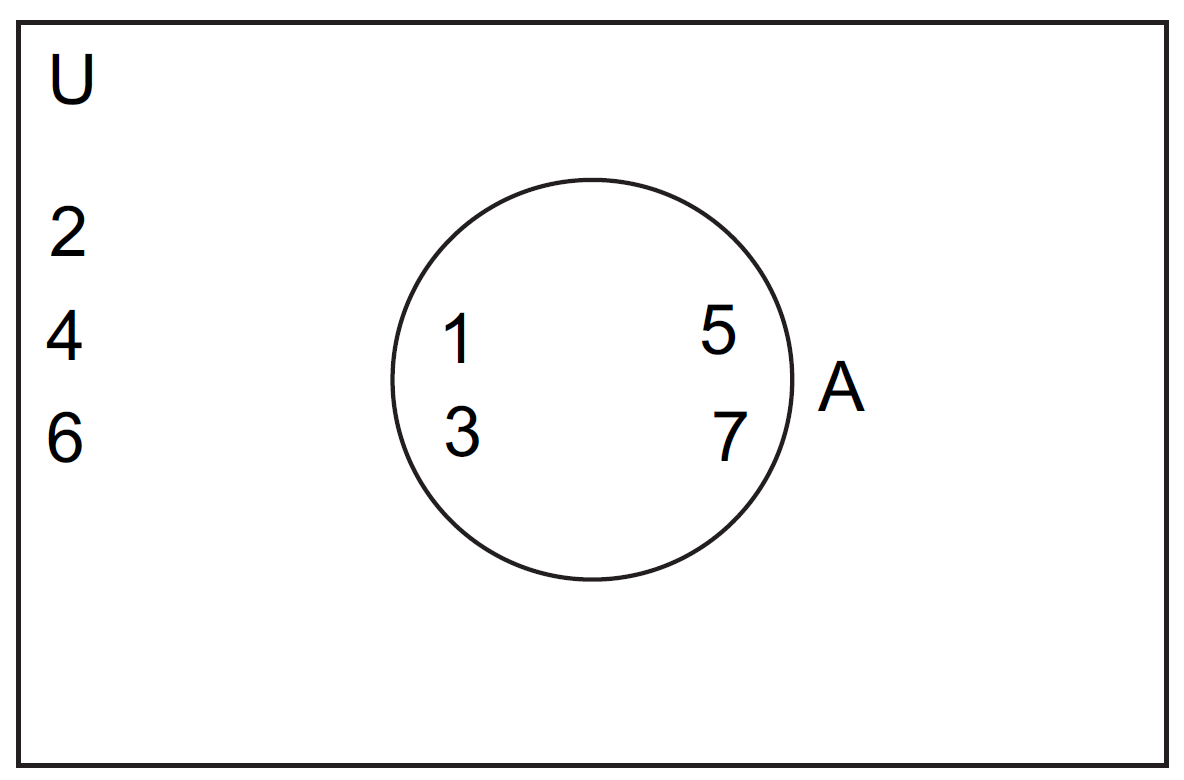
When the universal set and its subset are given
Let $U$ be the universal set and let $A \subseteq U$.
We draw a circle inside a rectangle.
The rectangular region represents $U$ and the circular region represents $A$.
EXAMPLE
Let $U=\{1,2,3,4,5,6,7\}$ and
$A=\{1,3,5,7\}$.
Then, we draw the Venn diagram, as shown in the given figure.
Clearly, $A’=\{2,4,6\}$.
CASE 2
When two intersecting subsets of U are given
For representing two intersecting subsets $A$ and $B$ of $U$, we draw two intersecting circles within the rectangle.
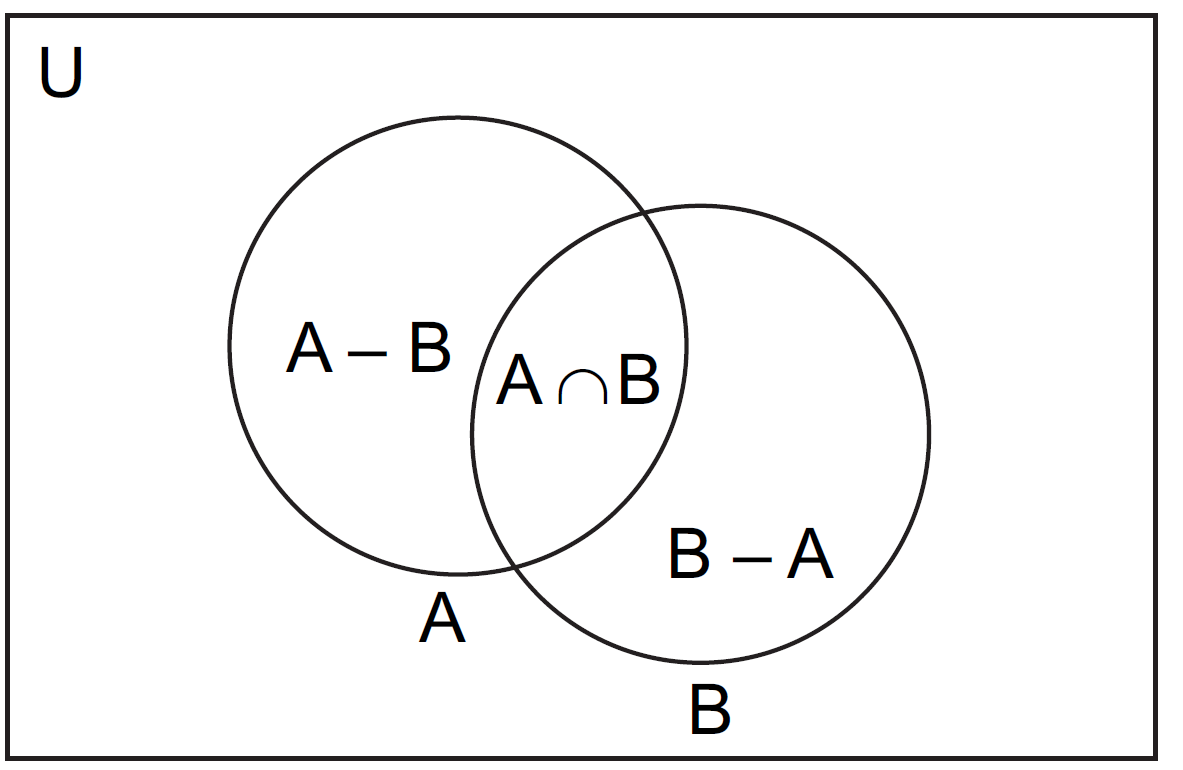
The common region of these circles represents $A \cap B$.
Excluding the region of $B$ from that of $A$ shows $(A-B)$.
Excluding the region of $A$ from that of $B$ shows $(B-A)$.
EXAMPLE
Let $U=\{1,2,3,4,5,6,7,8\}$ be the universal set, and let
$A=\{1,3,4,5\}$ and $B=\{2,4,5,6\}$ be its subsets.
Then, $A \cap B=\{4,5\}$.
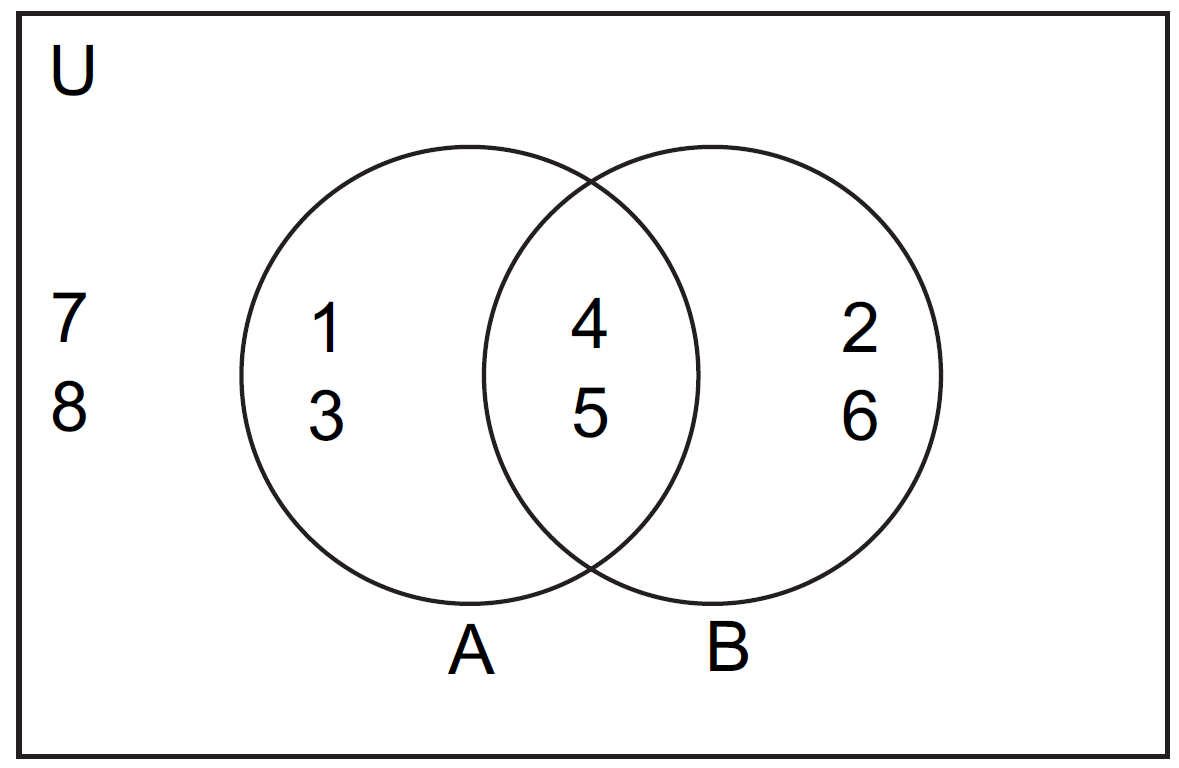
We draw the Venn diagram, as shown in the given figure.
Clearly, $(A-B)=\{1,3\}$ and $(B-A)=\{2,6\}$.
CASE 3
When two disjoint subsets of a set be given
In order to represent two disjoint subsets $A$ and $B$ of the universal set $U$, we draw two disjoint circles within a rectangle.
EXAMPLE
Let $U=\{1,2,3,4,5,6,7\}$ be the universal set, and let $A=\{1,3,5\}$ and $B=\{2,4\}$ be two of its disjoint subsets.
Clearly, $A \cap B=\phi$.
So, we may draw the Venn diagram, as shown in the adjoining figure.
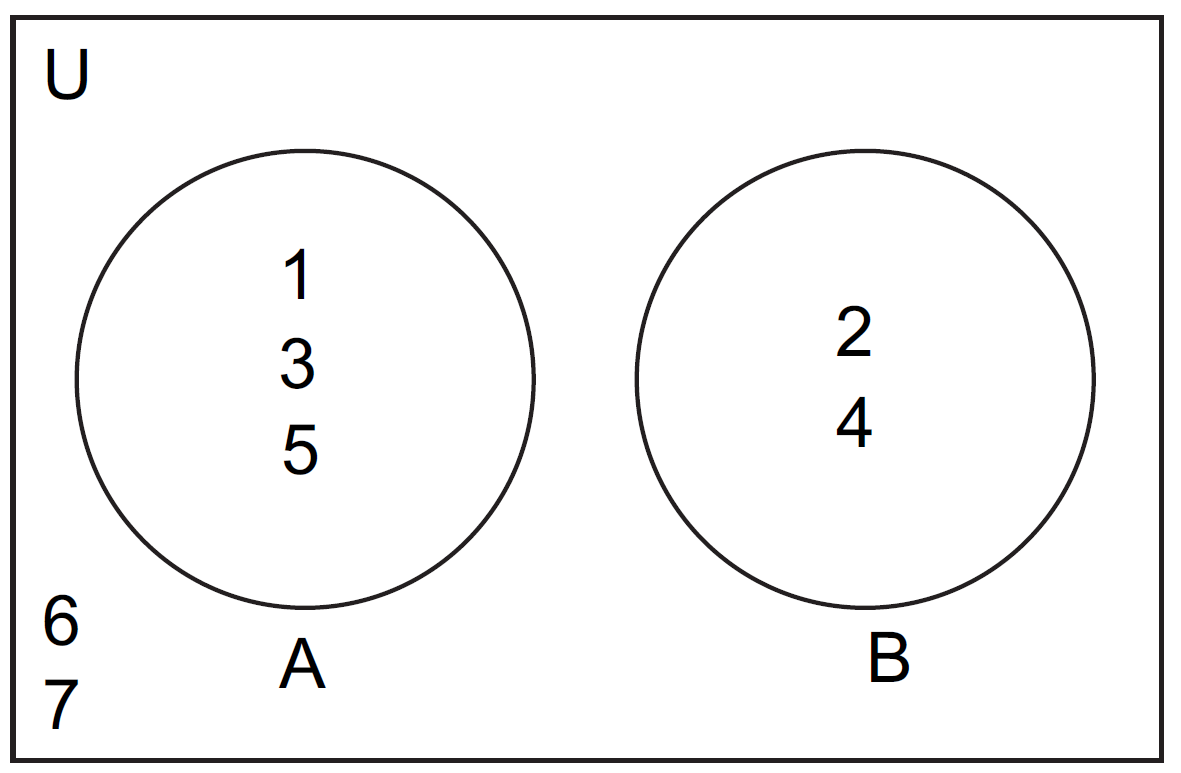
Clearly, $A \cup B=\{1,2,3,4,5\}$, $(A-B)=\{1,3,5\}$ and
$(B-A)=\{2,4\}$.
$A’=\{2,4,6,7\}$ and $B’=\{1,3,5,6,7\}$.
CASE 4
When $B \subseteq A \subseteq U$
In this case, we draw two concentric circles within a rectangular region.
The inner circle represents $B$ and the outer circle represents $A$.
EXAMPLE
Let $U=\{1,2,3,4,5,6,7,8\}$ be the universal set, and let $A=\{1,3,5,7\}$ and $B=\{3,7\}$ be its subsets.
Then, clearly $B \subseteq A$.
Now, we may draw the Venn diagram, as shown in the given figure.
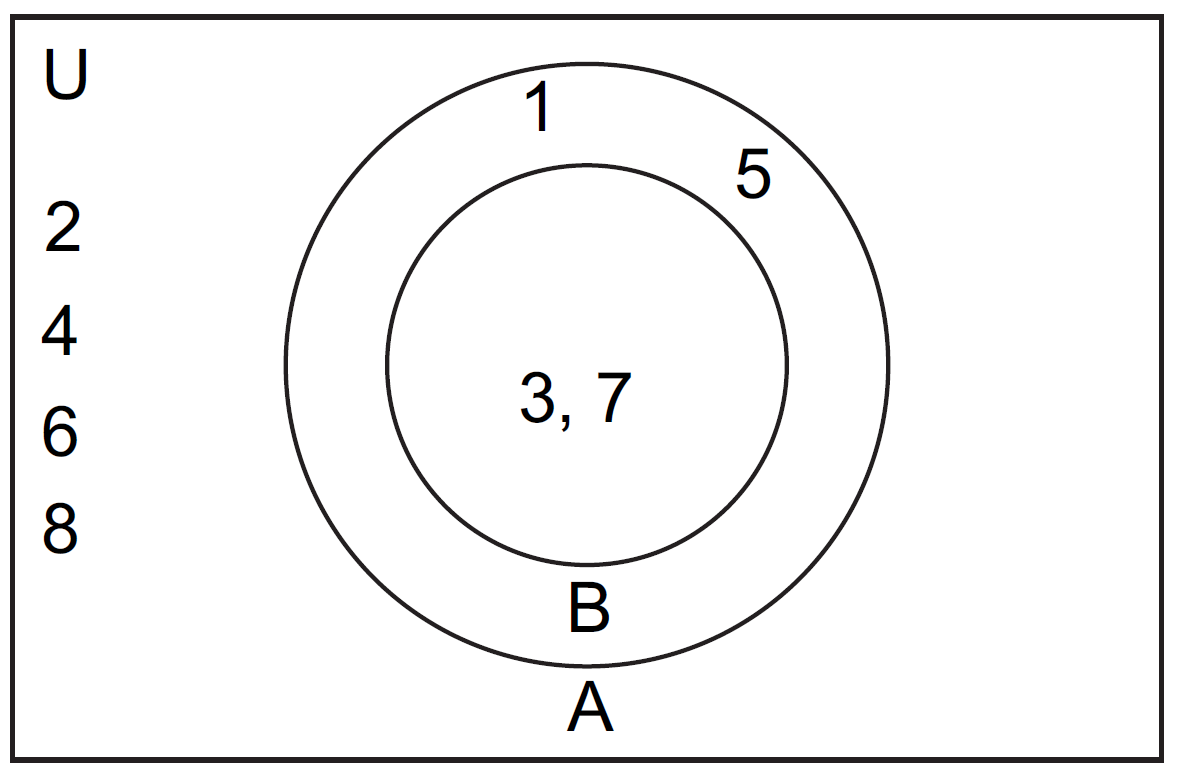
$A \cap B=\{3,7\}$, $A \cup B=\{1,3,5,7\}$,
$(A-B)=\{1,5\}$, $(B-A)=\phi$.
$A’=\{2,4,6,8\}$ and $B’=\{1,2,4,5,6,8\}$.
IMPORTANT RESULTS FROM VENN DIAGRAMS
Let $A$ and $B$ be two intersecting subsets of $U$.
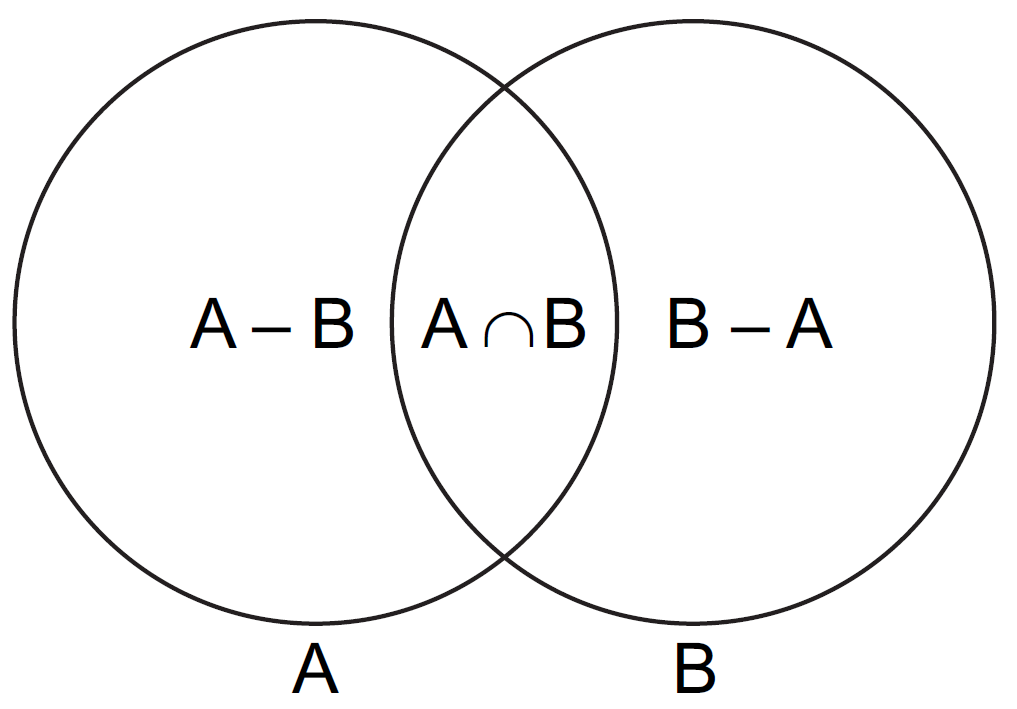
In counting the elements of $(A \cup B)$, the elements of $A \cap B$ are counted twice, once in counting the elements of $A$ and second time in counting the elements of $B$. Therefore,
$$n(A \cup B)=n(A)+n(B)-n(A \cap B).$$
If $A \cap B=\phi$, then $n(A \cap B)=0$ and therefore, in this case, we have
$$n(A \cup B)=n(A)+n(B).$$
From the Venn diagram, it is also clear that
(i) $n(A-B)+n(A \cap B)=n(A)$
(ii) $n(B-A)+n(A \cap B)=n(B)$
(iii) $n(A-B)+n(A \cap B)+n(B-A)=n(A \cup B)$.
SOME RESULTS DERIVED FROM VENN DIAGRAMS
RESULT 1
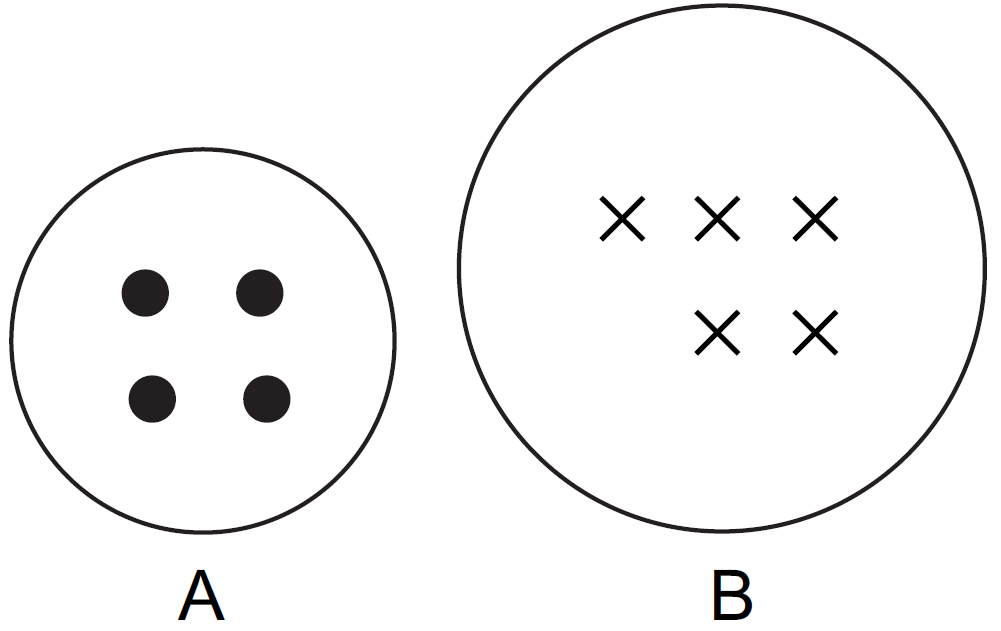
When $A$ and $B$ are disjoint sets, then we have
$$n(A \cup B)=n(A)+n(B).$$
RESULT 2
For any sets $A$ and $B$, prove that
$$n(A \cup B)=n(A)+n(B)-n(A \cap B).$$
PROOF
From the given Venn diagram, it is clear that the sets $(A-B)$, $(A \cap B)$ and $(B-A)$ are disjoint and their union is $(A \cup B)$.
Therefore,
$$n(A \cup B)=n(A-B)+n(A \cap B)+n(B-A)$$
$$n(A \cup B)=[n(A)-n(A \cap B)]+n(A \cap B)+[n(B)-n(A \cap B)]$$
$$n(A \cup B)=n(A)+n(B)-n(A \cap B).$$
Corollary 1 Prove that $n(A-B)+n(A \cap B)=n(A)$.
Corollary 2 Prove that $n(B-A)+n(A \cap B)=n(B)$.
RESULT 3
For any sets $A$, $B$, $C$ prove that
$n(A \cup B \cup C)=n(A)+n(B)+n(C)-n(A \cap B)-n(B \cap C)-n(A \cap C)+n(A \cap B \cap C).$
PROOF
We have
$n(A \cup B \cup C)=n[(A \cup B) \cup C]$
$=n(A \cup B)+n(C)-n[(A \cup B) \cap C]$
$=[n(A)+n(B)-n(A \cap B)]+n(C)-n[(A \cap C) \cup (B \cap C)]$
$=n(A)+n(B)+n(C)-n(A \cap B)-n(A \cap C)-n(B \cap C)+n(A \cap B \cap C).$
$=n(A) + n(B) + n(C) – n(A \cap B) – n(A \cap C) – n(B \cap C) + n(A \cap B \cap C)$
Hence,
$ n(A \cup B \cup C)=\{ n(A) + n(B) + n(C) + n(A \cap B \cap C) \}-\{ n(A \cap B) + n(B \cap C) + n(A \cap C) \}.$
Hence, the result follows.
SUMMARY
For any sets $A$, $B$, $C$ we have:
(i) $$n(A \cup B) = n(A) + n(B) – n(A \cap B).$$
(ii) If $A \cap B = \phi$, then $$n(A \cup B) = n(A) + n(B).$$
(iii) $$n(A – B) + n(A \cap B) = n(A).$$
(iv) $$n(B – A) + n(A \cap B) = n(B).$$
(v) $$n(A \cup B \cup C) = n(A) + n(B) + n(C) – n(A \cap B) – n(B \cap C) – n(A \cap C) + n(A \cap B \cap C).$$
SOLVED EXAMPLES BASED ON VENN DIAGRAMS
EXAMPLE 1 If $A$ and $B$ are two sets such that $n(A) = 27$, $n(B) = 35$ and $n(A \cup B) = 50$, find $n(A \cap B)$.
SOLUTION
We know that
$$n(A \cup B) = n(A) + n(B) – n(A \cap B).$$
$$n(A \cap B) = n(A) + n(B) – n(A \cup B) = (27 + 35 – 50) = 12.$$
Hence, $n(A \cap B) = 12$.
EXAMPLE 2 If $A$ and $B$ are two sets containing 3 and 6 elements respectively, what can be the maximum number of elements in $A \cup B$?
Find also the minimum number of elements in $A \cup B$.
SOLUTION
We know that
$n(A \cup B) = n(A) + n(B) – n(A \cap B).$ … (i)
CASE 1
From (i), it is clear that $n(A \cup B)$ will be maximum when $n(A \cap B) = 0$.
In that case,
$$n(A \cup B) = n(A) + n(B) = 3 + 6 = 9.$$
$\therefore$ maximum number of elements in $(A \cup B) = 9$.
CASE 2
From (i), it is clear that $n(A \cup B)$ will be minimum when $n(A \cap B)$ is maximum, i.e., when $n(A \cap B) = 3$.
In this case,
$$n(A \cup B) = n(A) + n(B) – n(A \cap B) = 3 + 6 – 3 = 6.$$
$\therefore$ minimum number of elements in $A \cup B = 6$.
EXAMPLE 3 A survey shows that 73% of the Indians like apples, whereas 65% like oranges. What percentage of Indians like both apples and oranges?
SOLUTION
Let $A =$ set of Indians who like apples
and $B =$ set of Indians who like oranges.
Then, $n(A) = 73$, $n(B) = 65$ and $n(A \cup B) = 100$.
$$n(A \cap B) = n(A) + n(B) – n(A \cup B) = 73 + 65 – 100 = 38.$$
Hence, 38% of the Indians like both apples and oranges.
EXAMPLE 4 In a survey of 425 students in a school, it was found that 115 drink apple juice, 160 drink orange juice and 80 drink both apple as well as orange juice. How many drink neither apple juice nor orange juice?
SOLUTION
Let $U =$ set of all students surveyed;
$A =$ set of all students who drink apple juice
and $B =$ set of all students who drink orange juice.
Then, $n(U) = 425$, $n(A) = 115$, $n(B) = 160$ and $n(A \cap B) = 80$.
$$n(A \cup B) = n(A) + n(B) – n(A \cap B) = 115 + 160 – 80 = 195.$$
Set of students who drink neither apple juice nor orange juice
$$= (A \cup B)’ = U – (A \cup B)$$
$$(A \cup B)’= n(U) – n(A \cup B) = 425 – 195 = 230.$$
Hence, 230 students drink neither apple juice nor orange juice.
EXAMPLE 5 In a group of 850 persons, 600 can speak Hindi and 340 can speak Tamil. Find
(i) how many can speak both Hindi and Tamil,
(ii) how many can speak Hindi only,
(iii) how many can speak Tamil only.
SOLUTION
Let $A =$ set of persons who can speak Hindi
and $B =$ set of persons who can speak Tamil.
$\therefore$ $n(A) = 600$, $n(B) = 340$ and $n(A \cup B) = 850$.
(i) Set of persons who can speak both Hindi and Tamil $= (A \cap B)$.
Now,
$$n(A \cap B) = n(A) + n(B) – n(A \cup B)$$
$$n(A \cap B) = 600 + 340 – 850 = 90.$$
Thus, 90 persons can speak both Hindi and Tamil.
(ii) Set of persons who can speak Hindi only $= (A – B)$.
Now,
$$n(A – B) + n(A \cap B) = n(A)$$
$$n(A – B) = n(A) – n(A \cap B)$$
$$n(A – B) = 600 – 90 = 510.$$
Thus, 510 persons can speak Hindi only.
(iii) Set of persons who can speak Tamil only $= (B – A)$.
Now,
$$n(B – A) = n(B) – n(A \cap B)$$
$$n(B – A) = 340 – 90 = 250.$$
Hence, 250 persons can speak Tamil only.
EXAMPLE 6 A market research group conducted a survey of 1000 consumers and reported that 745 consumers like product A and 430 consumers like product B. What is the least number that must have liked both products?
SOLUTION
Let $P$ and $Q$ be the sets of consumers who like product A and product B respectively.
Then, $n(P) = 745$ and $n(Q) = 430$.
Now,
$$n(P \cup Q) = n(P) + n(Q) – n(P \cap Q)$$
$$n(P \cap Q) = n(P) + n(Q) – n(P \cup Q)$$
$$n(P \cap Q) = 745 + 430 – n(P \cup Q).$$
Clearly, $n(P \cap Q)$ is least when $n(P \cup Q)$ is maximum and therefore,
$n(P \cup Q) = 1000$.
So,
$$n(P \cap Q) = 745 + 430 – 1000 = 175.$$
Hence, the least number of consumers liking both the products is 175.
EXAMPLE 7 Out of 600 car owners investigated, 500 owned car A; 200 owned car B and 50 owned both A and B cars. Verify whether the given data is correct or not.
SOLUTION
Let $P$ and $Q$ be the sets of those who own car A and car B respectively. Then,
$n(P) = 500$, $n(Q) = 200$ and $n(P \cap Q) = 50$.
Now,
$$n(P \cup Q) = n(P) + n(Q) – n(P \cap Q)$$
$$n(P \cup Q) = 500 + 200 – 50 = 650.$$
This is a contradiction, since the maximum value of $n(P \cup Q)$ is 600.
Hence, the given data is incorrect.
EXAMPLE 8 In a group of 52 persons, 16 drink tea but not coffee and 33 drink tea. Find
(i) how many drink tea and coffee both;
(ii) how many drink coffee but not tea.
SOLUTION
Let $A =$ set of persons who drink tea
and $B =$ set of persons who drink coffee.
Then, $(A – B) =$ set of persons who drink tea but not coffee.
And, $(B – A) =$ set of persons who drink coffee but not tea.
Given: $n(A – B) = 16$, $n(A) = 33$ and total number of persons $= 52$.
(i) Set of persons who drink tea and coffee both $= (A \cap B)$.
Now,
$$n(A – B) + n(A \cap B) = n(A)$$
$$n(A \cap B) = n(A) – n(A – B)$$
$$n(A \cap B) = 33 – 16 = 17.$$
Thus, 17 persons drink tea and coffee both.
(ii) Set of persons who drink coffee but not tea = $n(B – A)$
$$n(A \cup B) = n(A) + n(B) – n(A \cap B)$$
$$n(B) = n(A \cup B) + n(A \cap B) – n(A)$$
$$n(B) = 52 + 17 – 33 = 36.$$
Now,
$$n(B – A) = n(B) – n(A \cap B)$$
$$n(B – A) = 36 – 17 = 19.$$
Thus, number of persons who drink coffee but not tea $= 19$.
EXAMPLE 9 A school awarded 58 medals in three sports, namely 38 in football; 15 in basketball and 20 in cricket. If 3 students got medals in all the three sports, how many received medals in exactly two sports?
SOLUTION
Let $A$, $B$ and $C$ denote the sets of students who won medals in football, basketball and cricket respectively.
Then, $n(A) = 38$, $n(B) = 15$, $n(C) = 20$, $n(A \cap B \cap C) = 3$
and $n(A \cup B \cup C) = 58$.
Set of students who received medals in exactly two sports = $n(A \cap B) + n(B \cap C) + n(A \cap C)$
We know that
$n(A \cup B \cup C) = n(A) + n(B) + n(C) – n(A \cap B) – n(B \cap C) – n(A \cap C) + n(A \cap B \cap C).$
$n(A \cap B) + n(B \cap C) + n(A \cap C) = n(A) + n(B) + n(C) + n(A \cap B \cap C) – n(A \cup B \cup C)$
$n(A \cap B) + n(B \cap C) + n(A \cap C) = (38 + 15 + 20 + 3) – 58 = 76 – 58 = 18.$
Let $a$, $b$, $c$ and $d$ denote respectively the number of students who won medals in football and basketball both; basketball and cricket both; football and cricket both and all the 3 sports.
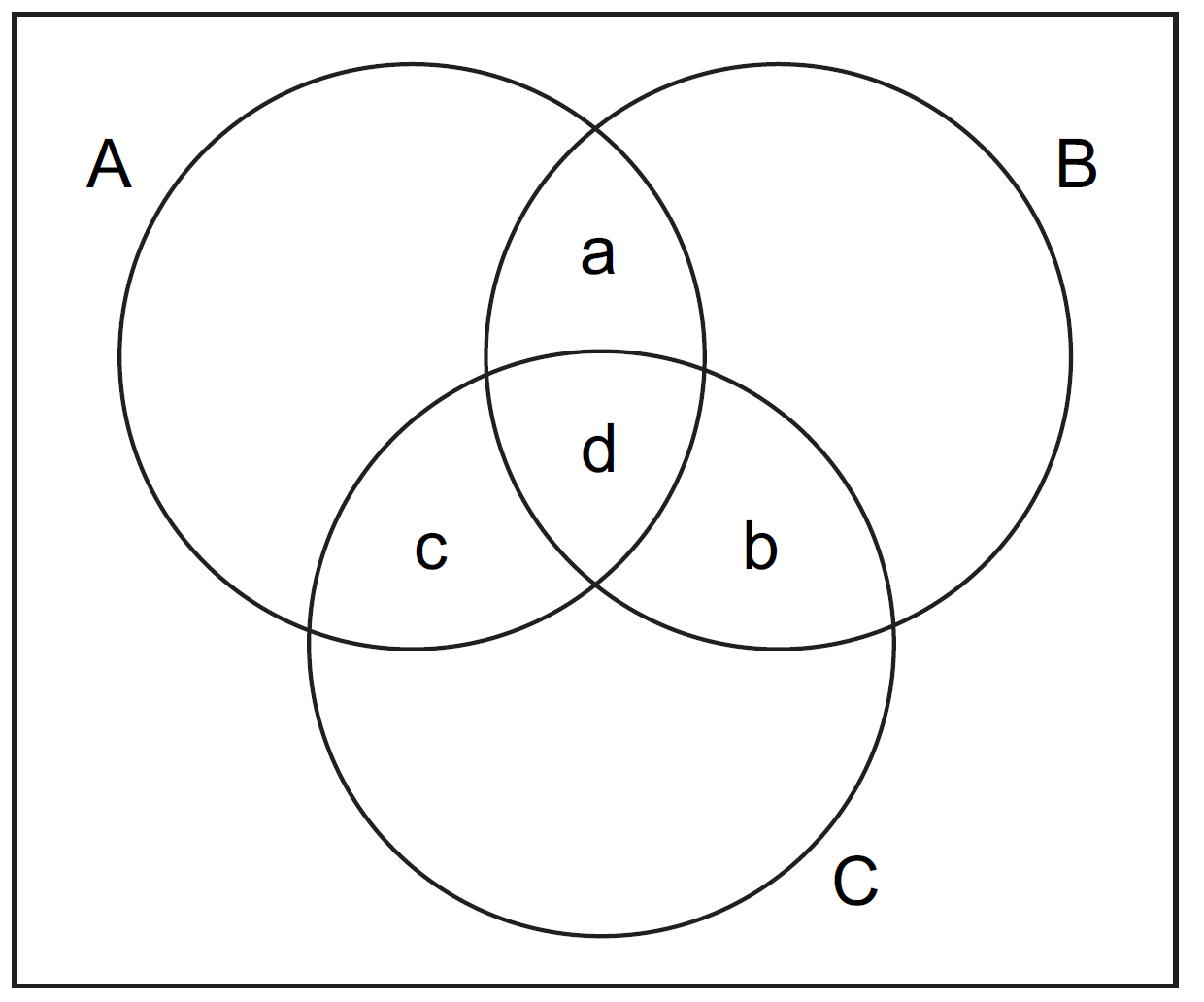
Then,
$$n(A \cap B) + n(B \cap C) + n(A \cap C) = 18$$
$$ (a + d) + (b + d) + (c + d) = 18$$
$$a + b + c + 3d = 18$$
$$a + b + c + 3 \times 3 = 18 \quad [\because d = 3]$$
$$a + b + c = 9.$$
Hence, 9 students received medals in exactly two sports.
EXAMPLE 10 In a survey it is found that 21 people like product A, 26 people like product B and 29 like product C. If 14 people like products A and B; 15 people like products B and C; 12 people like products C and A; and 8 people like all the three products, find
(i) how many people are surveyed in all;
(ii) how many like product C only.
SOLUTION
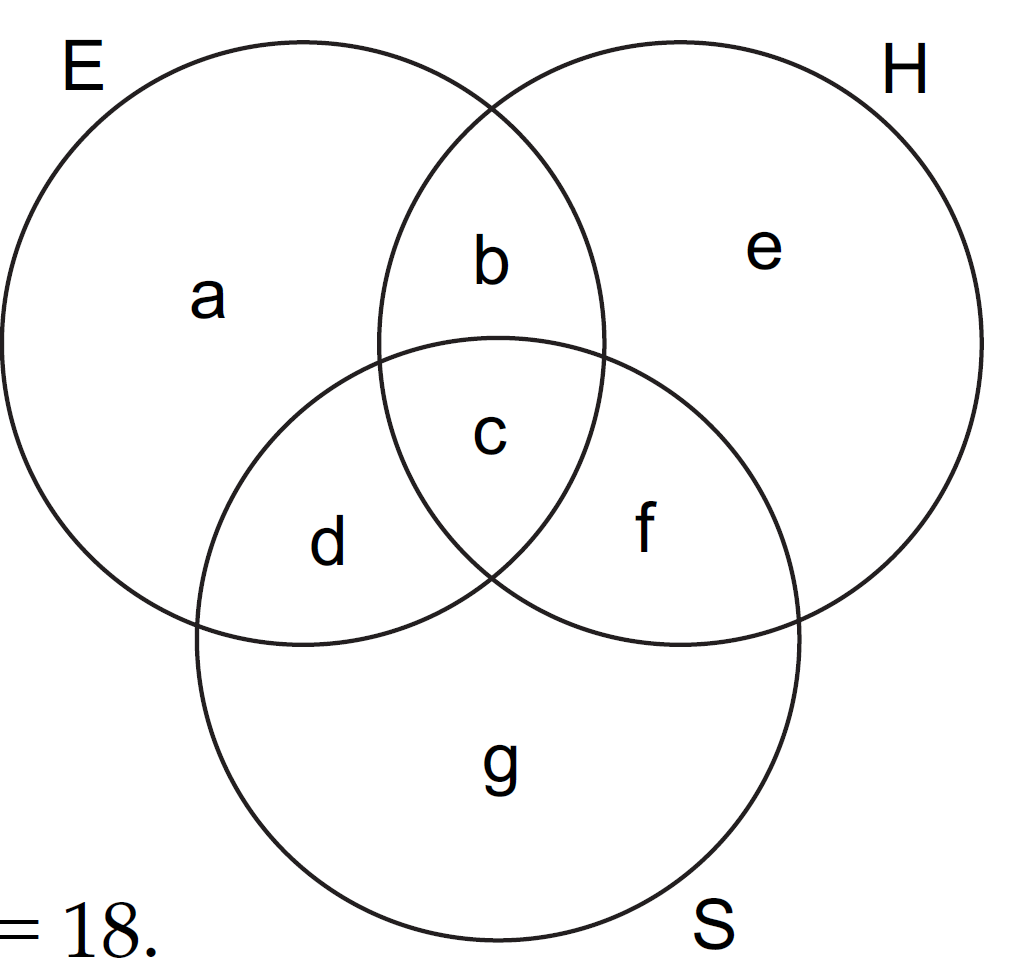
Let $A$, $B$, $C$ denote respectively the sets of people who like product A, B and C respectively, as shown in the given figure.
Let us denote the number of elements contained in bounded regions by $a$, $b$, $c$, $d$, $e$, $f$, $g$ as shown in the given figure.
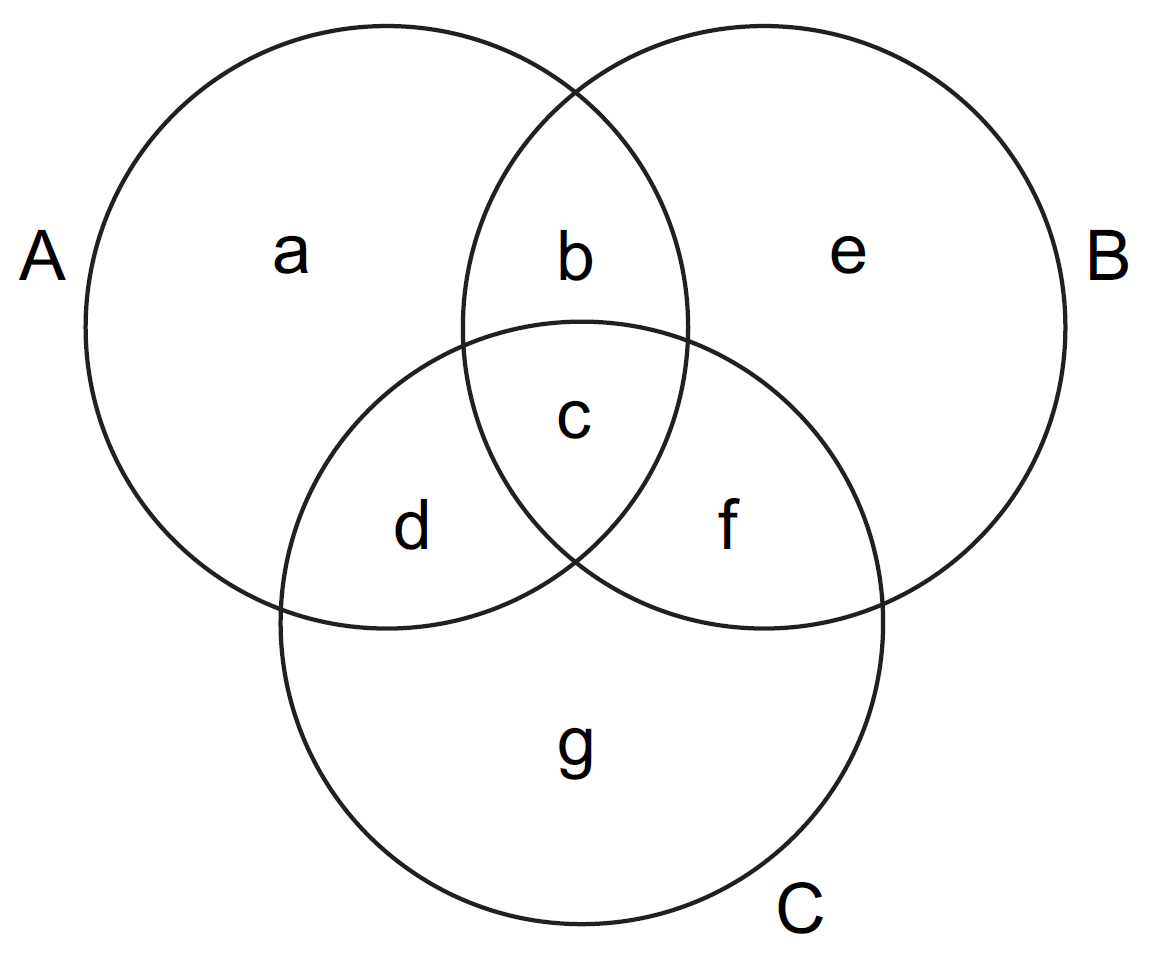
Then, we have
$a + b + c + d = 21,$
$b + c + e + f = 26,$
$c + d + f + g = 29,$
$b + c = 14,\ c + f = 15,\ c + d = 12$
and $c = 8.$
On solving these equations, we get
$$c = 8,\ d = 4,\ f = 7,\ b = 6,\ g = 10,\ e = 5,\ a = 3.$$
(i) Total number of surveyed people = $(a + b + c + d + e + f + g) = 43.$
(ii) Number of persons who like product C only = $g = 10.$
EXAMPLE 11 In a survey of 25 students, it was found that 12 have taken physics, 11 have taken chemistry and 15 have taken mathematics; 4 have taken physics and chemistry; 9 have taken physics and mathematics; 5 have taken chemistry and mathematics while 3 have taken all the three subjects. Find the number of students who have taken
(i) physics only;
(ii) chemistry only;
(iii) mathematics only;
(iv) physics and chemistry but not mathematics;
(v) physics and mathematics but not chemistry;
(vi) only one of the subjects;
(vii) at least one of the three subjects;
(viii) none of the three subjects.
SOLUTION
Let $P$, $C$ and $M$ be the sets of students who have taken physics, chemistry and mathematics respectively.
Let $a$, $b$, $c$, $d$, $e$, $f$ and $g$ denote the number of students in the respective regions, as shown in the adjoining Venn diagram.
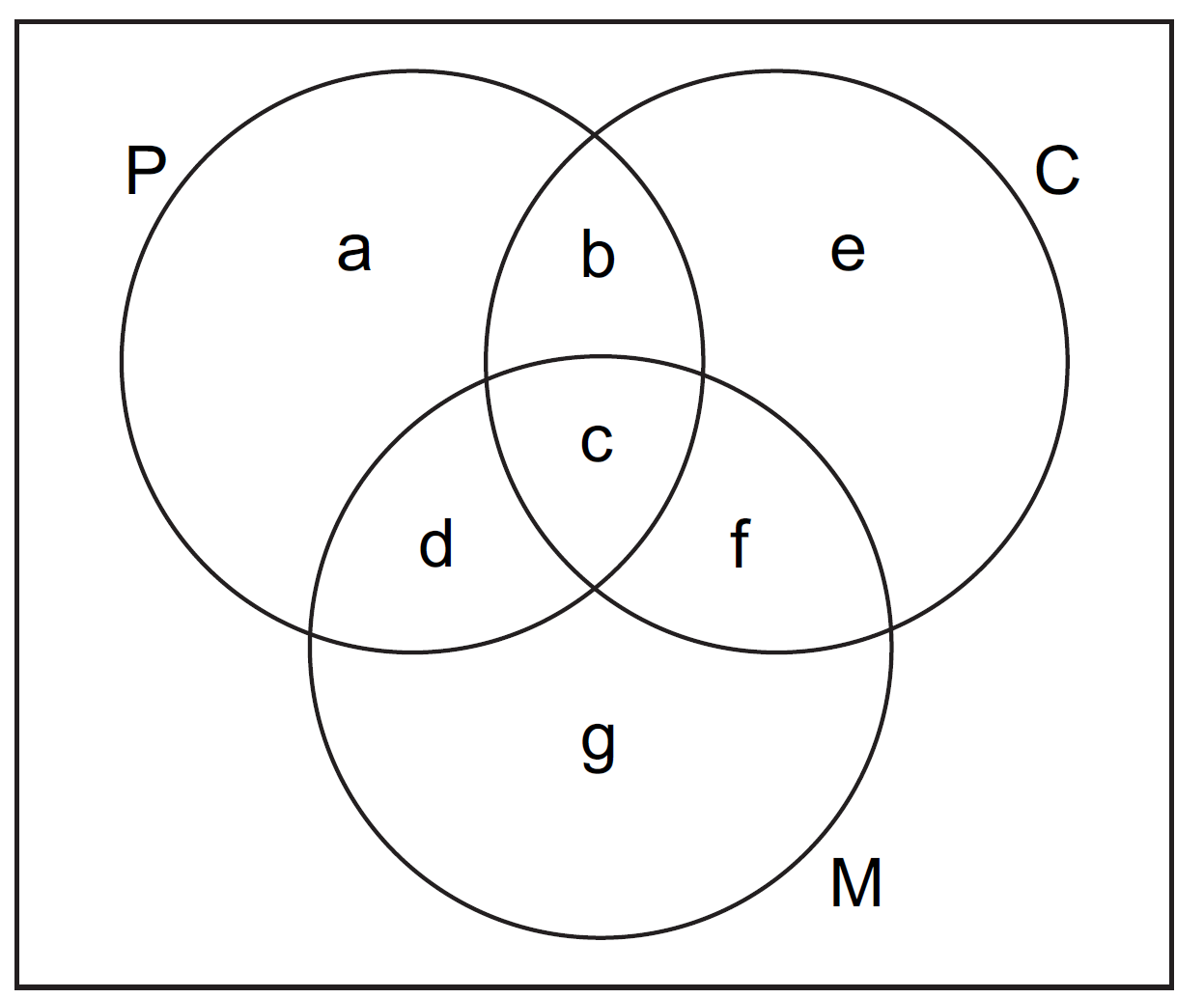
As per data given, we have
$a + b + c + d = 12,$
$b + c + e + f = 11,$
$c + d + f + g = 15,$
$b + c = 4,$
$c + d = 9,$
$c + f = 5,$
$c = 3.$
From these equations, we get
$$c = 3,\ f = 2,\ d = 6,\ b = 1.$$
Now,
$$c + d + f + g = 15 \Rightarrow 3 + 6 + 2 + g = 15 \Rightarrow g = 4;$$
$$b + c + e + f = 11 \Rightarrow 1 + 3 + e + 2 = 11 \Rightarrow e = 5;$$
$$a + b + c + d = 12 \Rightarrow a + 1 + 3 + 6 = 12 \Rightarrow a = 2.$$
So, we have:
$$a = 2,\ b = 1,\ c = 3,\ d = 6,\ e = 5,\ f = 2,\ g = 4.$$
(i) Number of students who offered physics only
$$a = 2.$$
(ii) Number of students who offered chemistry only
$$e = 5.$$
(iii) Number of students who offered mathematics only
$$g = 4.$$
(iv) Number of students who offered physics and chemistry but not mathematics
$$b = 1.$$
(v) Number of students who offered physics and mathematics but not chemistry
$$d = 6.$$
(vi) Number of students who offered only one of the given subjects
$$(a + e + g) = 2 + 5 + 4 = 11.$$
(vii) Number of students who offered at least one of the given subjects
$$(a + b + c + d + e + f + g) = 2 + 1 + 3 + 6 + 5 + 2 + 4 = 23.$$
(viii) Number of students who offered none of the three given subjects =$25 – 23 = 2.$
PRACTICE EXERCISE-1
1.
Let $A=\{a,b,c,e,f\}$, $B=\{c,d,e,g\}$ and $C=\{b,c,f,g\}$ be subsets of the set $U=\{a,b,c,d,e,f,g,h\}$.
Draw Venn diagrams to represent the following sets:
(i) $A \cap B$
(ii) $A \cup (B \cap C)$
(iii) $A-B$
(iv) $B-A$
(v) $(A \cup B)-C$
(vi) $(B-C) \cup (C-B)$
2.
Let $A=\{2,4,6,8,10\}$, $B=\{4,8,12,16\}$ and $C=\{6,12,18,24\}$.
Using Venn diagrams, verify that:
(i) $(A \cup B) \cup C=A \cup (B \cup C)$
(ii) $(A \cap B) \cap C=A \cap (B \cap C)$
3.
Let $A=\{a,e,i,o,u\}$, $B=\{a,d,e,o,v\}$ and $C=\{e,o,t,m\}$.
Using Venn diagrams, verify the following:
(i) $(A \cup B) \cup C=A \cup (B \cup C)$
(ii) $(A \cap B) \cup C=(A \cup C) \cap (B \cup C)$
4.
Let $A \subseteq B \subseteq U$. Exhibit it in a Venn diagram.
5.
Let $A=\{2,3,5,7,11,13\}$ and $B=\{5,7,9,11,15\}$ be subsets of $U=\{2,3,5,7,9,11,13,15\}$.
Using Venn diagrams, verify that:
(i) $(A \cup B)’=A’ \cap B’$
(ii) $(A \cap B)’=A’ \cup B’$
6.
Using Venn diagrams, show that $(A-B)$, $(A \cap B)$ and $(B-A)$ are disjoint sets, taking $A=\{2,4,6,8,10,12\}$ and $B=\{3,6,9,12,15\}$.
PRACTICE EXERCISE-2
- If $A$ and $B$ are two sets such that $n(A) = 37$, $n(B) = 26$ and $n(A \cup B) = 51$, find $n(A \cap B)$.
- If $P$ and $Q$ are two sets such that $n(P \cup Q) = 75$, $n(P \cap Q) = 17$ and $n(P) = 49$, find $n(Q)$.
- If $A$ and $B$ are two sets such that $n(A) = 24$, $n(B) = 22$ and $n(A \cap B) = 8$, find:
(i) $n(A \cup B)$
(ii) $n(A – B)$
(iii) $n(B – A)$ - If $A$ and $B$ are two sets such that $n(A – B) = 24$, $n(B – A) = 19$ and $n(A \cup B) = 11$, find:
(i) $n(A)$
(ii) $n(B)$
(iii) $n(A \cap B)$ - In a committee, 50 people speak Hindi, 20 speak English and 10 speak both Hindi and English. How many speak at least one of these two languages?
- In a group of 50 persons, 30 like tea, 25 like coffee and 16 like both. How many like
(i) either tea or coffee?
(ii) neither tea nor coffee? - There are 200 individuals with a skin disorder, 120 had been exposed to the chemical $C_1$, 50 to chemical $C_2$ and 30 to both the chemicals $C_1$ and $C_2$. Find the number of individuals exposed to
(i) chemical $C_1$ but not chemical $C_2$
(ii) chemical $C_2$ but not chemical $C_1$
(iii) chemical $C_1$ or chemical $C_2$ - In a class of a certain school, 50 students offered mathematics, 42 offered biology and 24 offered both the subjects. Find the number of students offering
(i) mathematics only,
(ii) biology only,
(iii) any of the two subjects. - In an examination, 56% of the candidates failed in English and 48% failed in science. If 18% failed in both English and science, find the percentage of those who passed in both the subjects.
- In a group of 65 people, 40 like cricket and 10 like both cricket and tennis. How many like tennis only and not cricket? How many like tennis?
- A school awarded 42 medals in hockey, 18 in basketball and 23 in cricket. If these medals were bagged by a total of 65 students and only 4 students got medals in all the three sports, how many students received medals in exactly two of the three sports?
- In a survey of 60 people, it was found that 25 people read newspaper $H$, 26 read newspaper $T$, 26 read newspaper $I$, 9 read both $H$ and $I$, 11 read both $H$ and $T$, 8 read both $T$ and $I$, and 3 read all the three newspapers. Find
(i) the number of people who read at least one of the newspapers,
(ii) the number of people who read exactly one newspaper. - In a survey of 100 students, the number of students studying the various languages is found as: English only 18; English but not Hindi 23; English and Sanskrit 8; Sanskrit and Hindi 8; English 26; Sanskrit 48 and no language 24. Find
(i) how many students are studying Hindi,
(ii) how many students are studying English and Hindi both. - In a town of 10,000 families, it was found that 40% of the families buy newspaper $A$, 20% buy newspaper $B$, 10% buy newspaper $C$, 5% buy $A$ and $B$; 3% buy $B$ and $C$ and 4% buy $A$ and $C$. If 2% buy all the three newspapers, find the number of families which buy
(i) $A$ only,
(ii) $B$ only,
(iii) none of $A$, $B$ and $C$. - A class has 175 students. The following description gives the number of students studying one or more of the subjects in this class: mathematics 100, physics 70, chemistry 46; mathematics and physics 30; mathematics and chemistry 28; physics and chemistry 23; mathematics, physics and chemistry 18. Find
(i) how many students are enrolled in mathematics alone, physics alone and chemistry alone,
(ii) the number of students who have not offered any of these subjects.
ANSWERS (EXERCISE)
- 12
- 43
- (i) 38 (ii) 16 (iii) 14
- (i) 35 (ii) 30 (iii) 54
- 60
- (i) 39 (ii) 11
- (i) 90 (ii) 20 (iii) 140
- (i) 26 (ii) 18 (iii) 68
- 14%
- 25, 35
- 22
- (i) 52 (ii) 30
- (i) 18 (ii) 3
- (i) 3300 (ii) 1400 (iii) 4000
- (i) 60, 35, 13 (ii) 32
HINTS TO SOME SELECTED QUESTIONS
- $$n(A \cap B) = n(A) + n(B) – n(A \cup B).$$
- $$n(P \cup Q) = n(P) + n(Q) – n(P \cap Q).$$
- (i) $$n(A \cup B) = n(A) + n(B) – n(A \cap B).$$
(ii) $$n(A – B) + n(A \cap B) = n(A).$$
(iii) $$n(B – A) + n(A \cap B) = n(B).$$ - (i) $$n(A – B) + n(A \cap B) = n(A)$$
$\Rightarrow$ $$n(A) = n(A – B) + n(A \cap B)$$
$\Rightarrow$ $$n(A) = 24 + 11 = 35.$$
(ii) $$n(B – A) + n(A \cap B) = n(B)$$
$\Rightarrow$ $$n(B) = 19 + 11 = 30.$$
(iii) $$n(A \cap B) = n(A) + n(B) – n(A \cup B).$$
- $$n(A \cup B) = n(A) + n(B) – n(A \cap B) = (50 + 20 – 10) = 60.$$
- $n(A) = 30$, $n(B) = 25$ and $n(A \cap B) = 16$.
(i) $$n(A \cup B) = n(A) + n(B) – n(A \cap B) = 39.$$
(ii) $$n(A’ \cap B’) = n[(A \cup B)’] = n(U) – n(A \cup B) = (50 – 39) = 11.$$ - $n(U) = 200$, $n(C_1) = 120$, $n(C_2) = 50$ and $n(C_1 \cap C_2) = 30$.
(i) $$n(C_1 – C_2) = n(C_1) – n(C_1 \cap C_2) = (120 – 30) = 90.$$
(ii) $$n(C_2 – C_1) = n(C_2) – n(C_1 \cap C_2) = (50 – 30) = 20.$$
(iii) $$n(C_1 \cup C_2) = n(C_1) + n(C_2) – n(C_1 \cap C_2) = (120 + 50 – 30) = 140.$$ - $n(A) = 50$, $n(B) = 42$ and $n(A \cap B) = 24$.
(i) $$n(A – B) = n(A) – n(A \cap B) = (50 – 24) = 26.$$
(ii) $$n(B – A) = n(B) – n(A \cap B) = (42 – 24) = 18.$$
(iii) $$n(A \cup B) = n(A) + n(B) – n(A \cap B) = (50 + 42 – 24) = 68.$$ - Failed in English only
$$= (56 – 18) = 38.$$
Failed in science only
$$= (48 – 18) = 30.$$
Failed in both English and science $= 18$.
Failed in one or both of the subjects
$$= (38 + 30 + 18) = 86.$$
Passed in both the subjects
$$= (100 – 86) = 14.$$
10. Let $A =$ set of people who like cricket.
$B =$ set of people who like tennis.
$n(A) = 40$, $n(A \cap B) = 10$.
$$n(A – B) = (40 – 10) = 30.$$
$$n(B – A) = 65 – (30 + 10) = 25.$$
Number of people who like tennis only $= 25$.
Number of people who like tennis
$$= (25 + 10) = 35.$$
11. Let $A$, $B$, $C$ denote the sets of students who bagged medals in hockey, basketball and cricket respectively.
Then, $n(A) = 42$, $n(B) = 18$, $n(C) = 23$, $n(A \cup B \cup C) = 65$ and $n(A \cap B \cap C) = 4$.
Then,
$$n(A \cup B \cup C) = {n(A) + n(B) + n(C) – n(A \cap B \cap C)} – {n(A \cap B) + n(B \cap C) + n(A \cap C)}$$
$$\Rightarrow 65 = (42 + 18 + 23 – 4) – x \quad \Rightarrow x = (87 – 65) = 22.$$
12.
$$a + b + c + d = 25,\ b + c + e + f = 26,\ c + d + f + g = 26,$$
and
$$c + d = 9,\ b + c = 11,\ c + f = 8,\ c = 3.$$
$\Rightarrow$ $f = 5,\ b = 8,\ d = 6,\ c = 3,\ g = 12,\ e = 10$ and $a = 8$.
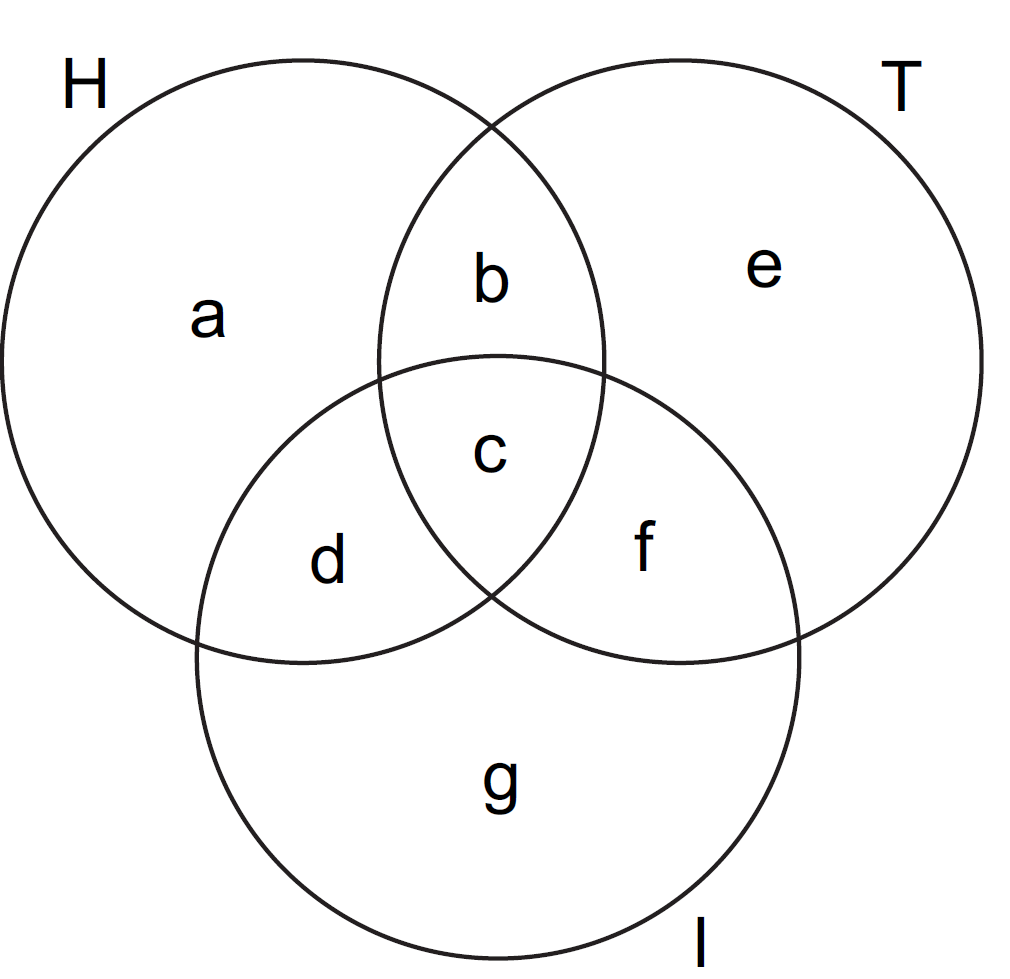
(i) Number of people who read at least one of the papers
$$(a + b + c + d + e + f + g) = 52.$$
(ii) Number of people who read exactly one newspaper
$$(a + e + g) = (8 + 10 + 12) = 30.$$
13. We have
$$a + b + c + d = 18,\ a + d = 23,\ c + d = 8,\ c + f = 8,$$
$$a + b + c + d + e + f + g = 26,\ c + d + f + g = 48$$
and
$$a + b + c + d + e + f + g + \text{(no language)} = 100,\ \text{no language} = 24.$$
$\Rightarrow$ $a = 18,\ d = 5,\ c = 3,\ f = 5$ and $b = 0$.
$g = 48 – (3 + 5 + 5) = 35$
and
$e = 76 – (18 + 5 + 3 + 5 + 35) = 76 – 66 = 10.$
(i) Number of students studying Hindi
$$(b + c + e + f) = (0 + 3 + 10 + 5) = 18.$$
(ii) Number of students studying English and Hindi both
$$(b + c) = (0 + 3) = 3.$$
14. $n(A) = (40\% \text{ of } 10000) = 4000,$
$n(B) = (20\% \text{ of } 10000) = 2000,$ $n(C) = (10\% \text{ of } 10000) = 1000,$
$n(A \cap B) = (5\% \text{ of } 10000) = 500,$ $n(B \cap C) = (3\% \text{ of } 10000) = 300,$
$n(A \cap C) = (4\% \text{ of } 10000) = 400,$ $n(A \cap B \cap C) = (2\% \text{ of } 10000) = 200,$
and $n(U) = 10000.$
a + b + c + d = 4000
b + c + e + f = 2000
c + d + f + g = 1000
b + c = 500
c + f = 300
c + d = 400
c = 200
On solving these equations, we get
$c = 200,\ d = 200,\ f = 100,\ b = 300,\ g = 500,\ e = 1400,\ a = 3300.$
(i) $a = 3300,$
(ii) $e = 1400,$
(iii) $10000 – (3300 + 300 + 200 + 200 + 1400 + 100 + 500) = (10000 – 6000) = 4000.$
FAQs (Very Short Type Questions and Answers) Based on Venn Diagrams
What is a Venn diagram in sets?
A Venn diagram is a graphical representation of sets using circles, where each circle represents a set and overlaps show common elements.
How are Venn diagrams useful in set theory?
They help visualize relationships between sets and make it easier to understand operations like union, intersection, and complement.
What does the union look like in a Venn diagram?
The union includes all regions covered by both sets:
$$
A \cup B
$$
What does the intersection look like in a Venn diagram?
The intersection is the overlapping region common to both sets:
$$
A \cap B
$$
How is complement shown in a Venn diagram?
The complement of a set includes all areas inside the universal set but outside the given set:
$$
A’ = U – A
$$
Can Venn diagrams be used to prove set laws?
Yes, Venn diagrams are commonly used to visually verify laws such as commutative, associative, distributive, and De Morgan’s Laws.
What is the role of the universal set in Venn diagrams?
The universal set is represented by a rectangle that contains all the circles (sets) under consideration.
What are disjoint sets in a Venn diagram?
Disjoint sets are represented by non-overlapping circles, showing that they have no common elements.
Are Venn diagrams useful in exams?
Yes, they are very helpful for solving problems quickly and accurately, especially in competitive exams.
Can Venn diagrams represent more than two sets?
Yes, Venn diagrams can represent three or more sets, although they become more complex as the number of sets increases.
Important Chapter Links
Venn Diagrams of Sets is a key topic in Class 11 CBSE Mathematics that provides a visual method to understand and solve problems involving sets. In this section, you will learn how to represent sets and their relationships using diagrams, and apply them to set operations like union, intersection, difference, and complement. Venn diagrams are especially useful for verifying important set laws and theorems, including De Morgan’s Laws, through clear graphical proofs. This topic also includes a variety of solved examples, JEE Previous Year Questions (PYQs), MCQs, NCERT Solutions and practice problems to strengthen conceptual understanding and improve problem-solving skills for competitive exams like JEE, NDA, and IMUCET.
PRACTICE EXERCISE (Very-Short-Answer Questions)
- If a set $A$ has $n$ elements then find the number of elements in its power set $P(A)$.
- If $A = \phi$ then write $P(A)$.
- If $n(A) = 3$ and $n(B) = 5$, find:
(i) the maximum number of elements in $A \cup B$,
(ii) the minimum number of elements in $A \cup B$. - If $A$ and $B$ are two sets such that $n(A) = 8$, $n(B) = 11$ and $n(A \cup B) = 14$ then find $n(A \cap B)$.
- If $A$ and $B$ are two sets such that $n(A) = 23$, $n(B) = 37$ and $n(A – B) = 8$ then find $n(A \cup B)$.
Hint $$n(A) = n(A – B) + n(A \cap B) \Rightarrow n(A \cap B) = (23 – 8) = 15.$$ - If $A$ and $B$ are two sets such that $n(A) = 54$, $n(B) = 39$ and $n(B – A) = 13$ then find $n(A \cup B)$.
Hint $$n(B) = n(B – A) + n(A \cap B) \Rightarrow n(A \cap B) = (39 – 13) = 26.$$ - If $A \subseteq B$, prove that $B’ \subseteq A’$.
- If $A \subseteq B$, show that $(B’ – A’) = \phi$.
Hint $A \subseteq B \Rightarrow B’ \subseteq A’ \Rightarrow B’ – A’ = \phi$. - Let $A = {x : x = 6n, n \in N}$ and $B = {x : x = 9n, n \in N}$, find $A \cap B$.
- If $A = {5, 6, 7}$, find $P(A)$.
- If $A = {2, {2}}$, find $P(A)$.
- Prove that $(A \cap (A \cup B)’) = \phi$.
- Find the symmetric difference $A \Delta B$ when $A = {1, 2, 3}$ and $B = {3, 4, 5}$.
- Prove that $A – B = A \cap B’$.
- If $A = {x : x \in R, x < 5}$ and $B = {x : x \in R, x > 4}$, find $A \cap B$.
Hint $A = (-\infty, 5)$ and $B = (4, \infty)$. So $A \cap B = (4, 5)$.
ANSWERS (EXERCISE)
- $2^n$
- ${\phi}$
- (i) 8 (ii) 5
- 5
- 45
- 67
- $A \cap B = {x : x = 18n, n \in N}$
- $P(A) = {\phi, {5}, {6}, {7}, {5, 6}, {5, 7}, {6, 7}, {5, 6, 7}}$
- $P(A) = {\phi, {2}, {{2}}, {2, {2}}}$
13. ${1, 2, 4, 5}$
15. $(4, 5)$