Argand Diagram or Complex Plane is a fundamental topic in Complex Numbers and is frequently asked in Class 11 Mathematics, JEE Main, JEE Advanced, NDA, IMU CET, CUET, and other competitive examinations in India. It provides a geometrical representation of complex numbers and helps students visualize the real part, imaginary part, modulus, argument, polar form, and conjugate of a complex number. A clear understanding of the complex plane is essential for solving advanced problems in algebra and coordinate geometry. In this article, we will learn how to represent complex numbers on the Argand plane, interpret their geometric significance, and solve important examples and exam-oriented questions.
How to represent Complex Numbers on a Complex Plane ?
Every complex number x + iy can be represented in a plane exactly as a point P(x, y) is represented by its co-ordinates x, y.
x-coordinate represents the real part of the complex number and y-coordinate represents the imaginary part of a complex number.
Complex number x + 0 i (real number) is represented by a point (x, 0) on the x-axis, x + 0i is the real number and every real number is represented by a point on x-axis. As such x-axis is called the real axis.
Similarly, a complex number 0 + iy (imaginary number) is represented by a point on y-axis. All the imaginary numbers are represented as points on y-axis. Therefore, y-axis is called the imaginary axis
The complex number z = x + iy is represented geometrically in a plane by a point P (x, y) whose co-ordinates referred to two rectangular axes X-axis and Y-axis are x (abscissa) and y (ordinate). The plane is called the Complex plane or Argand’s plane.
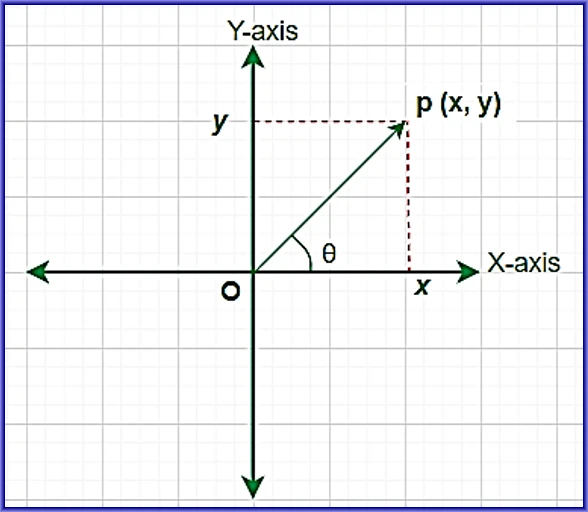
We observe that to every complex number z, there corresponds one and only one point and conversely, to every point in the plane, there corresponds one and only one complex number.
Build strong concepts by studying Modulus of Complex Number Properties Explain With Proof
Geometrical Representation of a Complex Number (Complex Plane or Argand Plane)
A complex number (z = a + i b) is represented by a unique point P(a, b) on the complex plane and every point on the complex plane represents a unique complex number.
The plane on which the complex numbers are uniquely represented is called the Complex plane. The Complex plane has two axes :
- X-axis or Real Axis
- Y-axis or Imaginary Axis
X-axis or Real Axis
- All the purely real complex numbers are uniquely represented by a point on it.
- The real part Re(z) of all complex numbers is plotted concerning it.
- That’s why the X-axis is also called the Real axis.
Y-axis or Imaginary Axis
- All the purely imaginary complex numbers are uniquely represented by a point on it.
- Imaginary part Im(z) of all complex numbers is plotted concerning it.
- That’s why the Y-axis is also called the Imaginary axis.
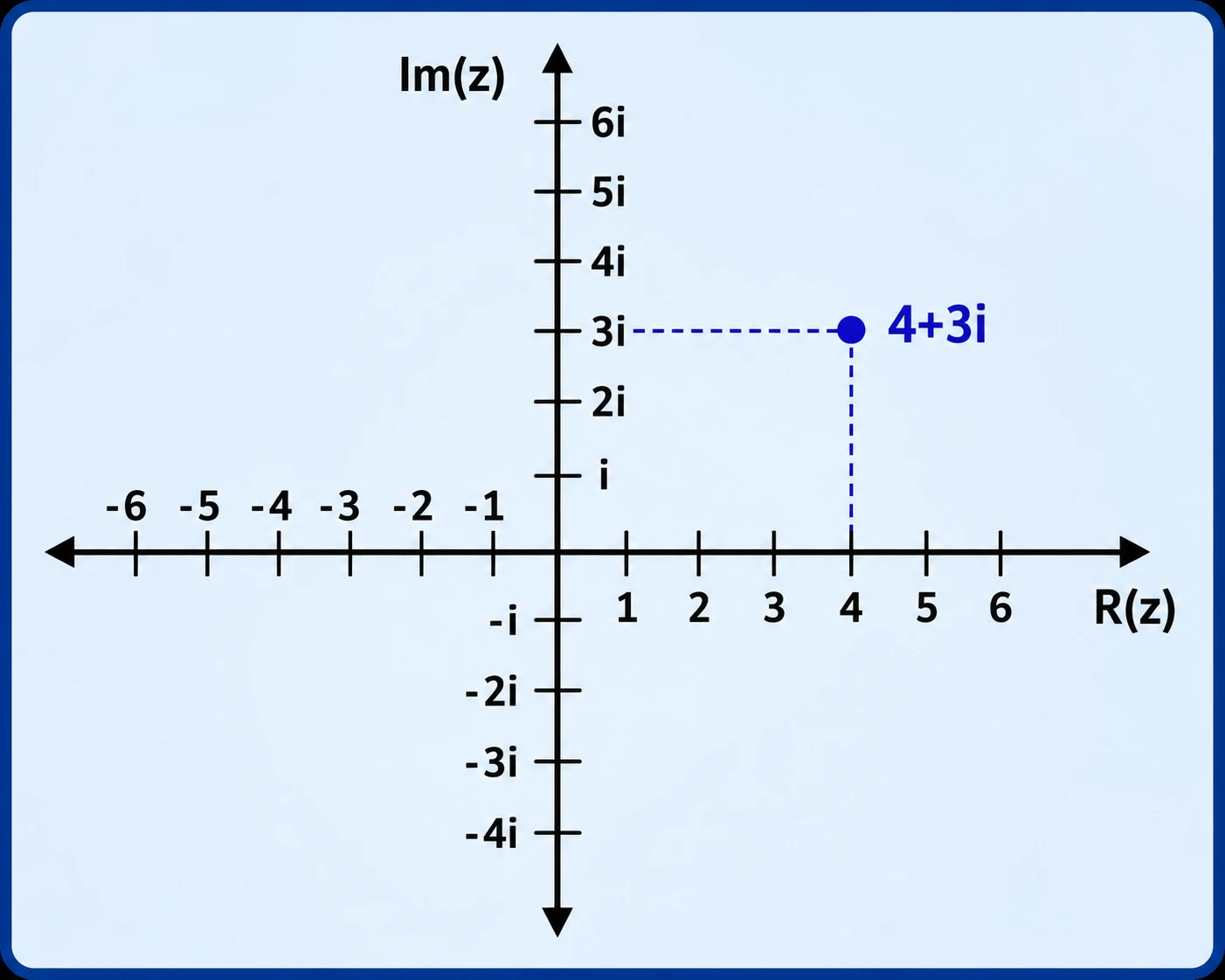
For example a complex number (z = 4 + i 3) is represented by a unique point P(4, 3) on the complex plane.
Similar topics for practice include Complex Numbers: Addition, Subtraction, Multiplication of Two Complex Numbers With Solved Examples
What is Argand’s Diagram ?
Argand plane is a graphical representation used in complex numbers. It consists of a Cartesian coordinate system where the horizontal axis represents real numbers and the vertical axis represents imaginary numbers.
Jean-Robert Argand was a Swiss mathematician after whom the Argand plane is named. He introduced this graphical representation in 1806.
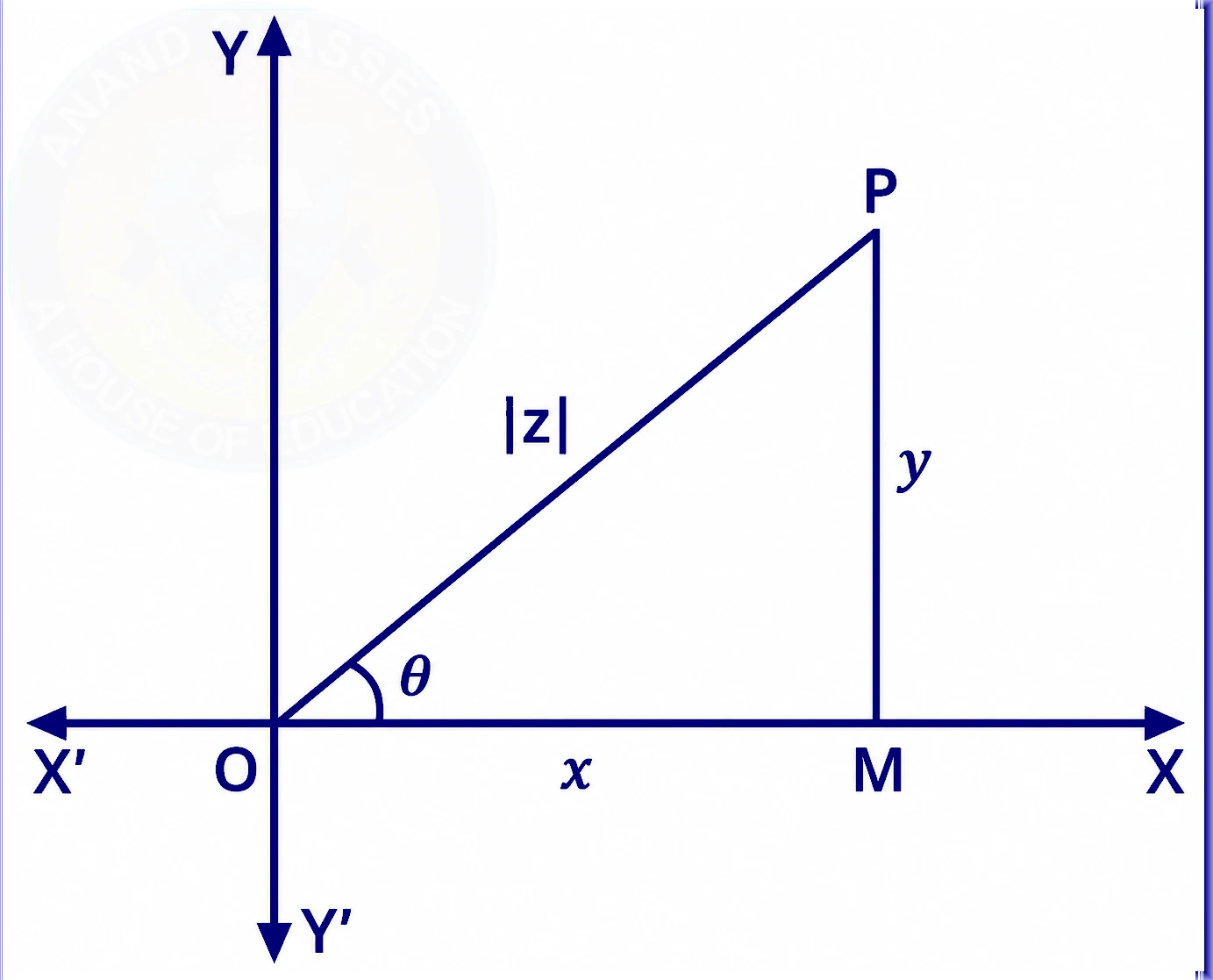
If we write x = r cos θ and y = r sin θ, then
z = x + iy = r cos θ + i r sin θ = r (cos θ + i sin θ)
In the figure, OM = real part = x and
MP = imaginary part = y
Now OP2 = x2 + y2 = r2 cos2θ + r2 sin2θ = r2
The complex number z = x + iy = r (cos θ + i sin θ)
where OP = r = , which is called modulus or absolute value of z and is written as | z |.
Also
where θ is called amplitude or argument of z and is written as amp (z) or arg (z).
Hence,
Explore detailed notes on Conjugate Properties of Complex Number, Multiplicative or Reciprocal, Additive Inverse of Complex Numbers
Solved Examples Based on Complex Plane or Argand Plane
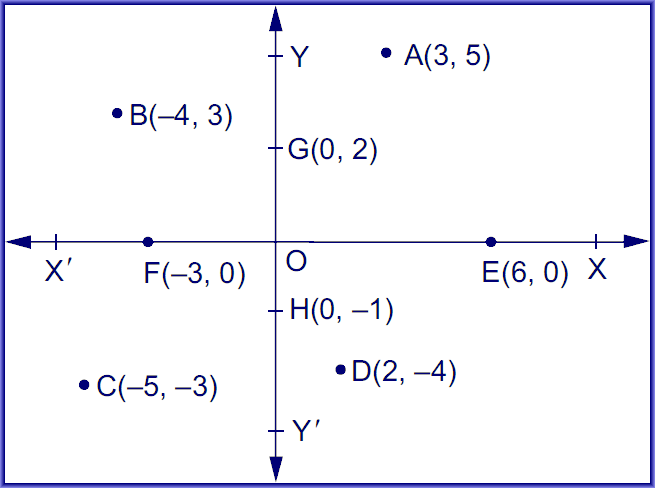
Example 1. Represent the following complex numbers in the complex plane :
(3 + 5i), (-4 + 3i), (-5 – 3i), (2 – 4i), (6 + 0i), (-3 + 0i), (0 + 2i) and (0 – i),
Solution.
The complex numbers represented geometrically in the above diagram are represented by the points :
A(3, 5), B(-4, 3), C(-5, -3), D(2, -4), E(6, 0), F(-3, 0), G(0, 2) and H(0, -1) respectively are as shown in the figure.
Example 2. Write the complex numbers that represent the following points in the plane :
(i) (2, 3) (ii) (0, 2) (iii) .
Solution.
(i) (2, 3) = 2 + 3i.
(ii) (0, 2) = 0 + 2i.
(iii) .
Example 3. Can two different points in the complex plane represent the same complex number ? Give reasons for your answer.
Solution. No.
Suppose (a, b) and (c, d) are two different points in the complex plane i.e. either a ≠ c, b ≠ d or a = c, b ≠ d or a ≠ c, b = d.
We know that (a, b) = a + ib and (c, d) = c + id.
Now a + ib = c + id
iff a = c and b = d, which is not true.
Hence, two different points in the complex plane cannot represent the same complex number.
Example 4. If z1 = 2 + 3i and z2 = 3 + i, plot the number z1 + z2. Also show that : | z1 | + | z2 | > | z1 + z2 |.
Solution. We have : z1 = 2 + 3i and z2 = 3 + i.
z1 + z2 = (2 + 3i) + (3 + i) = (2 + 3) + (3i + i) = 5 + 4i.
Now represent : z1 = 2 + 3i by the point A (2, 3) and z2 = 3 + i by the point B (3, 1). Then represent z1 + z2 = 5 + 4i by the point C (5, 4).
.
Since √13 + √10 > √41,
Therefore, OA + OB > OC
Hence, | z1 | + | z2 | > | z1 + z2 |.
Important concepts connected to this topic are What are Imaginary Numbers and iota (i), Powers of iota, Solved Examples
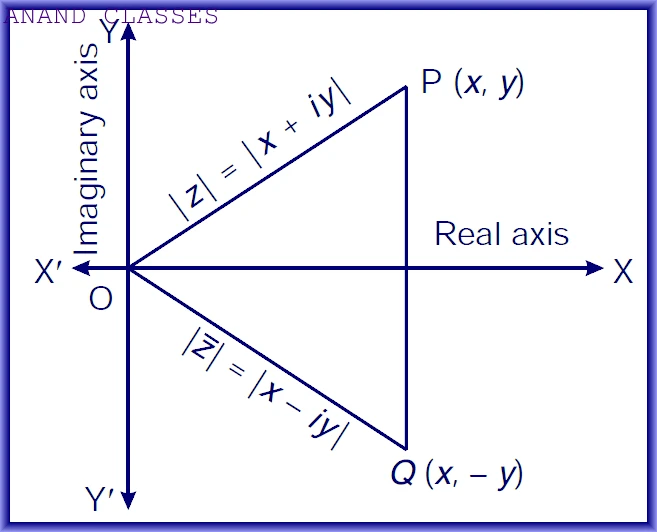
Geometrical Representation of Conjuage of a Complex Number
Let z be a complex number x + iy and it is represented by a point P(x, y), then
the conjugate complex number = x – iy is represented by the point Q(x, – y), the image or reflection of P about the real axis as shown below.
What is a complex plane?
A complex plane, also known as the Argand plane, is a two-dimensional coordinate system used to represent complex numbers graphically. The horizontal axis represents the real part, while the vertical axis represents the imaginary part of a complex number.
How is a complex number represented on the complex plane?
A complex number (z = x + iy) is represented by the point ((x, y)) on the complex plane, where (x) is the real part and (y) is the imaginary part.
What are the real and imaginary axes?
The horizontal axis (X-axis) is called the Real Axis because it contains all purely real numbers. The vertical axis (Y-axis) is called the Imaginary Axis because it contains all purely imaginary numbers.
What is an Argand diagram?
An Argand diagram is the graphical representation of complex numbers on the complex plane. It was introduced by Swiss mathematician Jean-Robert Argand in 1806.
How do you plot a complex number on the Argand plane?
To plot a complex number (a + ib), locate the point ((a, b)) on the coordinate plane. The value (a) is measured along the real axis and (b) along the imaginary axis.
What point represents the complex number 4 + 3i?
The complex number (4 + 3i) is represented by the point ((4, 3)) on the complex plane.
Can every point on the complex plane be represented by a complex number?
Yes. Every point ((x, y)) on the complex plane corresponds to the unique complex number (x + iy).
Can two different points represent the same complex number?
No. Each complex number corresponds to one unique point on the complex plane, and each point corresponds to one unique complex number.
What is the modulus of a complex number?
The modulus of a complex number (z = x + iy) is its distance from the origin and is given by | z | = √(x2 + y2)
What is the argument of a complex number?
The argument (or amplitude) of a complex number is the angle (theta) made by the line joining the origin to the point representing the complex number with the positive real axis. It is given by θ = tan-1(y/x)
How is a purely real number represented on the complex plane?
A purely real number (x + 0i) lies on the real axis and is represented by the point ((x, 0)).
How is a purely imaginary number represented on the complex plane?
A purely imaginary number (0 + iy) lies on the imaginary axis and is represented by the point ((0, y)).
What is the geometric representation of the conjugate of a complex number?
If (z = x + iy) is represented by the point ((x, y)), then its conjugate z* = x – iy is represented by the point ((x, -y)), which is the reflection of the original point across the real axis.
Why is the complex plane important?
The complex plane helps visualize complex numbers and their properties such as modulus, argument, addition, subtraction, multiplication, and conjugation, making complex number operations easier to understand geometrically.
What is the polar form of a complex number?
A complex number (z = x + iy) can be written in polar form as z = r (cos θ + i sin θ), where (r = | z |) is the modulus and θ = arg(z) is the argument of the complex number.
Is the modulus of a complex number always positive?
The modulus of a complex number is always non-negative. It is zero only when the complex number itself is zero.
What is the difference between the Cartesian form and polar form of a complex number?
The Cartesian form is written as (x + iy), while the polar form is written as r (cos θ + i sin θ). Both represent the same complex number but emphasize different properties.
How do you find the distance of a complex number from the origin?
The distance from the origin is the modulus of the complex number and is calculated using | z | = √(x2 + y2)
What is the relationship between complex numbers and coordinates?
Complex numbers and coordinates have a one-to-one correspondence. A complex number (x + iy) corresponds to the coordinate point ((x, y)), making the complex plane similar to the Cartesian coordinate system.
Important SETS Chapter Links
Sets Exercise 1.4 of Class 11 NCERT Mathematics covers important concepts of set operations including union, intersection, difference, and complement. This exercise helps students understand how to perform operations on sets and solve problems using Venn diagrams. It also introduces key properties and laws of sets that simplify calculations. With detailed solutions and examples, this exercise strengthens problem-solving skills and is highly useful for CBSE exams and competitive exams of India.
“Learn More about Imaginary Numbers and Iota“
Exercise-wise NCERT Solutions
- Basic definition of sets
- Writing sets in roster and set-builder form
- Types of sets
- Finite and infinite sets
- Subsets and proper subsets
- Number of subsets
- Set operations (union, intersection, complement)
- Advanced problems on set operations and Venn diagrams
- Mixed problems covering all concepts of the chapter